
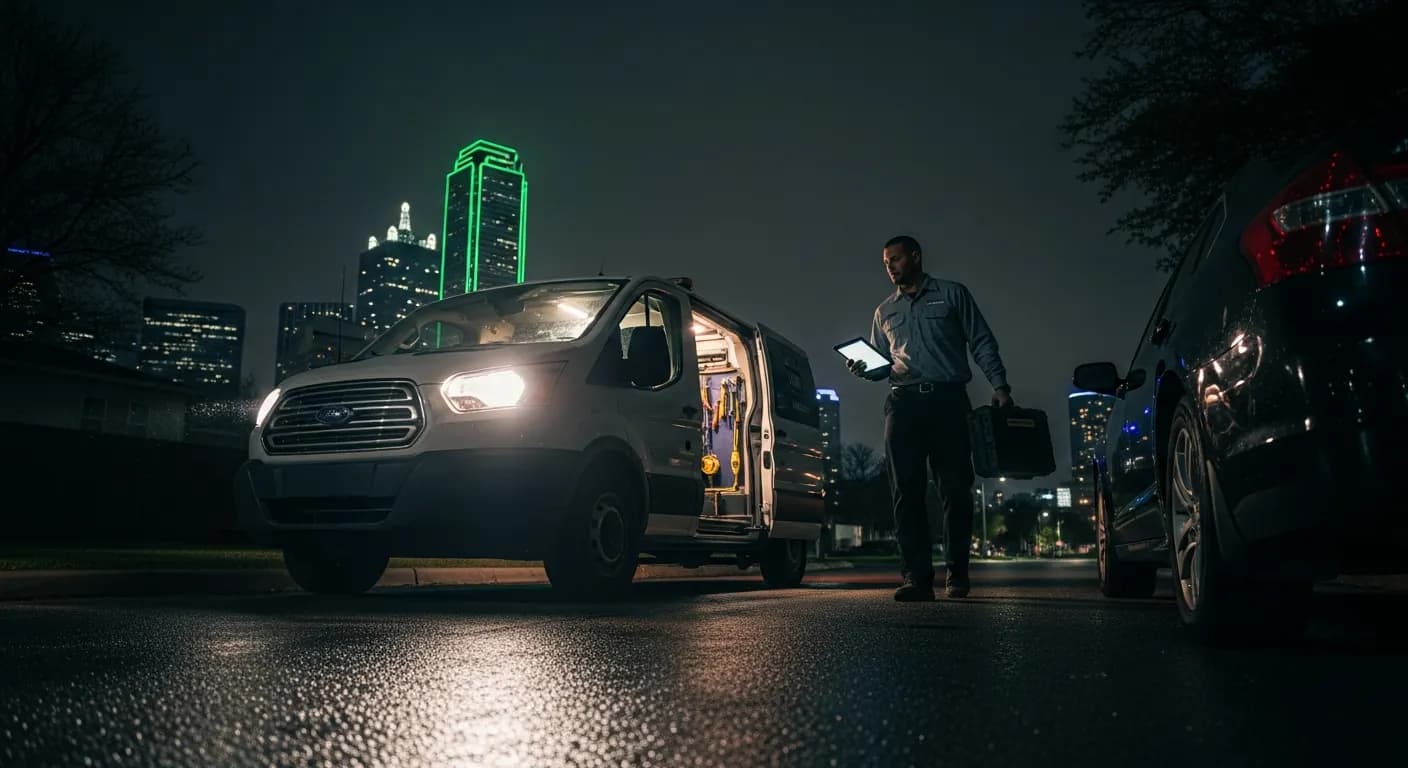
Dallas Locksmith 24/7: Response Times, Pricing, and the Texas DPS License You Should Check Before Dispatch
Dallas locksmith 24/7 guide: realistic response times, fair 2026 lockout and key replacement pricing, and the Texas DPS license to verify before dispatch.
As of July 2026 — pricing and service details below are current.
Why This Guide Exists
If you are reading this from the side of a road in Dallas at 11 PM, or from a parking garage downtown after a long shift, or from your front porch in Oak Cliff with your keys visible on the kitchen counter — skip to the pricing and licensing sections below. Everything else is context for the next time.
A 24/7 locksmith call is one of the few service decisions an American consumer is asked to make under stress, in the dark, at a price point they have never paid before, with a stranger who is about to be in physical contact with their vehicle or front door. The Federal Trade Commission has issued a standing consumer warning about exactly this scenario, noting that scam operators advertise nationally, route calls through unbranded call centers, and quote a low price by phone before tripling it on arrival.
This article walks through what a legitimate Dallas locksmith 24/7 dispatch actually looks like — the response time you should expect, the price ranges published by independent industry sources, and the one document (a Texas Department of Public Safety license number) you should ask for before a technician touches your lock.
What "24/7" Actually Means in Dallas
A genuine 24-hour locksmith operation in the Dallas–Fort Worth metroplex maintains rotating on-call technicians, staged service vehicles distributed across the metro footprint, and dispatch coverage on holidays. It is not a single owner-operator answering a cellphone at 3 AM after driving in from Mesquite.
Dallas covers roughly 340 square miles, and the National Insurance Crime Bureau's Hot Spots auto theft report consistently ranks the Dallas–Fort Worth–Arlington Metropolitan Statistical Area among the highest-volume metros in the country for vehicle thefts. High theft volume drives demand for after-hours rekey, key duplication after vehicle recovery, and ignition repair on tampered cylinders. A service that genuinely operates 24/7 carries the inventory and the trained programmers to handle these jobs at 2 AM, not just lockouts.
What you are paying for at 2 AM is not the labor of turning a tool inside a door — it is the standing capacity to answer the phone, dispatch a vehicle, and arrive within a reasonable window. Capacity costs money whether anyone calls or not, which is why after-hours rates are higher than weekday-afternoon rates at every legitimate shop.
Realistic Response Times in the Dallas Metro
The Associated Locksmiths of America (ALOA), the trade body that publishes the most widely-referenced certification standards in the United States, defines an emergency response as a technician on-site within 30 minutes for in-territory calls. Within Dallas city limits, 20-to-40 minutes is a reasonable target. Inside Loop 12 in daylight, 15-to-25 minutes is achievable. From far north Dallas to South Dallas during rush hour, 45-to-60 minutes is honest.
Any operator quoting "15 minutes anywhere in DFW" should be treated with caution. The Texas Department of Transportation's traffic data for I-35E and US-75 shows sustained average-speed drops below 25 mph during weekday peak periods on the corridors connecting the major Dallas service zones. Physics and traffic do not honor marketing copy.
The AAA Foundation for Traffic Safety's roadside-assistance research has documented that consumer-reported lockout response times average between 30 and 45 minutes nationally for traditional roadside-assistance dispatch. Specialist locksmiths in dense urban service areas typically beat that, but not by margins that justify a "we are 5 minutes away" promise from a stranger you have never called before.
"Quoted response time is one of the highest-correlation predictors of a scam dispatch. A real shop tells you the truth — sometimes it is 20 minutes, sometimes 50. An operator who quotes the same number to every caller is reading a script." — published guidance from the Better Business Bureau on locksmith complaints
What Dallas 24/7 Locksmith Service Should Cost
Pricing for emergency locksmith work breaks into a service-call fee (the cost of dispatching the truck), a labor charge (the work itself), and parts (if anything is replaced or programmed). After-hours premiums of 15-to-30 percent above daytime rates are standard industry practice and are disclosed by reputable operators on the phone before dispatch.
The ranges below reflect the bands published in ALOA member surveys, BBB consumer reports, and aggregated complaint data from FTC consumer-protection materials. They are not promises — your job, your vehicle, and your location matter — but they are what you should expect to hear quoted before a technician arrives.
| Service | Daytime | After Hours |
|---|---|---|
| Residential lockout (standard deadbolt, no damage) | $75 – $175 | $125 – $250 |
| Automotive lockout (no key needed) | $85 – $200 | $125 – $275 |
| Transponder / chip key replacement | $120 – $200 | Quote on dispatch |
| Remote head key | $160 – $280 | Quote on dispatch |
| Push-to-start proximity fob | $250 – $500 | Quote on dispatch |
| Single residential cylinder rekey | $20 – $40 per cylinder | Quote on dispatch |
| Six-cylinder house rekey (one visit) | $150 – $250 all-in | Quote on dispatch |
| Ignition cylinder repair or replacement | $200 – $500 | Quote on dispatch |
Disclaimer: After-hours premiums of 15–30% above daytime rates are standard and should be disclosed on the phone before dispatch. European vehicles, frameless-window cars, and all-keys-lost situations price above these bands. A quote dramatically below them — $19 service calls, $35 "starting at" lockouts — matches the documented FTC scam pattern rather than a real price.
Residential lockout, standard pin-tumbler deadbolt, no damage to door: $75–$175 all-in for a daytime call, $125–$250 after hours. A non-destructive entry on a residential lock takes a trained technician 2-to-15 minutes once on-site. Anyone telling you the lock has to be drilled on a standard Schlage or Kwikset residential deadbolt is either inexperienced or selling you a replacement you do not need.
Automotive lockout, no key needed (keys visible inside, fob in pocket): $85–$200 daytime, $125–$275 after hours. Modern vehicles with frameless windows, laminated side glass, or sensitive electronics on the door panel raise the price; a 2005 sedan is cheaper than a 2024 EV.
Lost car key replacement, transponder/chip key, standard domestic vehicle: $120–$200 on-site, including cutting and programming, with remote head keys at $160–$280 and push-to-start proximity fobs at $250–$500. European vehicles (BMW, Mercedes-Benz, Audi, Porsche) and their encrypted proximity fobs run $350–$600+ because of longer programming cycles and higher blank costs, and an all-keys-lost situation adds roughly $75–$250 on top of any of these because the immobilizer module has to be accessed directly. The dealership equivalent, per Consumer Reports' coverage of replacement-key pricing, typically runs $200–$450 plus a tow, plus 2-to-7 business days.
Rekey of a single residential lock cylinder: $20–$40 per cylinder for the labor, plus a service-call fee. A six-cylinder house rekey on a single visit usually runs $150–$250 all-in. This is the correct response after a roommate move-out, a key loss, or a recently-closed home purchase — full lock replacement is rarely necessary.
Ignition cylinder repair or replacement: $200–$500 depending on vehicle make. Steering-column work touches airbag and clockspring components and should be priced accordingly; if a shop quotes you $99 for an ignition replacement on a 2018 Ford F-150, they are quoting the part, not the work.
If a price quoted on the phone is dramatically below these ranges — $19 service calls, $35 "starting at" lockouts — the FTC's published scam pattern is that the actual invoice on completion will be 4-to-10 times the phone quote, with the technician refusing to leave until paid in cash.
The Texas DPS License You Should Verify
This is the single most important paragraph in this article.
Texas regulates locksmiths under the Private Security Bureau of the Texas Department of Public Safety. Every company offering locksmith services to the public in Texas is required to hold a Texas Private Security Bureau Company License, and every technician dispatched to your job is required to hold an individual Registration with the Bureau. The licensing program is described in Texas Occupations Code Chapter 1702 and administered through the Texas DPS Private Security Bureau.
Before authorizing any work — before the technician picks up a tool — you are entitled to ask for:
- The company license number (begins with a letter prefix designating license class, followed by digits).
- The technician's individual registration number, which should appear on a photo ID card the technician carries.
You can verify both numbers in real time through the Texas DPS Private Security Bureau's online license search tool. The lookup returns the company name on record, the license status (active, expired, suspended, revoked), the licensee's address of record, and the date of issue.
An operator that cannot or will not produce a current Texas DPS company license number on request should not be allowed near your vehicle, your front door, or your business. This is not a customer-service preference — it is the basis for liability coverage, for any claim you might file if your property is damaged, and for any recourse you have if work is botched. An unlicensed operator carries no required bonding, no required insurance, and no enforceable consumer protection.
The Texas DPS also publishes a public enforcement actions page listing license suspensions and revocations. A two-minute check before authorizing work is the most effective single defense against the scam pattern documented by the FTC and BBB.
ALOA Certification Is a Bonus, Not a Substitute
ALOA's voluntary certifications — RL (Registered Locksmith), CRL (Certified Registered Locksmith), CPL (Certified Professional Locksmith), CML (Certified Master Locksmith) — are evidence that an individual technician has passed competency exams in mechanical and electronic locking systems. ALOA also operates a continuing-education program and publishes a code of ethics for member companies.
ALOA certification is meaningful. It is not, however, a substitute for the Texas DPS Private Security Bureau license. The license is the legal authorization to operate; the ALOA credential is the demonstration of voluntary technical competence. A reputable Dallas 24/7 operator carries both. If forced to choose one to verify under pressure at 2 AM, verify the DPS license.
Vehicle-Specific Notes for the Dallas Metro
Automotive locksmith work in Dallas is split between mechanical and electronic skill sets. Programming late-model fobs requires equipment that costs the shop $15,000–$45,000, plus ongoing subscription fees for manufacturer database access through the National Automotive Service Task Force (NASTF) Secure Data Release Matrix. NASTF credentials let a licensed locksmith pull a key code from a vehicle's VIN through proper legal channels — they are how legitimate mobile key replacement is done without towing the car to a dealership.
If a locksmith offers to replace a modern transponder or proximity key without asking for your VIN, without asking for your photo ID, and without producing NASTF documentation on request, the work being performed is not the legitimate process. The verification step protects you from being on the receiving end of a stolen-vehicle key duplication, and it protects the locksmith from prosecution.
For Dallas drivers, the practical implication is straightforward: keep your title, registration, and a government-issued photo ID accessible. A 30-second document check before key cutting is industry-standard and is a sign you are dealing with a properly-credentialed operator.
When to Call 911 First
Some lockouts are not locksmith calls. A child or pet locked in a vehicle in Dallas summer heat — the National Weather Service's Dallas/Fort Worth office records sustained 100°F-plus daytime highs across most of June, July, and August — is a life-safety emergency. Dial 911 first. The Dallas Fire-Rescue Department and Dallas Police Department will dispatch and force entry without waiting for a locksmith's arrival window.
Texas Transportation Code Section 545.4191 provides legal protection for first responders forcibly entering a vehicle to rescue an endangered occupant. Do not lose minutes calling locksmiths to compare prices when a child is inside a hot car. Call 911, then call a locksmith if the vehicle needs lock repair after entry.
Similarly, if you arrive home and find evidence of forced entry — a damaged door frame, a punched lock cylinder, a broken window — do not enter. Call Dallas Police Department (non-emergency 214-744-4444, 911 if a suspect may still be inside) and wait for officers to clear the residence before any locksmith work begins. A locksmith's job after a confirmed break-in is rekey, hardware upgrade, and damage repair, not initial security clearance.
A Brief Pre-Dispatch Checklist
Before you hand over a credit card or hand over your keys, run through five questions:
- What is your Texas DPS Private Security Bureau company license number? Write it down. Verify it on the DPS site if you have a moment.
- What is the all-in price, including service call, labor, and after-hours premium, for the job I just described? Get a number, not a range, and confirm whether it includes any parts.
- What is the estimated arrival window? A range like "25-to-45 minutes" is honest. A flat "15 minutes" is suspicious.
- Is the technician arriving in a marked vehicle, and will they show a Texas DPS registration ID card on arrival? Both should be yes.
- What payment methods do you accept? Cash-only is a red flag. Legitimate operators take cards.
A real 24/7 Dallas locksmith will answer all five without hesitation. An operator who deflects on any of them is telling you something important about the invoice you are about to be handed.
The Short Version
Genuine Dallas locksmith 24/7 service exists, and it is reasonably priced when measured against the standing capacity required to deliver it. The variation between a legitimate $145 after-hours residential lockout and a $700 scam invoice for the same work comes down to two minutes of verification on the front end — a license number and a price quote, both confirmed on the phone before a technician arrives.
The Texas DPS Private Security Bureau license is the single document that separates a regulated business from an opportunistic operator. The phone-quoted price, written down and confirmed against the published ranges above, is the protection against the bait-and-switch invoice. Carry those two habits into your next emergency and the experience will look very different from the consumer-protection stories the FTC keeps publishing.
Frequently Asked Questions
Q: How fast can a 24/7 locksmith actually reach me in Dallas? A: A realistic overnight arrival window across the Dallas metro is 25 to 45 minutes, and an operator who quotes a flat 15 minutes at 2 a.m. is telling you something about their honesty rather than their fleet. Traffic, distance from the technician's current position, and the density of the area all move that number. Ask for a window rather than a single figure, and ask where the technician is coming from.
Q: What does an after-hours car lockout cost in Dallas? A: A car lockout runs $85 to $200 during normal hours and $125 to $275 after hours, with the premium reflecting the standing overnight capacity a genuine 24/7 operation has to fund. Get the all-in number on the phone before dispatch, including the service call and any after-hours premium. A quote that arrives only after the technician is at your window is the classic setup for an inflated invoice.
Q: How do I verify a Dallas locksmith is actually licensed? A: Ask for the company's Texas DPS Private Security Program license number on the phone and confirm the technician carries a DPS registration ID card on arrival. Texas regulates locksmith work through the Department of Public Safety, not through TDLR, so any company citing the wrong agency is worth a second look. A legitimate operator gives you the number without hesitation.
Q: Can a locksmith make a car key at 3 a.m., or only open the door? A: Yes, a properly equipped mobile automotive locksmith can cut and program a replacement key overnight, not merely open the door. Basic transponder keys run $120 to $200 and push-to-start proximity fobs $250 to $500, with all-keys-lost situations adding roughly $75 to $250. Whether your specific vehicle is serviceable on-site depends on the make and model year, which a technician confirms from the VIN before dispatch.
Q: What proof do I need to have a car key made? A: You need to show ownership — typically the title or current registration matched against a government-issued photo ID. This 30-second check is industry standard and is a positive signal about the operator, not an obstacle. A shop willing to cut a key to a vehicle without verifying you own it is exactly the shop you do not want handling your car.
Talk to a Dallas Automotive Locksmith
Dallas Locksmith Pros runs mobile automotive service across the Dallas metro, 24/7. Give us the year, make, and model on the phone and you get a firm all-in price before anyone is dispatched — no surprise add-ons at the curb. Call (469) 896-4128 to get a technician moving, or browse the automotive locksmith service and the Dallas service area for what we cover.
Related articles
Emergency Locksmith in Southlake: Luxury Vehicle Priority Dispatch
2026 guide to emergency locksmith service in Southlake TX: 24/7 dispatch, luxury and European vehicle handling, and honest after-hours pricing.
Read moreLocked Out of My Car in Dallas: Real Cost, Real Response Time, Right Now
As of August 2026, a Dallas car lockout is $85-$200 daytime and $125-$275 after hours, non-destructive entry, mobile and 24/7.
Read moreMy Door Won't Unlock and I Need a Pro Locksmith in Dallas ASAP: Emergency Rates
Locked out in Dallas? Get fast help from a pro locksmith! Discover emergency rates and tips for quick access. Call or text now for immediate assistance.
Read moreNeed a Dallas locksmith right now?
Licensed mobile automotive locksmith. Same-day response across DFW.
Call (469) 896-4128