
Why Luxury Car Keys Cost More in Dallas (2026 Explainer)
2026 guide to why luxury car keys cost more in Dallas: European smart fobs run $350-$600+ vs $120-$200 transponders. The real reasons, explained.
Why the Same "Car Key" Ranges From $120 to $600+
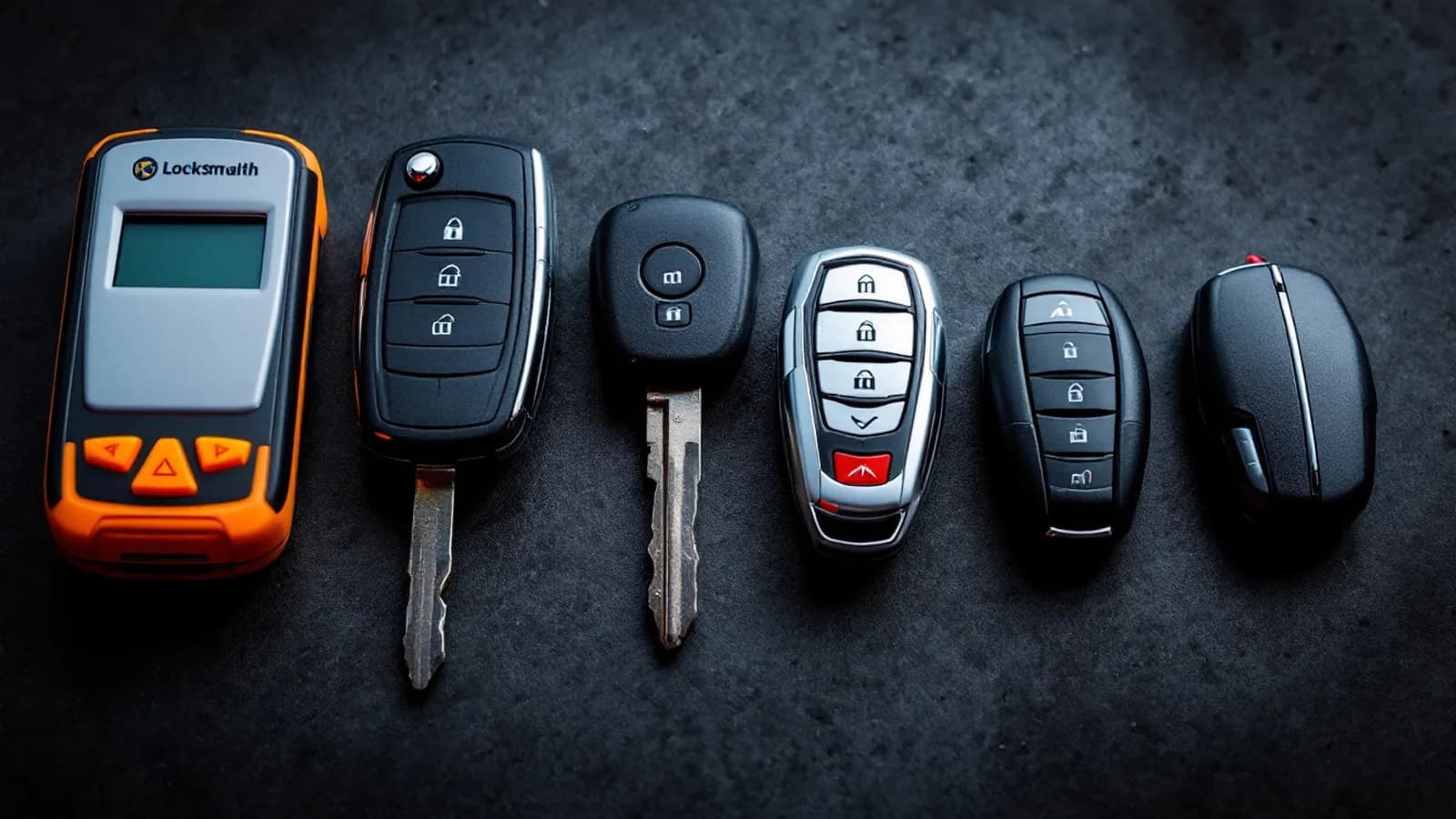
As of August 2026, a basic transponder key for an older economy car in Dallas costs $120 to $200, while a smart proximity fob for a European luxury vehicle runs $350 to $600 or more — and an all-keys-lost situation adds $75 to $250 on top of either. Owners are often stunned by that spread. It's the same object, roughly the same size, doing the same job: it starts the car. So why does a Mercedes or BMW key cost three to five times what a Honda key does? The short answer is that a modern luxury key isn't really a key — it's a small encrypted computer that has to negotiate with several layers of factory security, and the tooling required to talk to those layers is expensive to own and expensive to operate. Our European car locksmith service exists specifically for that higher tier of complexity, and this guide breaks down exactly where the money goes.
If you drive a BMW, Mercedes, Audi, Porsche, Jaguar, or Land Rover in the Dallas area — or an upscale Toyota, Honda, or GM model — this explainer will help you tell a fair quote from a padded one, and understand why "just get a key made" is a very different job depending on what's in your garage.
The Full 2026 Dallas Price Scale
Here is the honest, published pricing scale we use across every job, from an economy transponder to a European smart fob, as of July 2026:
| Key type | Typical vehicles | Dallas price range (2026) |
|---|---|---|
| Transponder key | Older economy cars, basic chip | $120 – $200 |
| Remote head key | Common domestic/Asian with integrated remote | $160 – $280 |
| Flip key | Mid-tier vehicles with switchblade remote | $180 – $320 |
| Smart proximity fob (domestic/Asian) | Toyota, Honda, GM, Nissan push-button | $250 – $500 |
| European smart fob | BMW, Mercedes, Audi, Porsche, JLR | $350 – $600+ |
| All-keys-lost surcharge | Any (no working key exists) | +$75 – $250 |
| Dealer path (key + programming + tow + queue) | Any | $700 – $1,100+ all-in |
Notice the pattern: price climbs with security sophistication, not with the physical size of the key. A remote head key costs more than a plain transponder because it integrates a radio remote; a smart fob costs more than a flip key because it adds passive entry and a rolling encrypted handshake; and a European smart fob tops the scale because those brands layer the most advanced immobilizer and authentication systems in the market. The rest of this article explains each of those layers.
Reason One: Encrypted Immobilizer Generations
Every car built in the last couple of decades has an immobilizer — a security module that will not let the engine start unless it recognizes a valid, registered key. On an early-2000s economy car, that immobilizer used a simple fixed-code transponder chip: the key broadcast a static code, the car checked it against a list, done. Cheap to read, cheap to clone.
Luxury and European manufacturers have spent twenty years making that handshake progressively harder to defeat. Modern systems use rolling codes — the security value changes with every use, so intercepting one transmission is useless — layered over strong encryption. Each generation of immobilizer (BMW's CAS and later FEM/BDC systems, Mercedes' EIS/EZS and DAS variants, Audi's immobilizer generations) uses different cryptography and a different registration procedure. A locksmith or dealer can't use one universal method; they need the specific tooling and know-how for that exact generation. That fragmentation — dozens of distinct, deliberately-hardened security systems — is the first reason luxury keys cost more. You're paying for expertise in a narrow, high-security niche. Our pages on BMW key programming and Mercedes key programming go deeper on those specific systems.
Reason Two: Dealer-Level Tooling
To communicate with a modern luxury immobilizer, you need diagnostic equipment on par with what the factory ships to its dealerships. Each brand runs its own platform — BMW uses ISTA, Volkswagen and Audi use ODIS, Mercedes uses Xentry, Jaguar and Land Rover use SDD/Pathfinder. These are not consumer tools. Licensed access, subscriptions, hardware interfaces, and constant updates run into thousands of dollars per brand, per year, and a shop that services multiple European makes has to maintain several of them at once.
An economy transponder, by contrast, can often be handled with a modest universal programmer that costs a fraction as much. So when a locksmith quotes $500 for a Porsche fob (see Porsche key replacement in Plano) versus $150 for a Corolla transponder, a large part of that gap is amortized tooling: the Porsche job requires equipment and licensing that only pays for itself across a specialized book of European work. This is the same reason our post on dealer versus mobile European car keys matters — a qualified mobile locksmith carries that dealer-grade tooling to your driveway, which is what lets you skip the dealership without losing capability.
Reason Three: OEM Online Security Authentication
Here is the layer most owners have never heard of, and it's increasingly the real driver of cost on newer vehicles. Starting broadly around 2015 and expanding since, manufacturers began gating key registration behind online security authentication — before a new key can be added, the programming tool must connect to the automaker's secured server and prove the operator is authorized to create a key for that specific VIN.
This exists for good reason: it makes stealing a car by cutting an unauthorized key dramatically harder. But it also means that for affected vehicles, even a fully equipped locksmith can't just plug in and go — they need legitimate, credentialed access to that OEM security data. The professional locksmith industry addresses this through the National Automotive Service Task Force and its Secure Data Release System; you can read about it at NASTF. Locksmiths who complete NASTF vetting can obtain authorized access to many manufacturers' security gateways, which is precisely what keeps newer luxury vehicles serviceable outside the dealer. The cost of maintaining that credentialing, and the per-transaction fees some gateways charge, flows into the price of the key. It's a genuine, unavoidable expense — and a locksmith who has it is worth more than one who doesn't.
Reason Four: Chip Security and Rolling-Code Complexity
Beyond the immobilizer and the online gate, the fob hardware itself is more sophisticated on luxury vehicles. A European smart fob contains a higher-security transponder chip, a radio transmitter for passive entry and remote functions, and firmware that participates in the encrypted rolling-code exchange. The blank fob costs more to manufacture, and the correct blank for a given model year has to be sourced precisely — the wrong chip generation simply won't register, no matter how good the programmer is.
This is also why buying a "compatible" fob online to save money so often ends in a total loss. Per the FTC's used-car and parts buying guidance, verifying part compatibility before you pay is essential — and with luxury fobs the compatibility question is genuinely hard, because model years within the same nameplate can use different chips. A specialist supplies the correct blank as part of the job. For the broader trap of cheap-fob-and-scam pitfalls, our guide on avoiding car key replacement scams in Dallas is worth reading before you hand anyone your VIN or your money.
Reason Five: All-Keys-Lost Complexity
Everything above gets harder when no working key exists. With a live key in hand, the programmer authenticates the new fob off the existing one — the security system already trusts the session. With all keys lost, the technician has to establish trust from nothing: read the immobilizer's state, sometimes reset or bypass it, sometimes wait out a deliberate security-access delay the manufacturer built in to frustrate thieves, and only then register a new key. On some European platforms this can even require removing and directly reading a control module.
That's why the all-keys-lost surcharge — $75 to $250 on top of the fob price — is consistent across the industry regardless of who does the work. It reflects real additional labor and, on some vehicles, real additional risk. It is not a markup a shop invented; the security system imposes it. Our post comparing proximity fobs and transponder keys covers how the key type itself sets the baseline before any all-keys-lost surcharge is added.
Luxury Versus Economy: A Concrete Comparison
To make the abstraction tangible, compare two real scenarios. A 2012 Honda Civic that needs a spare transponder key: simple fixed-or-early-rolling immobilizer, inexpensive blank, universal-grade tooling, no online gate. That's a $120 to $200 job, done in twenty minutes. Now a 2020 BMW that's lost all keys: FEM/BDC-generation security, ISTA-level tooling, likely an online authentication requirement, a high-security fob blank, and the all-keys-lost procedure. That's a European smart fob at $350 to $600+ plus the $75 to $250 surcharge — and even then, only if the VIN isn't one that mandates dealer-only authorization.
The brands cluster predictably. BMW, Mercedes, Audi, Porsche, Jaguar, and Land Rover occupy the top European tier — see our BMW brand page and Mercedes-Benz brand page for specifics. Toyota, Honda, and GM push-button vehicles sit in the domestic/Asian smart-fob band at $250 to $500 — more than a plain transponder, less than European, because their immobilizers are strong but their tooling ecosystem is more accessible. The takeaway: "luxury" pricing tracks the security architecture, and the badge is only a rough proxy for it.
The Honest Boundary: When Even a Specialist Needs the Dealer
Transparency matters, so here's the limit. For the large majority of luxury vehicles on Dallas roads, a qualified specialist with NASTF credentials and the right brand tooling can cut and program keys on-site — including all-keys-lost — for meaningfully less than the dealer path. But a subset of the newest VINs route key creation exclusively through manufacturer-controlled channels that even a credentialed locksmith can't fully bypass. On those, the dealer is the only path, and a reputable locksmith will tell you that on the phone rather than dispatching a technician who can't finish.
This honesty cuts against the shop's own short-term interest, which is exactly why it's the mark of a trustworthy provider. If a locksmith promises they can do any vehicle with zero exceptions, be skeptical. The real world has boundaries, and a professional names them up front. Upscale Dallas-area neighborhoods where we see the most European work — Preston Hollow, Highland Park, Southlake, and Frisco — are also where owners are most likely to have hit one of these edge cases, so the phone triage matters.
How to Read a Luxury Key Quote
Put it together and you can evaluate any quote you're given. A fair European-fob price reflects: the correct high-security blank, brand-specific tooling time, any OEM online authentication fee, the programming labor, and — if applicable — the all-keys-lost surcharge. A quote well below the $350 to $600+ band for a genuine European smart fob is a warning sign, not a bargain; it often means the wrong (non-working) blank, a bait-and-switch, or a shop that will discover mid-job it can't actually finish. A quote well above it, without a clear reason like a required module removal, is padding.
The single best protection is a flat-rate quote before dispatch, given after the locksmith has your year, model, and whether any key still works. Have those three facts ready. For the fastest route to a working key on any make, start with our car key replacement service; for the European tier specifically, our European car locksmith page covers capability by brand.
Where Volvo, Maserati and Alfa Romeo Sit on This Scale
The five reasons above explain the German cars most owners have in mind. They apply just as squarely to a set of makes that owners routinely mis-price in both directions.
Volvo lands across a wider band than any other European make, because at least three security generations are still on the road. An older chipped blade key is genuinely a $120 to $200 job and should never be quoted like a current car, while the current SPA and CMA platform cars carry a full European smart fob at $350 to $600+. Volvo routes key authorization through its Central Electronic Module, which is why the current cars price as module work — the full breakdown is in our Volvo key replacement cost guide.
Maserati sits firmly in the European smart fob band at $350 to $600+, and owners are frequently surprised that it is not higher. The badge suggests boutique exotica; the electronics underneath are far more conventional than the price of the car implies.
Alfa Romeo is the one owners over-estimate most. The current Giulia and Stelvio were engineered in the Fiat-Chrysler era and share that group's security architecture, which means they behave far more like a Dodge or Jeep under the trim than like an Italian one-off. That is good news for both feasibility and cost.
The general rule holds across all three: the badge is a poor predictor, the model year and the security generation are good ones, and the VIN answers both in about thirty seconds.
Frequently Asked Questions
Q: Why does a BMW or Mercedes key cost so much more than a Honda key in Dallas? A: Because a European smart fob is a high-security encrypted device that requires brand-specific dealer-level tooling like ISTA or Xentry, often an OEM online authentication step, and a costly high-security blank, while an older Honda transponder uses a simple chip and universal-grade tooling. That is why European fobs run $350 to $600+ against $120 to $200 for a basic transponder.
Q: What is OEM online security authentication and why does it affect price? A: It is a manufacturer-controlled online step, common on vehicles roughly 2015 and newer, where the programming tool must connect to the automaker's secured server and prove authorization before a new key can be created for that VIN. Maintaining credentialed access through systems like the NASTF Secure Data Release program costs money, and that expense is part of why newer luxury keys cost more.
Q: Is a $200 quote for a European luxury car key a good deal? A: No, a $200 quote for a genuine European smart fob is a red flag, not a bargain, because the correct high-security blank and the required tooling alone place a real job in the $350 to $600+ range. A price that low usually signals the wrong non-working blank, a bait-and-switch, or a shop that will find mid-job it cannot complete the work.
Q: Can a mobile locksmith really do luxury European keys, or only the dealer? A: Yes, a qualified specialist with NASTF credentials and brand-specific tooling programs most BMW, Mercedes, Audi, Porsche, and Jaguar Land Rover keys on-site, including all-keys-lost, for less than the dealer path. Only a subset of the newest VINs route key creation through dealer-only channels, and a reputable locksmith confirms that on the phone before dispatch.
Q: Why does all-keys-lost add so much to a luxury key job? A: Because with no working key the technician cannot authenticate off an existing fob and must establish trust from nothing, resetting or bypassing the immobilizer and sometimes waiting out a built-in security delay. That extra labor and risk is what the $75 to $250 all-keys-lost surcharge covers, and it is consistent across the industry regardless of who performs the work.
Q: Does the brand alone determine what my key costs? A: Not exactly, the security architecture determines the cost and the brand is only a rough proxy for it. A push-button Toyota or GM smart fob sits at $250 to $500 because its immobilizer is strong but its tooling is more accessible, while European brands top the scale at $350 to $600+ because they layer the most advanced encryption, tooling, and online authentication requirements.
The Bottom Line
Luxury car keys cost more in Dallas because they carry more security — encrypted rolling-code immobilizers, brand-specific dealer-grade tooling, OEM online authentication, sophisticated fob hardware, and, when all keys are lost, a harder registration process. Every dollar of the gap between a $150 transponder and a $550 European fob maps to one of those layers. Understanding them lets you spot a fair quote and reject both the scam-cheap price and the padded one.
Call (469) 896-4128 with your year, model, and whether any working key exists — Dallas Locksmith Pros answers 24/7 and quotes flat-rate before dispatch, and tells you honestly if your VIN is one of the rare dealer-only exceptions.
Related articles
Dealer-Level Diagnostic Equipment for Car Keys in Arlington, TX: What It Buys You
As of August 2026, dealer-level equipment is what makes Mercedes, BMW, and Volvo keys possible curbside in Arlington. What it does, and what it still cannot.
Read moreDealer vs. Mobile Locksmith for European Car Keys in Dallas
2026 Dallas comparison: dealer vs mobile locksmith for BMW, Mercedes, Audi, Porsche keys. $350-$600 mobile vs $700-$1,100 dealer, tow costs, and queues.
Read moreLuxury Car Locksmith in Highland Park: BMW, Mercedes, Porsche, Range Rover
2026 Highland Park luxury car locksmith guide — BMW, Mercedes, Porsche & Range Rover key costs, why European fobs run $350-$600+, and same-day mobile service.
Read moreNeed a Dallas locksmith right now?
Licensed mobile automotive locksmith. Same-day response across DFW.
Call (469) 896-4128