
Dallas Commercial Locksmith: Office Rekey, Master Key Systems, and Access Control Cost Guide
2026 Dallas commercial locksmith pricing: office rekeys, master key systems, Grade 1 hardware, and access control — plus the Texas DPS licensing rules.
As of July 2026 — pricing and service details below are current.
Why Commercial Locksmith Work Is a Different Profession
Most Dallas business owners discover the gap between residential and commercial locksmith work the first time they ask for a "rekey" after firing an employee, and the price quoted is six times what a homeowner would pay for the same task. The difference is not markup. (If the vehicles in your fleet are what you actually need covered, that is our automotive locksmith service — a separate discipline with its own tooling and pricing.) Commercial hardware operates under different physical standards, on different keyway systems, with different liability exposure, and is governed by a different set of professional credentials than the residential trade.
A Schlage B60 residential deadbolt and a Schlage L-series mortise lock both turn keys, but the resemblance ends there. The L-series is rated for a service life that the Builders Hardware Manufacturers Association (BHMA) certifies through ANSI/BHMA A156.13 testing — Grade 1 commercial mortise locks must withstand 1,000,000 cycles of operation and a minimum of 1,000 pounds of axial force before failure. The residential deadbolt next to it on the rack is tested to 250,000 cycles at lower force thresholds. They are not interchangeable, and the labor required to service them is not interchangeable either.
This guide walks through what Dallas commercial locksmith work actually costs in 2026 — office rekeys after turnover, master key system design, BHMA-graded hardware, and electronic access control — with the sourced industry references that explain why the numbers look the way they do, and the Texas Department of Public Safety licensing rules that govern every business doing this work in the state.
The First Number Every Dallas Business Owner Should Know
Office rekey after employee separation is the most common commercial locksmith call in the Dallas metroplex, and the price almost always surprises the operations manager placing the order.
A typical 6,000-square-foot Dallas office suite has between 12 and 25 keyed cylinders — front entry, suite entries on multi-tenant floors, server rooms, file rooms, executive offices, supply closets, and back-of-house storage. Rekeying every cylinder on a single visit so the departed employee's key no longer works runs $25–$60 per cylinder for the labor, plus a commercial service-call fee of $95–$175, plus parts (new pins) at $4–$12 per cylinder.
The all-in number on a midsize Dallas office turnover rekey, then, lands between $475 and $1,650, depending on cylinder count, keyway complexity, and whether the existing system uses standard pin tumbler or a restricted/patented keyway. The Bureau of Labor Statistics' Job Openings and Labor Turnover Survey reports professional and business services quits rates in Texas consistently above 2.5% per month — meaning a 60-employee Dallas office with key-holders distributed across the staff is statistically rekeying twice a year, every year, for the lifetime of the lease.
That math is why the second most common commercial locksmith conversation in Dallas is about master key system design, which moves the cost of access changes from "rekey every cylinder" to "swap a single pin chamber and reissue one key."
| Commercial Service | Typical Dallas Range | Basis |
|---|---|---|
| Office rekey (per cylinder) | $25–$60 | Labor only; pins $4–$12 extra |
| Commercial service-call fee | $95–$175 | Per visit, before labor |
| Midsize suite turnover rekey (12–25 cylinders) | $475–$1,650 | All-in, standard keyway |
| Master key system design + install (25 cylinders) | $1,800–$4,500 | Restricted keyway, front-end cost |
| Access change on an existing master system | $200–$600 | Versus ~$1,500 system-wide rekey |
| Electronic access control (4 doors) | $5,500–$14,000 | Installed, excludes subscription |
Disclaimer: Final pricing depends on cylinder count, keyway type, hardware grade, door prep, and building access conditions. Restricted and patented keyways carry higher per-cylinder cost than standard pin tumbler. Call or text (469) 896-4128 for an itemized written quote.
Master Key Systems: What You Are Actually Paying For
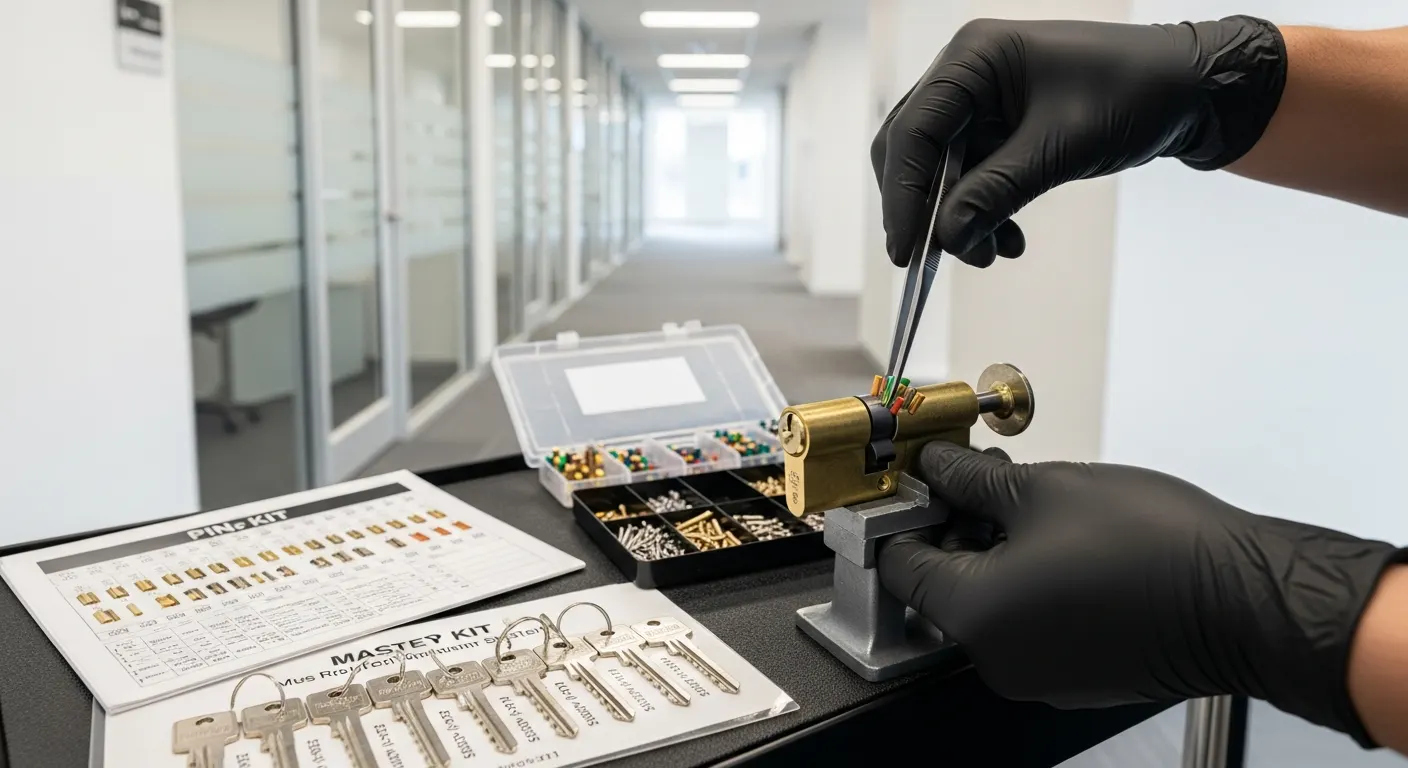
A master key system is a designed hierarchy of keys cut to operate specific subsets of cylinders. The Great Grand Master operates everything. The Grand Master operates a building. The Master operates a floor or department. The Change Key operates a single door. ALOA's educational materials on master keying describe the discipline of designing these hierarchies — the math of available key cuts, the security margin against unauthorized key derivation, and the long-term serviceability of the keyway.
A well-designed master key system for a 25-cylinder Dallas office, on a restricted commercial keyway like Medeco or ASSA Abloy's Mul-T-Lock, typically costs $1,800–$4,500 to design and install on the front end. That includes the locksmith's design time (drawing the hierarchy, plotting pin combinations, calculating key cut depths), the cylinders themselves (restricted commercial cylinders run $45–$120 each versus $12–$30 for standard pin tumbler), and the cut keys (restricted blanks cost the locksmith $8–$25 apiece, and are sold only to license-holders on file with the manufacturer).
The reason businesses pay the front-end premium is the back-end economics. When a department manager leaves a master-keyed Dallas office, the locksmith returns, rekeys only the chambers that need to change, and issues new change keys for the affected doors. The cost is a fraction of a system-wide rekey, often $200–$600 instead of $1,500. Over a five-year lease with normal turnover, a master key system pays for itself two to four times over.
The other reason — equally important — is that restricted keyways stop unauthorized duplication at the hardware store. Standard Schlage and Kwikset keys can be cut at any big-box hardware counter in Dallas in 90 seconds for $3. Restricted commercial keys can only be cut by an authorized dealer with a current contract with the manufacturer, against a signed list of authorized signatories for the customer account. That control is the security feature, and it is the difference between a key policy and a documented chain of custody.
"The most expensive part of any master key system is the day it gets compromised. Restricted keyways do not eliminate that risk, but they push the attack surface from the hardware store counter to the locksmith's signature card, and that is where the rest of the security program can actually enforce policy." — guidance published by ASIS International, the global trade association for security management professionals
BHMA Grades: Why Hardware Specifications Matter on a Commercial Door
The BHMA certification grade printed on the side of a commercial lockset is not a marketing tier — it is the result of standardized testing under ANSI/BHMA A156 series standards and predicts how the lock will hold up over a Dallas office's lease term.
Grade 1 is the commercial-duty standard for high-traffic doors. Mortise locks at Grade 1 are tested to 1,000,000 operating cycles, 1,000 pounds of axial load, and 250 inch-pounds of torque. They are the appropriate specification for main entries, suite entries on multi-tenant floors, and any door that will see more than 100 cycles per day.
Grade 2 is the medium-duty commercial standard, tested to 400,000 cycles. Appropriate for interior office doors, conference rooms, and lower-traffic suite entries.
Grade 3 is the residential standard, tested to 200,000 cycles. Inappropriate for commercial installation regardless of price.
The price difference between Grade 1 and Grade 3 hardware at the wholesale level is substantial — a Grade 1 Schlage L-series mortise lock runs $400–$900 installed in Dallas, while a Grade 3 Schlage residential deadbolt runs $40–$120 installed. The price difference at the failure level is the cost of replacing a worn-out door lock that has stranded a business twice in three years versus a lock that has been on the same door for fifteen years without service.
Cheaping out on commercial hardware is a false economy that the Dallas commercial leasing market has been priced into for decades. If a Dallas commercial locksmith proposes Grade 3 residential hardware for a commercial application, the proposal is wrong and should be rejected on specification grounds before price ever enters the conversation.
Electronic Access Control: The Conversation That Has Replaced "Add a Few More Keys"
The fastest-growing segment of commercial locksmith work in the Dallas metroplex is the conversion from mechanical keys to electronic access control. The economics that used to favor master keys — front-end design cost amortized over years of low rekey expense — now favor card and mobile credentials in many cases, particularly for offices with more than 25 employees or with high turnover.
A basic electronic access control installation on a single Dallas office door — strike, reader, controller, power supply, request-to-exit sensor, and credentials for 25 users — runs $1,800–$4,200 installed by a properly-licensed commercial locksmith. A four-door system covering an entire suite runs $5,500–$14,000. Brett's and Brivo and Genetec and ASSA Abloy's HID Origo cloud platforms dominate the small-to-midsize Dallas commercial market in 2026, and the labor to install them is now a standard line item in the Dallas commercial locksmith catalog.
What you are buying with electronic access control is not better mechanical security — a determined attacker with a pry bar defeats both keyed and credentialed doors at similar speeds. What you are buying is:
- Audit logging. Every entry, every door, every credential, time-stamped, exportable to a CSV. After-hours building access becomes a forensic record instead of a guess.
- Instant credential revocation. A separated employee's badge is disabled from a browser in 30 seconds. There is no on-site rekey, no cylinder replacement, no key collection conversation.
- Time-of-day and zone restrictions. The contractor crew has access from 7 AM to 5 PM, weekdays, through the loading dock only. The credential simply will not open the front entry at 9 PM on a Saturday.
- Integration with HR systems. Onboarding and offboarding events flow from the HRIS to the access control system automatically. Manual key reissue becomes a legacy process.
ASIS International's Physical Security Principles framework treats access control auditability as a baseline expectation for commercial security programs above the smallest scale. The U.S. Small Business Administration's guidance for small business security recommends documented access policies for any business with employees handling cash, customer data, or controlled inventory — and access control logs are how those policies are demonstrated in an audit or an insurance claim.
The mistake Dallas businesses make most often is buying access control hardware from one vendor, installation from a second vendor, and ongoing administration from nobody at all. The right Dallas commercial locksmith partner handles design, installation, credential provisioning, periodic audit of the user list against current employee rosters, and the inevitable hardware service calls when a door strike fails after five years of office use. The hourly service rates on access control work — typically $125–$185 per hour in the Dallas market for credentialed technicians — reflect the training and the certification overhead the locksmith carries.
Texas DPS Licensing for Commercial Work
The Texas Department of Public Safety Private Security Bureau licensing rules described in Texas Occupations Code Chapter 1702 apply to commercial locksmith work in the same way they apply to residential and automotive — every company offering services in Texas holds a Company License from the Bureau, and every technician dispatched to a job holds an individual Registration. The Texas DPS license search tool verifies both numbers in real time.
For commercial work, the licensing question carries additional weight because the dollar value of the contract is higher, the access being granted is broader, and the consequences of a compromised installation are larger. A Dallas commercial property manager who hires an unlicensed locksmith to install an access control system on a downtown office floor has handed building-wide access credentials to a vendor with no required bonding, no required insurance, no required background check on the technicians, and no enforceable consumer protection if something goes wrong.
The Better Business Bureau's locksmith scam research documents the commercial sector as a slower-growing but higher-dollar-value target for unlicensed operators. Commercial property managers should treat the DPS company license number as the first line in any locksmith vendor file, not the last.
The National Automotive Service Task Force credentialing that governs automotive key programming has a commercial parallel in the dealer authorization required for restricted keyway distribution and in the manufacturer certifications carried by qualified access control installers (Brivo, HID, ASSA Abloy, Allegion). A Dallas commercial locksmith on a complex master key or access control project should be able to produce, on request, the DPS company license number, the technician registrations, the manufacturer authorizations for any restricted keyway being installed, and the certifications for any electronic access control platform being deployed.
A Short Procurement Checklist for Dallas Commercial Locksmith Work
Before authorizing any commercial locksmith project above $500, work through six questions on a written quote:
- Texas DPS Private Security Bureau company license number. Written down on the quote. Verified on the DPS site before the contract is signed.
- Hardware specification by BHMA grade. Grade 1 for high-traffic commercial doors, Grade 2 for interior commercial, Grade 3 only for residential applications. The grade is printed on the side of the lock body and stated in the product datasheet.
- Keyway specification. Standard pin tumbler is fine for low-security applications; restricted commercial keyways (Medeco, Mul-T-Lock, ASSA, Schlage Primus) are appropriate above that. The proposal should state which keyway and why.
- Itemized line items. Cylinders, labor, service call, parts, credentials, and any subscription or software costs broken out separately. A single lump-sum number on a commercial proposal is a sign to ask for the breakdown.
- Warranty terms. A reputable Dallas commercial locksmith warrants labor for 90 days minimum and passes through the manufacturer warranty on hardware (typically 1–10 years depending on product line).
- Service-call response time and after-hours rate. Commercial doors fail at inconvenient hours. The relationship is worth more than the proposal — confirm what an emergency callout looks like before the system is installed.
The Short Version
Commercial locksmith work in Dallas is a distinct profession from residential locksmith work, governed by stricter hardware standards, broader licensing exposure, and a longer planning horizon. A reasonable office turnover rekey runs $475–$1,650 all-in on a midsize Dallas suite. A master key system designed for a 25-cylinder office lands at $1,800–$4,500 on installation and recovers that investment across normal turnover. A four-door electronic access control system runs $5,500–$14,000 installed and replaces the rekey conversation with a browser-based user list.
The two documents that separate a credible Dallas commercial locksmith proposal from a problem waiting to happen are the Texas DPS Private Security Bureau company license number and the BHMA hardware grade specification. Verify both before signing anything, and most of the rest of the commercial locksmith experience takes care of itself.
Frequently Asked Questions
Q: How much does it cost to rekey a Dallas office after an employee leaves? A: Between $475 and $1,650 all-in for a typical 6,000-square-foot suite, which usually carries 12 to 25 keyed cylinders. That breaks down to $25–$60 per cylinder in labor, a commercial service-call fee of $95–$175, and $4–$12 per cylinder in new pins. Cylinder count and keyway type move the number more than anything else on the quote.
Q: Is a master key system actually worth the upfront cost? A: For most Dallas offices on a multi-year lease, yes. A 25-cylinder system runs $1,800–$4,500 to design and install, but afterward a departure costs $200–$600 to remediate instead of roughly $1,500 for a system-wide rekey. With Texas professional-services quit rates running above 2.5% per month, a typical office rekeys about twice a year, and the system pays for itself two to four times over a five-year lease.
Q: What BHMA grade should I specify for my commercial doors? A: Grade 1 for main entries, suite entries, and any door seeing more than 100 cycles a day — it is tested to 1,000,000 cycles. Grade 2 is appropriate for interior commercial doors, and Grade 3 belongs in residential applications only. The grade is printed on the lock body and stated in the datasheet, so it can be verified rather than taken on trust.
Q: Why can't I just get my commercial keys copied at a hardware store? A: If you are on a standard Schlage or Kwikset keyway, you can — anyone holding your key can, for about $3 in 90 seconds, which is precisely the problem. Restricted keyways such as Medeco, Mul-T-Lock, ASSA, and Schlage Primus can only be cut by an authorized dealer against a signed list of authorized signatories on your account. That control is what converts a key policy into a documented chain of custody.
Q: Does a Dallas commercial locksmith need a state license? A: Yes. Locksmith companies in Texas are regulated by the DPS Private Security Program, and the company license number belongs in writing on any proposal before you sign it. Verify it on the DPS site independently rather than accepting a number read over the phone, and expect the technician to carry a DPS registration card on arrival.
Q: How quickly can you respond if a commercial door or lock fails after hours? A: Commercial hardware tends to fail at the least convenient hour, which is why after-hours response terms belong in the original agreement rather than negotiated during the emergency. Confirm the callout rate and response window before a system is installed. Call or text (469) 896-4128 to discuss coverage for your building.
Related articles
MINI Cooper Key Replacement Cost in Dallas (2026): Why the Module, Not the Badge, Sets the Price
As of August 2026, a MINI key in Dallas runs $160-$850+ depending on whether your car hosts keys in CAS, FEM or BDC. Here is what moves the number.
Read moreAston Martin Key Replacement in Dallas: What's Actually Under the Badge
As of August 2026, an Aston Martin key in Dallas runs $350-$600+ on supported VINs, plus $75-$250 all-keys-lost. Two eras, two different jobs.
Read moreGMC Sierra & Yukon Ignition Repair in Dallas: Three Failures Wearing One Symptom
As of August 2026, GMC ignition system repair in Dallas runs $250-$350, cylinder replacement $180-$400. Often the cheapest fix is the worn key.
Read moreNeed a Dallas locksmith right now?
Licensed mobile automotive locksmith. Same-day response across DFW.
Call (469) 896-4128