
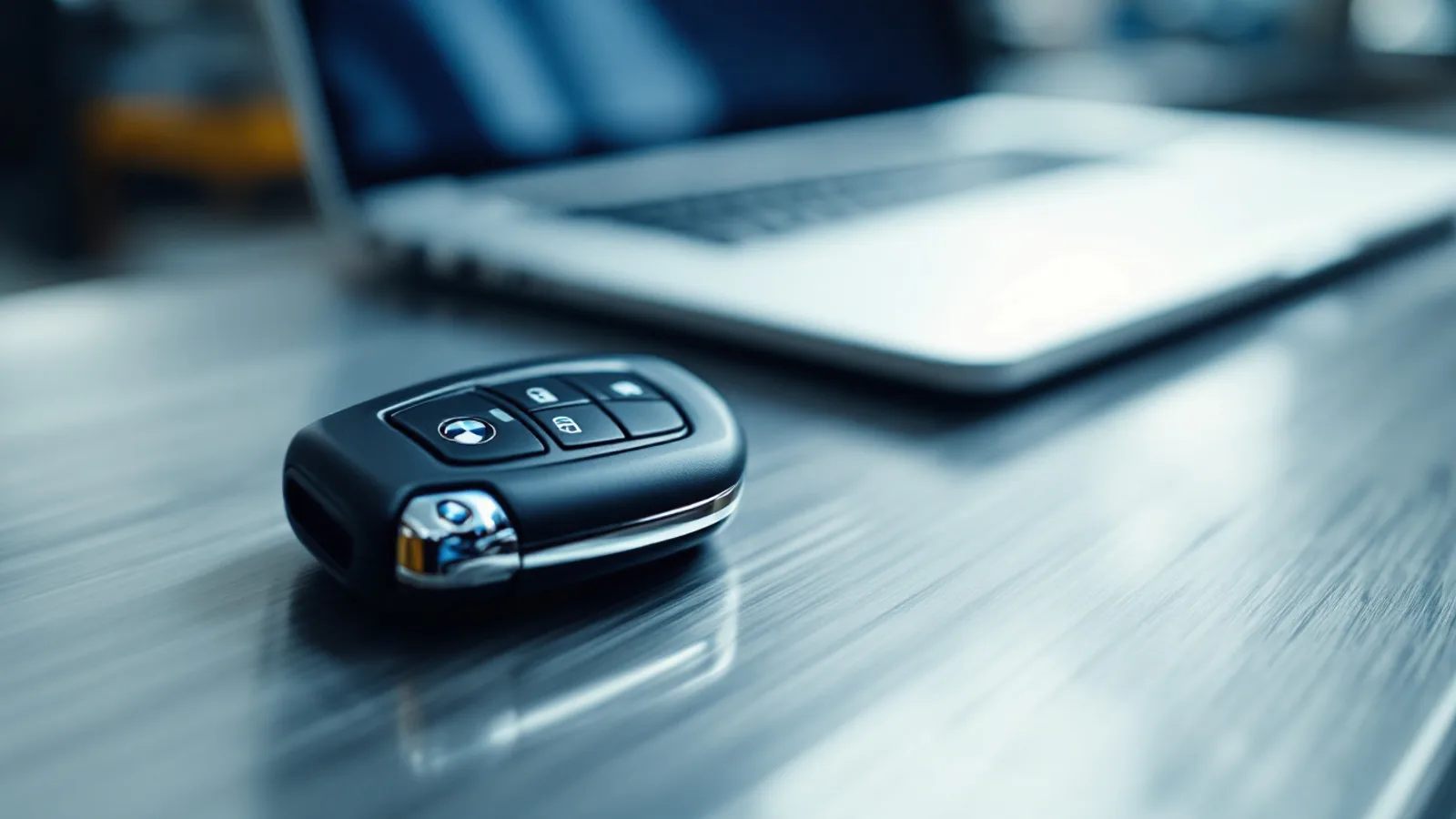
BMW Comfort Access Key Programming in Dallas: How Proximity Keys Work
As of July 2026, BMW Comfort Access fob programming in Dallas runs $350-$600+, plus $75-$250 all-keys-lost. CAS/FEM/BDC and antenna calibration explained.
BMW Comfort Access: What Actually Happens When You Walk Up to the Car
As of July 2026, programming a BMW Comfort Access proximity key in Dallas runs $350 to $600+ for the smart fob, with an all-keys-lost recovery adding roughly $75 to $250 on top, because with no working key in existence the technician has to authenticate a new credential directly against the car's security module rather than off a key you already hold. That still lands well under the $700 to $1,100+ all-in dealer path, which stacks an OEM key at retail, dealership programming labor, a flatbed tow, and a service queue. Comfort Access is BMW's marketing name for a keyless-entry and keyless-start system, and the reason it feels like magic at the door is a small chain of antennas, an encrypted transponder, and one of three generations of security computer doing a handshake in under a second. This guide walks through exactly how that handshake works, why a spare costs less than an all-keys-lost job, and where the honest capability line sits on the newest cars.
Comfort Access is the feature that lets you leave the fob in a pocket, pull the door handle, and drive off with a push of the start button — no key ever leaves your bag. Dallas is thick with BMWs configured this way, from 3 Series dailies around Uptown to X5s and 7 Series in the Park Cities. When the system stops cooperating — a fob that won't be detected, a "key not recognized" message, or a key lost entirely — understanding the machinery underneath tells you whether you need a locksmith, a dealer, or just a battery. Our BMW key programming service handles Comfort Access fobs on-site across Dallas, and the deeper BMW FEM/CAS/FRM repair service covers the security modules those keys talk to.
How Comfort Access Detects Your Key
The "proximity" in a proximity key is not one signal but a two-way conversation between low-frequency antennas in the car and a transponder inside the fob. When you touch or approach a door handle, the car's body electronics energize a set of LF antennas — there are several, positioned in the doors, the cabin, and the trunk area — that broadcast a short-range wake-up field. Your fob, sitting passively until that moment, picks up the field, wakes its transceiver, and answers on a separate radio frequency with an encrypted rolling code. The car checks that code against what its security module expects, and only if the math matches does it unlock and, once you're inside and press start, allow the engine to run.
Two things make this different from an old-fashioned remote. First, the fob is not transmitting constantly; it is listening for the car's LF field and only replies when addressed, which is why a Comfort Access fob can sit in a drawer for months and still work. Second, the position of the antennas is what lets the car tell whether the key is outside at the handle (unlock the door) or inside the cabin (allow start). That spatial awareness is the "antenna calibration" part of the system — the car reasons about signal strength across multiple antennas to decide where the key physically is.
Antenna Calibration and Why Detection Fails
Because Comfort Access decides what to do based on which antennas hear the fob most strongly, a lot of "my key won't work" complaints trace back to the detection layer rather than the key itself. A weak fob battery is the single most common culprit: as the coin cell fades, the fob's reply gets faint, and the car intermittently fails to hear it at the handle even though the same fob still starts the car when held right against the start button (BMW deliberately includes a backup near-field coil at the column or in the tray for exactly this fail-safe). If your fob works only when pressed to a specific spot, the battery is the first suspect, not the programming — a symptom we cover in depth in our guide to a dead key fob battery causing a no-start.
Beyond batteries, aftermarket window tint with metallic content, phone-charging pads, and other key fobs stacked together can all interfere with the LF field or the reply. None of that means the key needs reprogramming. A methodical technician rules out the cheap causes — battery, interference, a fob that simply fell out of sync — before touching the security module, which is exactly the order that saves you money.
CAS, FEM, and BDC: The Three Brains Behind the Key
Here is the part that determines whether a job is routine or requires module-level work: the security computer your BMW uses depends on its generation, and BMW has run three broad families of it.
CAS (Car Access System) is the older architecture, found across a long run of BMWs. The CAS module stores the immobilizer secret and manages key authorization. Different CAS versions behave differently, and all-keys-lost on some of them involves reading data from the module to calculate a fresh key.
FEM (Front Electronic Module) and its sibling BDC (Body Domain Controller) are the newer integrated controllers that fold the access and body electronics into one unit. On FEM/BDC cars, adding a key or recovering all-keys-lost is more involved: the module frequently has to be accessed and pre-processed on the bench before a key can be written, which is skilled work and part of why newer BMWs sit higher on the price and complexity scale.
Knowing which of these three your car uses — something a specialist infers from the model, year, and VIN — is what lets an honest shop tell you on the phone whether your car is a straightforward on-site job or a module-level one. Our BMW FEM/CAS/FRM repair service exists precisely because these modules sometimes need repair or pre-processing, not just a key, and the BMW brand page lays out capability by generation.
Spare Key vs. All-Keys-Lost
The single biggest price lever on a Comfort Access job is whether you still hold one working key.
Adding a spare while a working key exists is the friendlier scenario. The car already trusts a valid credential, so the technician can often authorize the new fob by leaning on that live key. The security module is awake and cooperative, and the job is comparatively quick — this is the lower end of the European smart-fob band.
All-keys-lost removes that shortcut. With no valid key anywhere, the technician has to convince a system engineered specifically to reject unknown keys to accept a brand-new one from nothing. On CAS cars that can mean reading immobilizer data through the diagnostic port; on FEM/BDC cars it often means removing and bench-processing the module. That added labor, tooling, and risk is exactly what the all-keys-lost surcharge reflects. When you simply need a working key today, the car key replacement service is the fastest starting point, and the lost car keys service details the all-keys-lost sequence.
BMW Comfort Access Key Cost in Dallas (2026)
Here is how Comfort Access key work prices out across the Dallas market as of July 2026, on the published mobile-locksmith scale. A spare-add with a live key is the cheap end; all-keys-lost adds the surcharge; the newest FEM/BDC cars carry an honest asterisk.
| Scenario | Typical BMW module/era | Dallas price range (2026) |
|---|---|---|
| Spare Comfort Access fob (working key exists) | CAS-era 3/5/X models | $350 – $500 |
| Replacement smart fob (working key exists) | Any serviceable Comfort Access BMW | $350 – $600+ |
| All-keys-lost, CAS-era | Serviceable CAS 3/5/7/X | $450 – $750 |
| All-keys-lost, FEM/BDC-era | Newer integrated-module cars | $550 – $850+ (module work) |
| Newest / gated VINs | Latest models, some encrypted VINs | OEM/dealer auth may be required |
| Dealer path (key + programming + tow + queue) | Any | Commonly $700 – $1,100+ all-in |
Two clarifications. The "European smart fob $350–$600+" band is the fob-and-programming baseline; the all-keys-lost surcharge ($75–$250) is what lifts the recovery rows higher, and FEM/BDC module work sits at the top because of the bench pre-processing involved. The "gated VINs" row is deliberately unpriced as a mobile job — for a subset of the newest BMWs, key generation may sit behind manufacturer online authentication, and quoting a firm curbside number there would be dishonest. Reading and writing a BMW security module is skilled security-electronics work, the kind the Bureau of Labor Statistics groups among specialized installation-and-repair trades — you are paying for equipment and expertise, not a badge premium.
The Honest Boundary on the Newest BMWs
This is the part a straight-dealing locksmith says out loud. For the large majority of Comfort Access BMWs on Dallas roads, a properly equipped mobile specialist programs a working key on-site — the same result as the dealer, with no tow and no queue. But on a subset of the newest cars, all-keys-lost key generation can require OEM online authentication through BMW's secured systems, and no independent tool bypasses that gate. The correct answer for those specific VINs is dealer or OEM-authorized service, not a workaround.
A reputable BMW locksmith identifies these cars on the phone from the model, year, and VIN before anyone is dispatched. That candor is your protection: the National Automotive Service Task Force publishes the industry framework for exactly these secure vehicle-access standards, and a locksmith who respects that boundary is the one telling you the truth rather than promising something that ends in a wasted trip. If a shop swears it can do any BMW all-keys-lost same-day regardless of year, be skeptical. This is the same reason many smart-key jobs can't be done on-site by every locksmith — a topic we unpack in why most locksmiths can't program smart keys on-site.
What a Dallas Comfort Access Visit Looks Like
For a serviceable BMW, a key visit at your Dallas location runs like this:
- Phone triage. Model, year, and VIN let the technician identify the security module (CAS vs. FEM/BDC), confirm serviceability, and give a flat-rate quote before dispatch — or honestly flag a gated newest-model VIN for the dealer.
- Ownership verification. For all-keys-lost, which creates a working key from nothing, the technician confirms ownership with photo ID plus registration or title. The immobilizer exists to stop unauthorized key creation, mirroring NHTSA's vehicle theft-prevention guidance.
- Non-destructive entry. The BMW is opened without damaging the door, handle, or trim.
- Rule out the cheap causes. On a "won't detect" complaint, the battery, interference, and sync are checked before any module work.
- Module access and key calculation. Depending on generation, the technician reads the security module through the diagnostic port or bench-processes it, then calculates and writes the new key.
- Verification. Passive unlock at each handle, push-button start, and remote functions are all tested before the technician leaves.
On-site time varies by module generation and whether a working key exists, but the car is drivable the moment the new fob verifies.
Avoiding the Common Overpays
Don't default to the dealer tow. For most serviceable Comfort Access BMWs, a mobile specialist produces an identical working key with no tow and no dealership queue. Paying full dealer-plus-tow price on a car a specialist can service in your driveway is the most common BMW overpay.
Don't buy a bare fob online. An uncut, unprogrammed Comfort Access fob from a marketplace listing is not a working key — many are the wrong frequency or the wrong module generation for your exact VIN, and a mismatched key is money lost. Per the FTC's consumer guidance, confirm compatibility before you pay.
Change the fob battery first on a detection complaint. If the key only works pressed against the start button, that is the classic weak-battery signature, not a reprogramming problem — a fresh coin cell may be the entire fix. When the fob truly needs replacing or reprogramming, the key fob programming service handles it, and Dallas import owners can start from the broader European car locksmith service. We run the identical BMW service across Dallas, Highland Park, University Park, and Preston Hollow.
Frequently Asked Questions
Q: How much does BMW Comfort Access key programming cost in Dallas in 2026? A: A BMW Comfort Access smart fob runs $350 to $600+ programmed on-site, with all-keys-lost adding roughly $75 to $250 on top for a serviceable car; FEM/BDC module work lands at the higher end because the module is bench-processed. A spare added while a working key exists sits lower. That still beats the $700 to $1,100+ all-in dealer path, which adds a tow and a service queue.
Q: What is the difference between CAS, FEM, and BDC on my BMW? A: They are three generations of the security computer that authorizes your key. CAS is the older Car Access System; FEM (Front Electronic Module) and BDC (Body Domain Controller) are the newer integrated controllers. FEM/BDC all-keys-lost usually needs bench pre-processing of the module, which is why newer BMWs cost more. The VIN tells a specialist which one you have.
Q: Why does my Comfort Access key only work when I hold it against the start button? A: A weak fob battery is almost always the cause. BMW builds in a backup near-field coil at the column so a fading fob still starts the car when pressed to that spot, even after it is too weak to be detected at the door handle. Change the coin cell first; if the problem persists after a fresh battery, then the fob or module may need attention.
Q: Can a mobile locksmith program a BMW proximity key without the dealer? A: Yes, for most serviceable Comfort Access BMWs a properly equipped specialist programs a working key on-site with the same result as the dealership. The exception is a subset of the newest cars where all-keys-lost may require BMW's OEM online authentication, which a reputable locksmith flags from the VIN before dispatch rather than at the curb.
Q: Does my BMW need to be towed if I lost every key? A: No for most serviceable models, where all-keys-lost is a mobile job at your Dallas address and the car is drivable the moment the new key verifies. Only the newest gated VINs that require the dealer need a tow, because a keyless BMW cannot drive itself there. Knowing the model and year upfront tells you which situation applies.
Q: Will making a new key disable my lost Comfort Access fob? A: Yes, during an all-keys-lost job the locksmith invalidates the lost keys as the new one is registered, so a key that turns up or is stolen later can no longer unlock or start the car. This is a deliberate security step. If you are only adding a spare while keeping a working key, your existing keys stay active alongside the new one.
The Bottom Line
Comfort Access feels effortless because a chain of LF antennas, an encrypted transponder, and one of three security modules — CAS, FEM, or BDC — do a fast handshake every time you approach the car. When it fails, the fix ranges from a two-dollar battery to module-level bench work, and the price follows that range. Know that a European smart fob sits at $350 to $600+, that all-keys-lost adds $75 to $250, that FEM/BDC work runs higher, and that a straight answer about the newest-model OEM-authentication boundary is the mark of a BMW locksmith worth calling. Have the model, year, and VIN ready and call (469) 896-4128 — Dallas Locksmith Pros answers 24/7 and quotes flat-rate before dispatch.
Related articles
BMW All-Keys-Lost in Uptown Dallas: 2026 Cost & CAS/FEM Guide
As of July 2026, BMW all-keys-lost in Uptown Dallas runs $425-$850 on a serviceable car. CAS, FEM, and BDC generations explained honestly.
Read moreBMW Key Fob Programming in Allen, TX: 2026 Cost Guide
2026 BMW key fob programming in Allen: Comfort Access & spare fobs $350-$600+, all-keys-lost adds $75-$250, plus CAS, FEM, and BDC explained.
Read moreMINI Cooper Key Replacement Cost in Dallas (2026): Why the Module, Not the Badge, Sets the Price
As of August 2026, a MINI key in Dallas runs $160-$850+ depending on whether your car hosts keys in CAS, FEM or BDC. Here is what moves the number.
Read moreNeed a Dallas locksmith right now?
Licensed mobile automotive locksmith. Same-day response across DFW.
Call (469) 896-4128