
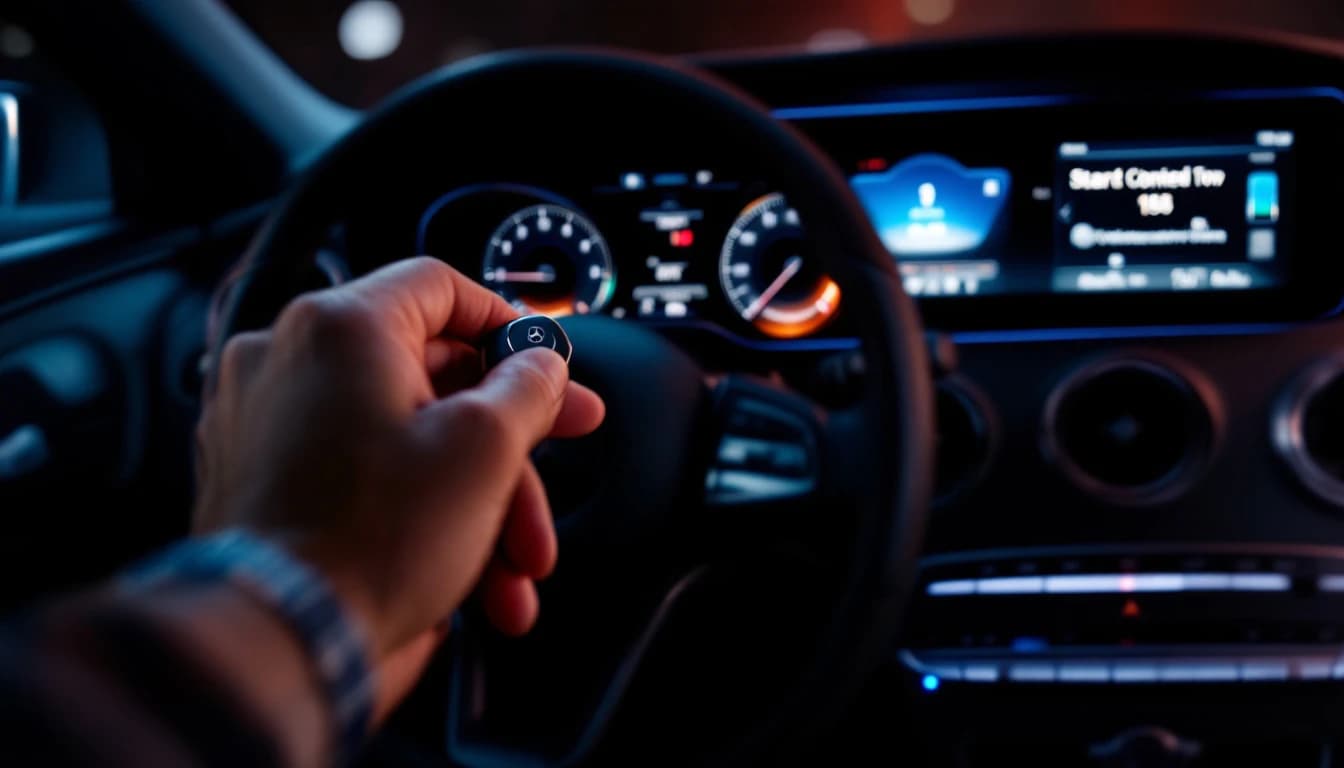
Mercedes 'No Key Detected' in Dallas: EIS/EZS Diagnosis Explained
2026 guide: Mercedes 'no key detected' in Dallas is a $10 fob battery about half the time — and an EIS/EZS module issue the rest. How to tell, and real costs.
TL;DR for Mercedes Owners
As of September 2026, when a Mercedes in Dallas flashes "Key Not Detected" or simply refuses to recognize the key, the cause splits into two very different worlds. Roughly half the time it is the cheap world: a $5-$15 fob battery, a worn fob, or driver error with the backup-start procedure — fixable in minutes. The other half is the expensive world: a fault in the EIS/EZS (Electronic Ignition Switch), the steering lock module (ESL/ELV), or the fob's own electronics — problems that need module-level diagnosis and land anywhere from $350 for a replacement smart key to $500-$900+ for module work. The difference between those two worlds is a 10-minute diagnostic sequence you can partially run yourself, and this guide walks through it honestly: what to check before you spend a dollar, what a mobile locksmith actually tests on-site, what each outcome costs in the Dallas market, and the small set of cases where the dealer really is the right answer. If your Mercedes is dead in a driveway right now, our no-key-detected and immobilizer service handles exactly this, and when the diagnosis lands on the module rather than the key, security module programming cost in Dallas sets out each outcome and its price, or call (469) 896-4128.
What "No Key Detected" Actually Means on a Mercedes
Every modern Mercedes runs its key security through the EIS — Mercedes calls it EZS in German documentation, Electronic Ignition Switch in English. It is not a mechanical switch. It is a security computer that does three jobs: it reads your key (by radio for SmartKeys, by direct contact when the key is inserted or docked), it checks the key's encrypted credentials against its internal list, and — only if satisfied — it releases the electronic steering lock (ESL/ELV) and authorizes the engine start.
"No key detected" means that chain broke somewhere. The message does not tell you where. The break can be:
- In the key — dead battery, aged fob electronics, water damage, or a fob that has simply worn out its internal contacts.
- In the EIS itself — an internal fault, a power-supply problem, or corrupted communication with the rest of the car.
- In the steering lock (ESL/ELV) — the single most common module failure on W204 C-Class and W207/W212 E-Class cars; when the lock motor fails, the EIS may read the key fine and the car still will not release to start.
- In the car's power basics — a weak 12-volt main battery causes more phantom "key" errors on Mercedes than owners believe, because the EIS and ESL are voltage-sensitive.
This layered design is standard modern anti-theft engineering — per the National Highway Traffic Safety Administration, electronic immobilization became near-universal because it works — but it means the same dashboard message covers a $10 fix and a $900 fix. Diagnosis order matters enormously.
The Cheap World: What to Check Before You Spend Anything
Run these in order. They cost nothing and resolve a large share of Dallas "no key detected" calls before a locksmith is ever needed.
1. The fob battery — even if the buttons still work. Lock/unlock buttons can function on a battery that is too weak for the passive proximity handshake. Replace the coin cell (most Mercedes fobs take a CR2025 or two CR2016s; the emergency blade releases the cover) and retest. This is the single most common cause.
2. The backup-start position. Every keyless Mercedes has a fallback for a weak fob: hold the fob directly against the marked spot (commonly the cupholder area or the steering column, depending on model) or dock it in the ignition slot on older cars, then start. If the backup position starts the car, your EIS is healthy — the problem is the fob or its battery, and you have just saved yourself a module diagnosis.
3. The other key. If you have a second key, test it. Two keys failing identically points away from the fobs and toward the EIS or the car's power supply. One key working and one not is a fob problem, full stop.
4. The 12-volt battery. Dim interior lights, sluggish cranking, or a car that sat for weeks? A weak main battery destabilizes the EIS and ESL. Charging or jumping the car (correctly, per your manual) clears a surprising number of phantom key errors.
If steps 1-4 fix it, you are done, and your only follow-up decision is whether to replace an aging fob before it strands you somewhere worse than your driveway — pricing for that is in the next section.
The Expensive World: EIS, Steering Lock, and Dead Fobs
If the backup position does not start the car, both keys fail, and the 12-volt battery is healthy, you are in module territory. Here is what each outcome looks like and what it costs in Dallas:
| Diagnosis | What it means | Typical Dallas cost (2026) |
|---|---|---|
| Dead fob battery / worn fob shell | Fob electronics fine, power or contacts failed | $5 – $15 DIY battery; fob case rebuild inexpensive |
| Fob dead — replacement SmartKey needed | Fob electronics failed; new key programmed to EIS | $350 – $600+ (European smart fob band) |
| All keys lost / no working key | New key written at module level, no key to clone | Add $75 – $250 to the key price |
| ESL/ELV steering-lock fault | Lock motor or module failed; EIS often still healthy | $400 – $800 depending on model and repair vs. replace |
| EIS/EZS module fault | The ignition module itself failed | $500 – $900+; the honest quote comes after diagnosis |
Two notes on that table. First, the SmartKey replacement band is the same published European smart fob pricing of $350-$600+ that applies across German brands, with the standard $75-$250 all-keys-lost adder if no working key exists. Second, the module rows are ranges, not quotes — an honest shop will not give you a firm EIS number over the phone, because "no key detected" alone cannot distinguish an EIS fault from an ESL fault from a wiring issue. What a good shop will do is quote the diagnostic visit flat, tell you the decision tree in advance, and credit the diagnosis toward the repair. That structure is consistent with ALOA professional standards on transparent, stated-in-advance pricing, and it is what you should demand from anyone you call.
The W204/W212-era steering lock deserves its own sentence: if your 2008-2014 C-Class or E-Class shows key trouble accompanied by a steering wheel that never unlocks or a start button that does nothing, the ESL is the prime suspect — a known failure pattern on those chassis, and one a mobile specialist resolves routinely. It is also a close cousin of general ignition repair work, which is why shops that do both diagnose it faster.
How a Mobile Diagnosis Actually Works
Here is what happens when Dallas Locksmith Pros dispatches on a Mercedes "no key detected" call anywhere in the coverage area — Dallas, Allen, McKinney, or the rest of DFW:
Step 1 — Reproduce and isolate (10 minutes). The tech runs the same cheap-world checks above, properly: fob battery under load, backup-start position, both keys, and battery voltage at the terminals. A meaningful fraction of calls end here with a small bill and a working car.
Step 2 — Talk to the EIS (15-30 minutes). With Mercedes-capable diagnostic equipment, the tech reads the EIS directly: does it see the key? Which key tracks are used and which are free? Is it communicating with the ESL? Are there stored faults? This is the step that separates a locksmith with real module-level capability from a general roadside service — the EIS answers precisely if you have the equipment to ask.
Step 3 — The verdict, quoted flat. Fob dead → a new SmartKey is cut and programmed on-site, same visit, at the quoted key price. ESL fault → repair or replacement quoted before work starts. EIS fault → the honest conversation: what fixing the module costs, what the timeline is, and whether your specific case is one of the few better served by the dealer.
Step 4 — Verification. Whatever the fix, it ends the same way: multiple starts, steering lock cycling, remote functions tested, before payment.
The alternative path — tow to the dealership — starts with a flatbed that per AAA's towing cost data runs into the low hundreds of dollars, continues with a diagnostic fee at Dallas dealer labor rates, and typically ends one to three days later. For a dead fob (the most common outcome!) that path means you paid a tow and multiple days to receive a key a mobile tech programs in your driveway in an hour. Tow-to-dealer makes sense after a mobile diagnosis says the fault genuinely needs Mercedes' online systems — a category that exists but is small, and governed by the OEM secure-data rules tracked through NASTF. A trustworthy locksmith tells you when you are in it.
Honest Boundaries: What We Will Tell You Up Front
A few truths that a sales page would hide and a diagnosis-first shop will not:
- We cannot quote an EIS repair sight-unseen. Anyone who gives you a firm module-repair price over the phone from the words "no key detected" is guessing with your money.
- Some late-model cases are dealer jobs. The newest Mercedes platforms tie first-time key authorization into OEM online security gateways. If your car is in that set, the right answer is the dealer, and the diagnosis visit will say so plainly.
- A refurbished-module shortcut has strings. Swapping in a used EIS is not plug-and-play — Mercedes modules are married to the car's other computers. Done wrong, it creates the exact no-start it was meant to fix. This is module work, not parts-swapping.
- If the car is older and the repair approaches the car's value, we will say that too. Per the Bureau of Labor Statistics, skilled diagnostic labor is priced like the skilled trade it is — sometimes the honest advice is about whether to spend it.
For the broader picture of what German-vehicle work costs and why, the luxury vehicle locksmith guide covers Mercedes alongside Audi and Porsche, and the European car locksmith service page explains the equipment side. Everything Mercedes-specific — SmartKeys, spares, all-keys-lost — lives on our Mercedes-Benz brand page, and if the diagnosis ends in "you need a new key," pricing follows the standard car key replacement bands.
Which Mercedes Generation You Have Changes the Answer (Updated September 2026)
As of September 2026, the single most useful thing you can establish before anyone quotes you is which drive-authorization era your car belongs to. Mercedes did not build one key system, it built several, and the gap between them is the gap between a driveway visit and a dealer appointment.
Cars on the earlier FBS3 generation are the ones a well-equipped independent can genuinely serve, including all-keys-lost, without a tow. Cars on the later encrypted FBS4 generation are far more frequently OEM territory, and anyone promising otherwise without asking your VIN is guessing with your money. If you want that split in full, our guide to Mercedes FBS4 key replacement without the dealer sets out exactly where the line falls by generation, and what each side of it costs.
One more pattern worth ruling out before any module is discussed: if the fault appears only in wet weather and clears once the car dries, this is very likely not an EIS complaint at all. Mercedes door handles carry the low-frequency antennas that wake the key, and water in a handle or its connector blocks exactly that exchange while leaving the fob's own buttons working normally. That version is diagnosed in car won't detect the key after rain or a car wash, and it is a $150–$350 repair rather than a module job.
Two field patterns are worth knowing before you call:
The car starts if you hold the key against the start button. That is not a fault code, it is the car's low-power backup reader doing its job while the wireless path fails — which usually means a flat coin cell rather than a module problem. It is the cheapest outcome on this page and the one owners most often escalate unnecessarily. The full diagnostic tree is in what it means when your car only starts with the fob against the button.
It works some mornings and not others. An intermittent Mercedes is the cheapest version of this fault and the one most often over-repaired. A call we took in University Park this month is typical: a C-Class that started every day for a fortnight, refused once on a cold Saturday, then behaved again by lunchtime. The owner had already ordered a fob. It was a coin cell reading low under load, replaced in ten minutes. If your fault comes and goes rather than staying, work through why a car key only works sometimes before ordering anything.
The fob has been wet at some point. Water damage produces intermittent detection that comes and goes for weeks before failing completely, and it is regularly misdiagnosed as an EIS fault because the symptom wanders. If the fob has a history involving a pool, a wash or a storm, read what to do with a wet key fob first — a shell-and-board inspection costs $40 to $95 and rules out a $500 conversation.
Frequently Asked Questions
Q: Why does my Mercedes say "key not detected" when the key is right there? A: The most common cause is a fob battery too weak for the passive proximity handshake — even when the lock buttons still work. After that: a worn fob, a weak 12-volt car battery destabilizing the ignition electronics, or a fault in the EIS/EZS ignition module or electronic steering lock. Try a fresh fob battery and the backup-start position before assuming the worst.
Q: How do I start a Mercedes when the key is not detected? A: Use the backup-start procedure: hold the fob directly against the marked backup position (often the cupholder area or steering column, model-dependent) or dock it in the ignition slot on older cars, then start. If this works, your EIS is healthy and the problem is the fob or its battery — a cheap fix, not a module repair.
Q: How much does it cost to fix "no key detected" on a Mercedes in Dallas? A: It spans two worlds. A fob battery is $5-$15. A replacement SmartKey runs $350-$600+ (add $75-$250 if all keys are lost). A failed electronic steering lock (ESL) typically runs $400-$800, and a genuine EIS/EZS module fault $500-$900+. A mobile diagnostic visit determines which world you are in before any repair money is spent.
Q: What is the EIS/EZS on a Mercedes? A: It is the Electronic Ignition Switch — a security computer, not a mechanical switch. It reads your key's encrypted credentials, verifies them, and only then releases the electronic steering lock and authorizes engine start. Nearly every key-recognition problem on a modern Mercedes runs through the EIS, which is why proper diagnosis means talking to that module directly with Mercedes-capable equipment.
Q: Can a mobile locksmith really fix this, or do I need the Mercedes dealer? A: Most cases, yes — dead fobs, replacement SmartKeys, all-keys-lost, steering-lock faults, and most EIS issues are handled on-site with the right equipment, saving the tow and days of dealer queue. The exception is a small set of the newest platforms where first-time key authorization requires Mercedes' online security gateway. An honest diagnosis identifies those cases up front instead of charging you to find out.
Q: My steering wheel is locked and the car won't start — same problem? A: Closely related. On 2008-2014 C-Class and E-Class models especially, the electronic steering lock (ESL/ELV) is a known failure point: the EIS may recognize your key perfectly while the failed lock motor prevents the start release. Key trouble plus a steering wheel that never unlocks points strongly at the ESL rather than the key — a routine mobile repair.
The Bottom Line
"No key detected" on a Mercedes is a message, not a diagnosis. Half the time it is a coin-cell battery and a two-minute fix; the other half it is the EIS, the steering lock, or the fob's electronics — real module work with real costs, from $350 for a fresh SmartKey to $900+ for an ignition module. The order of operations protects your wallet: fob battery, backup position, second key, car battery — then a mobile diagnosis that talks to the EIS directly and quotes the actual fix flat before work begins.
If your Mercedes will not see its key today, call (469) 896-4128 — same-day mobile diagnosis across Dallas and DFW, honest verdicts, and the dealer recommendation freely given on the rare cases that need it.
Related articles
Mercedes No Key Detected in Plano: Diagnose the No-Start (2026)
2026 Mercedes 'no key detected' in Plano: telling a $5 dead fob battery from an EZS/EIS module fault, plus fob replacement $350-$600+ and on-site diagnosis.
Read moreImmobilizer Repair in Frisco: When 'Key Not Detected' Means Module Work
2026 guide: immobilizer repair in Frisco TX — when 'key not detected' is a $10 battery vs. real module work. Causes by brand, mobile diagnosis, honest costs.
Read moreCar Won't Detect the Key After Rain or a Car Wash (Dallas Fix)
As of September 2026: if your Dallas car only says No Key Detected when it's wet, the fault is usually the car, not the fob. How to tell in five minutes.
Read moreNeed a Dallas locksmith right now?
Licensed mobile automotive locksmith. Same-day response across DFW.
Call (469) 896-4128