
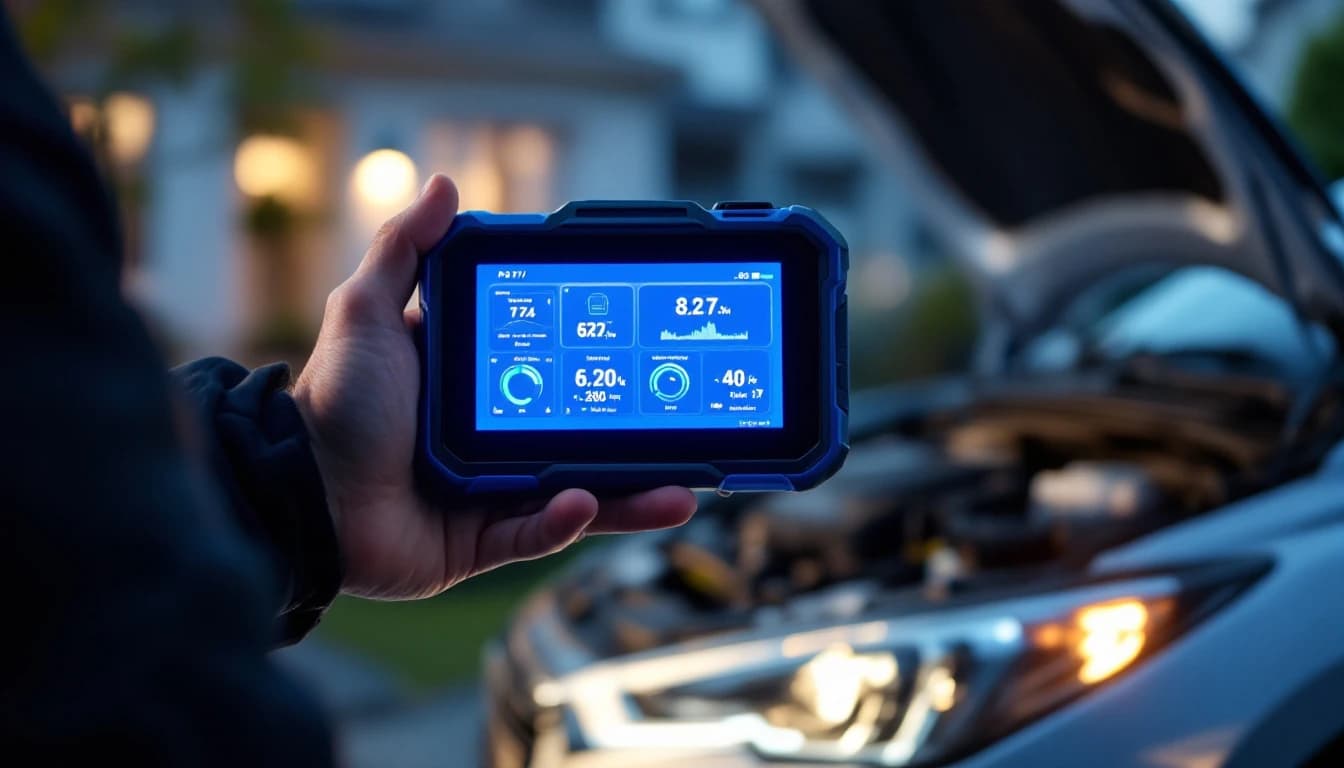
Immobilizer Repair in Frisco: When 'Key Not Detected' Means Module Work
2026 guide: immobilizer repair in Frisco TX — when 'key not detected' is a $10 battery vs. real module work. Causes by brand, mobile diagnosis, honest costs.
TL;DR for Frisco Drivers
As of July 2026, a car in Frisco flashing "key not detected," a blinking key icon, or cranking without ever firing is usually suffering one of two problems — and they are priced a hundred dollars-to-a-thousand apart. The first is trivial: a weak fob battery, a de-synced remote, or a low 12-volt car battery confusing the electronics. The second is genuine immobilizer module work: the security computer that authorizes your engine start (BCM, CAS/FEM, EIS, or the brand equivalent) has a fault, or every programmed key has failed or gone missing. Mobile diagnosis in Frisco settles which one you have in under half an hour, at your driveway on Preston Road or your office parking garage near the Star — no tow down the Tollway. Replacement keys run the published Dallas-market bands ($120-$200 basic transponder up to $350-$600+ European smart fobs, +$75-$250 if all keys are lost), and true module repair typically lands $400-$900 depending on the vehicle. This guide explains the immobilizer in plain language, the common failure patterns by brand family, and how the mobile diagnostic flow protects you from paying module prices for battery problems. Immediate help: our no-key-detected and immobilizer service, or (469) 896-4128.
What an Immobilizer Is, in Plain Language
Every car built in roughly the last 25 years has two locks: the one you can see (the door and ignition hardware) and one you cannot — the immobilizer. It is an electronic handshake between your key and a security computer in the car. Your key carries a chip with an encrypted credential; when you try to start the engine, the car's security module challenges the chip, checks the answer against its internal list of trusted keys, and only then allows fuel and spark.
The system exists because it works. Per the National Highway Traffic Safety Administration, electronic immobilizers spread to essentially every new vehicle because they measurably cut theft — a car that cannot be hot-wired is a car that mostly does not get stolen. The trade-off is that you now depend on a small computer's good health every time you turn the key, and when that computer, its antenna, or its stored key list develops a fault, the car locks you out with the same enthusiasm it locks out a thief.
Different brands name the module differently — BMW's CAS/FEM/BDC, Mercedes' EIS/EZS, GM's BCM-linked PassLock descendants, Ford's PATS, Toyota/Honda's immobilizer ECUs — but the architecture, the failure modes, and the repair discipline are the same family of work. That work is module programming and repair, and it is a different trade from cutting keys.
Cheap Cause or Module Work? The Symptoms Sorted
The frustrating thing about immobilizer trouble is that a $10 problem and a $900 problem produce nearly identical dashboards. Here is the honest sorting, from most to least likely:
| Symptom pattern | Most likely cause | Cost frame (2026, Frisco/DFW) |
|---|---|---|
| Buttons work, car won't detect fob for start | Weak fob coin cell | $5 – $15 DIY |
| Car sat for weeks; multiple warning lights; slow crank | Low 12-volt car battery upsetting modules | Charge/jump; battery if needed |
| One key fails, the other key works | Worn/failed fob | New key: $120 – $600 by key type |
| Both keys fail the same way | Immobilizer antenna, wiring, or module fault | Diagnosis first; repair $400 – $900 |
| Key icon flashing, cranks but never fires, every time | Immobilizer actively blocking start — module or key-list fault | Diagnosis first; repair $400 – $900 |
| No working key exists at all | All-keys-lost: new key written at module level | Key price + $75 – $250 AKL adder |
| Intermittent no-starts after an ignition gets stiff or sticky | Failing ignition lock dragging electronics with it | See ignition repair: often $150 – $450 |
The key-price bands referenced there are the site's published Dallas-market scale, unchanged for Frisco: basic transponder keys $120-$200, remote head keys $160-$280, flip keys $180-$320, smart proximity fobs $250-$500, European smart fobs $350-$600+, with the $75-$250 all-keys-lost adder when no working key exists. The full price guide breaks those down by key type if your diagnosis ends in "you need a new key" — which, happily, is a far more common ending than "you need a new module."
Common Causes by Brand Family
Immobilizer faults are not evenly distributed. After enough service calls across Frisco, Plano, and McKinney, clear patterns emerge by brand family:
German (BMW, Mercedes, Audi, VW). The most complex immobilizer architectures on the road, and the most expensive when they fault. BMW's CAS and FEM modules and Mercedes' EIS/EZS with its companion electronic steering lock are the classic cases — the Mercedes steering lock on 2008-2014 C- and E-Class cars is a known failure point that presents exactly like a key problem. These are the jobs where dealer-level diagnostic equipment on a mobile truck earns its keep; the deep-dives live in our BMW all-keys-lost guide and Mercedes EIS diagnosis guide, and brand specifics on the BMW and Mercedes-Benz pages.
American (Ford, GM, Chrysler/Dodge). Ford's PATS and GM's security systems are robust but age-sensitive: worn ignition lock cylinders, tired antenna rings around the key slot, and corroded connectors cause a large share of "theft light" no-starts on 2000s-2010s trucks and SUVs — extremely common vehicles in Frisco driveways. These frequently overlap with mechanical ignition repair rather than pure module work, which keeps costs at the lower end.
Asian (Toyota, Honda, Nissan, Hyundai/Kia). Generally the most reliable immobilizers in the fleet. When trouble does appear it is usually a failed smart key, a dead key-slot antenna, or — on Hyundai/Kia — aftermarket-alarm wiring interfering with the factory system. Most repairs here are key-side, not module-side, which is good news for the invoice.
A note on aftermarket remote starts and alarms. A meaningful fraction of stubborn immobilizer complaints in the northern suburbs trace to aging aftermarket remote-start bypass modules wired in years ago. When the bypass fails, it can block the factory handshake entirely. Diagnosis has to check for this before condemning the factory module — one more reason a systematic diagnostic flow beats parts-cannon guessing.
The Mobile Diagnostic Flow in Frisco
Here is what actually happens when Dallas Locksmith Pros takes an immobilizer call in Frisco — same flow whether the car is in a Panther Creek garage, an office lot in Hall Park, or a driveway in Allen:
1. Phone triage (free, 5 minutes). Year, make, model, exact symptom, and what you have already tried. Real triage sometimes ends the call — if the story says "fob battery," we will say so and let you spend $10 instead of dispatching a truck. Per ALOA professional standards, the price structure — diagnostic visit, likely outcomes, key prices — gets stated before dispatch, not discovered after.
2. On-site basics (10-15 minutes). Fob battery under load, backup-start position, second key if you have one, 12-volt battery voltage, and a visual on the ignition and key antenna. A significant share of calls resolve right here.
3. Module-level scan (15-30 minutes). The diagnostic equipment talks directly to the immobilizer: is it seeing the key? Are credentials failing? Are there stored faults in the security module, the antenna circuit, or (German cars) the steering lock? This is where "key not detected" gets translated into a specific named fault — and where a mobile module-capable locksmith differs from a jump-start roadside service.
4. Flat-rate verdict. Key-side fault → a new key is cut and programmed on the spot at the published band price (full key replacement service). Module-side fault → a flat repair quote before any work begins, typically in the $400-$900 frame depending on the module and whether it can be repaired or must be replaced and re-married to the car. All-keys-lost → the standard AKL flow with proof of ownership required.
5. Verification. Multiple starts, remote functions, steering-lock cycling where applicable — then the invoice, matching the quote.
Why mobile matters specifically here: an immobilizer-blocked car cannot be driven to a shop by definition. The alternative to a mobile diagnosis is a tow — and per AAA's towing cost data, a metro tow runs into the low hundreds of dollars before anyone has diagnosed anything. Frisco to a Dallas dealership down the Tollway is real mileage, real money, and one to three days of queue — a painful price to pay to learn your fob battery was flat.
Honest Boundaries and When the Dealer Wins
The same honesty rules we publish for European vehicles apply to every immobilizer call:
- No firm module-repair quotes over the phone. "Key not detected" names a symptom, not a component. Anyone quoting module repair sight-unseen is guessing with your money.
- Some late-model vehicles are dealer jobs. The newest platforms gate first-time key authorization behind OEM online security gateways under the secure-data framework tracked by NASTF. If your car is in that set, the diagnosis says so plainly, and you drive (or tow) to the dealer knowing exactly what to ask for.
- Used-module swaps are not plug-and-play. Security modules are married to the car's other computers; done casually, a junkyard swap creates the exact no-start it was meant to cure. If a repair path requires module replacement, the re-marrying work is part of the quote or the quote is fiction.
- Sometimes the honest answer is economic. Skilled diagnostic labor is priced like the skilled trade the Bureau of Labor Statistics classifies it as. On a high-mileage car worth little more than the repair, we will say so before you spend.
One boundary that is not real: the idea that suburban drivers must default to a dealership because "locksmiths only do house keys." A properly equipped automotive locksmith carries the same class of programming capability the dealer uses — the smart-key programming explainer covers exactly what that equipment is and why most generalist locksmiths do not have it.
Frequently Asked Questions
Q: What does immobilizer repair cost in Frisco? A: Diagnosis-dependent, in three tiers. Key-side fixes run the published key bands: $120-$200 for basic transponder keys up to $350-$600+ for European smart fobs, plus $75-$250 if all keys are lost. Genuine module repair typically runs $400-$900 depending on the vehicle and whether the module can be repaired or must be replaced and re-married. Fob batteries and de-synced remotes cost almost nothing — which is why diagnosis comes first.
Q: How do I know if my immobilizer is the problem and not the key? A: Two quick tests. First, try your second key — if it works, the problem is the failed key, not the immobilizer. Second, use the backup-start position (holding the fob against the marked spot, usually the steering column or cupholder area) — if the car starts that way, the immobilizer is healthy and your fob or its battery is the issue. If both keys fail identically and the backup position does nothing, the fault is on the car side and needs a module-level scan.
Q: Can an immobilizer problem be fixed at my house in Frisco, or does the car have to be towed? A: It can almost always be diagnosed and usually fixed on-site — that is the point of mobile service, since an immobilizer-blocked car cannot be driven anywhere by definition. A mobile tech runs the module-level scan in your driveway and performs key programming, antenna repairs, and most module work on the spot. Only the small set of newest vehicles requiring OEM online authorization end up at a dealer, and you learn that from a driveway diagnosis instead of a $200+ tow.
Q: What is a car immobilizer, exactly? A: It is the electronic anti-theft handshake between your key and a security computer in the car. The key carries an encrypted chip; the car's module challenges it at every start and only enables fuel and spark for a credential on its trusted list. Per NHTSA, immobilizers became near-universal because they measurably reduce theft. When the module, its antenna, or its key list faults, the car blocks you exactly as it would block a thief.
Q: Why does my security light flash and the engine cranks but won't start? A: A flashing security/key icon during cranking is the immobilizer announcing it does not trust the key it sees — the engine spins but the module withholds fuel and spark authorization. Causes range from a degraded key chip or a failing antenna ring around the ignition to a genuine module fault or interference from an old aftermarket remote-start bypass. This exact pattern is the classic case for a module-level scan rather than parts guessing.
Q: Do you cover all of Frisco, or just Dallas? A: All of Frisco and the surrounding corridor — Plano, McKinney, Allen, and the rest of DFW — with the same flat-rate pricing as Dallas proper. Mobile response is 24/7, and there is no separate travel surcharge for the northern suburbs; the number quoted on the phone is the number on the invoice.
The Bottom Line
"Key not detected" in Frisco is a fork in the road: one path costs less than lunch, the other is real module work. The immobilizer is a security computer doing its job — the skill lies in finding out which part of the handshake broke before spending repair money. Run the free checks (fob battery, backup position, second key, car battery), and if the fault survives them, get a mobile module-level diagnosis in your driveway instead of paying a tow to discover the answer at a service counter three days from now.
Dallas Locksmith Pros runs that diagnostic flow across Frisco and all of DFW, 24/7, with flat rates quoted before dispatch. Call (469) 896-4128 — and if it turns out to be the battery in your fob, we would genuinely rather tell you that on the phone.
Related articles
Dodge Charger & Challenger WIN Module Programming in Dallas: When New Keys Cannot Fix It
As of August 2026, a failed Dodge WIN module is module work, not key work. Relearn $120-$280, FOBIK $150-$300, smart prox $250-$400 in Dallas.
Read morePush-Button Start Not Working in Dallas? 2026 Fix Guide
2026 Dallas guide: why push-button start won't work. Most fixes are cheap (dead fob battery); a new smart fob runs $250-$500. Backup-start trick inside.
Read moreMercedes 'No Key Detected' in Dallas: EIS/EZS Diagnosis Explained
2026 guide: Mercedes 'no key detected' in Dallas is a $10 fob battery about half the time — and an EIS/EZS module issue the rest. How to tell, and real costs.
Read moreNeed a Dallas locksmith right now?
Licensed mobile automotive locksmith. Same-day response across DFW.
Call (469) 896-4128