
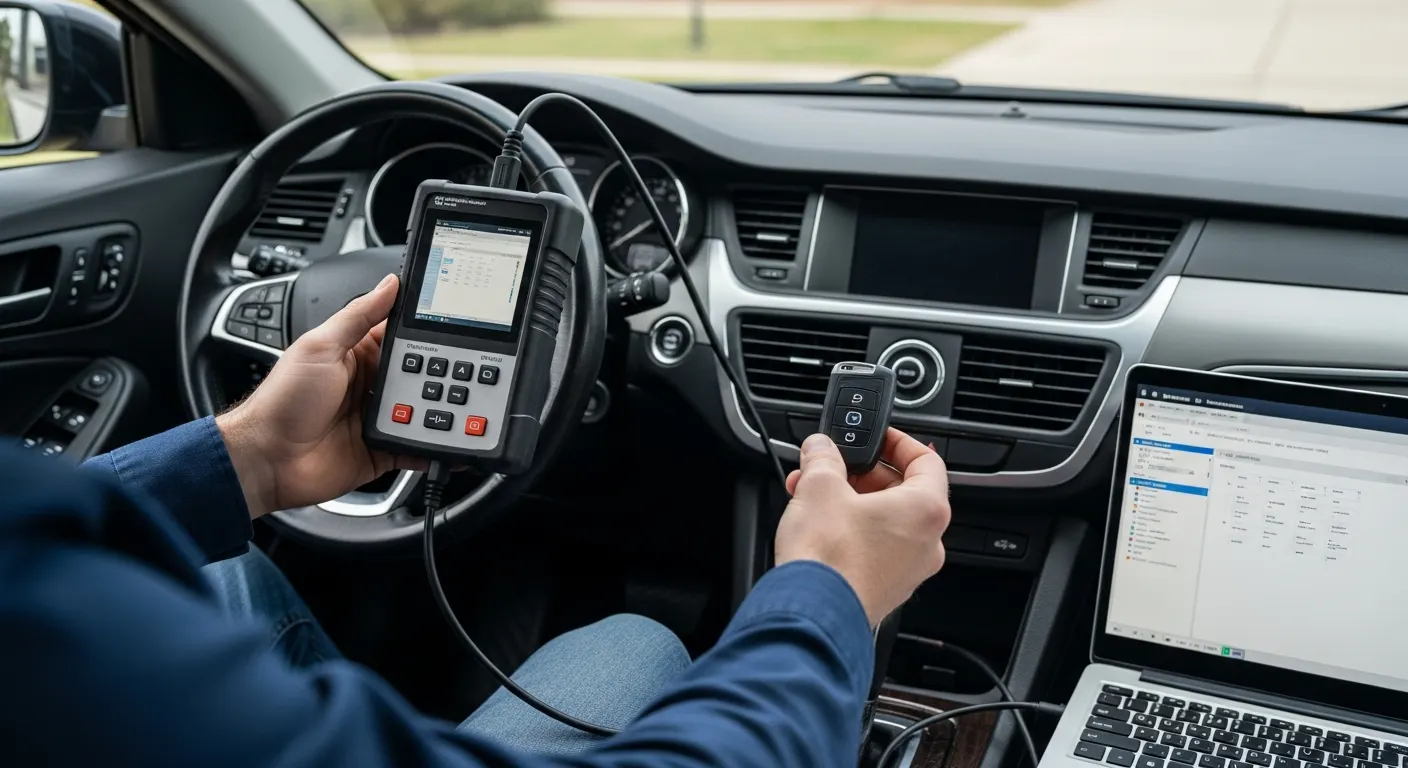
Smart Key Programming Dallas: Why Most Locksmiths Can't Do It On-Site (and How to Pick One Who Can)
Smart key programming in Dallas is technically gated — most locksmiths can't do late-model fobs on-site. What NASTF credentials mean and the questions to ask.
As of July 2026 — pricing and service details below are current.
The Quiet Tier Split Inside the Locksmith Industry
If you call ten locksmiths in Dallas and ask each of them to program a smart key for a 2022 Toyota RAV4 in your driveway, you will get ten confident "yes" answers on the phone. On arrival, two of them will actually do the work. The remaining eight will quote a price to tow your vehicle to a dealership, or they will arrive with no equipment, charge you a service-call fee, and tell you the job is "too new" for their system.
This is not a Dallas problem. It is a structural problem inside the locksmith trade nationally. Modern vehicle key programming has bifurcated into two distinct skill sets — mechanical lock work and electronic key authorization — and the second tier requires capital equipment, ongoing manufacturer subscriptions, and federally-traceable credentials that most independent locksmiths do not carry.
This article explains what smart key programming actually is at the chip and protocol level, why the on-site capability gap exists, which Dallas-area vehicles are gated behind which technologies, and the four questions that will tell you in 90 seconds whether the operator on the phone can actually do the work or is about to bill you for showing up and shrugging.
What "Smart Key" Actually Means
The phrase "smart key" gets used loosely. In the industry, it covers four distinct technologies that share the same plastic housing but require completely different programming workflows.
1. Transponder keys (1996–present). A passive RFID chip molded into the plastic head of a traditional cut blade. The vehicle's immobilizer reads the chip when the key is in the ignition cylinder; if the chip ID matches, the engine starts. The Society of Automotive Engineers and federal regulators have tracked the rise of these systems closely. The National Highway Traffic Safety Administration's theft-data publications document the steep theft-rate drop that followed mandatory immobilizer adoption.
2. Remote-only fobs (1990s–present). A separate plastic remote with lock/unlock/trunk/panic buttons, sometimes paired with a transponder key blade. The remote is programmed independently of the transponder; the two functions can fail separately and be replaced separately.
3. Proximity smart keys / push-to-start (2003–present). A combined remote-and-immobilizer fob that authenticates wirelessly without being inserted into a cylinder. The vehicle scans for the fob, authenticates it via rolling-code cryptography, unlocks the doors when the fob is in range, and authorizes engine start when the fob is detected inside the cabin.
4. Phone-as-key / digital key systems (2018–present). BMW, Tesla, Hyundai/Genesis, Ford, Lincoln, and others now deploy NFC and UWB-based digital keys provisioned through a smartphone. These are out of scope for traditional locksmith programming and route through the manufacturer's app and dealer back-end.
The peer-reviewed literature on vehicle immobilizer security — including analyses published in the National Library of Medicine's PMC archive examining the cryptographic protocols underlying modern automotive access control — describes the progression from fixed 32-bit IDs to AES-128 rolling codes with seed-and-key challenge-response sequences. The short version: each generation tightens the math, and each generation requires the programmer to either pull the security seed from the vehicle (challenge-response) or obtain it from the manufacturer (authorization-required).
Why "On-Site" Is Hard
The reason a 22-year veteran locksmith might refuse to touch a 2023 Honda Civic key while happily cutting a key for a 1998 Ford Ranger is not skill. It is access.
To program a late-model proximity key on-site, the technician needs four things in the truck:
- A current-generation diagnostic programmer. Tools like the Autel IM608 Pro, Xhorse VVDI Key Tool Plus, AVDI Abrites, or OEM-equivalent dealer interfaces. Capital cost is $4,000 to $15,000 per tool, and most shops carry two or three to cover make-specific gaps.
- Active manufacturer subscriptions. Toyota Techstream, Honda HDS, Ford IDS, GM SPS2, Hyundai-Kia GDS, and BMW ISTA all require paid software licenses with monthly or per-token fees ranging from $30 per token to thousands per year per make.
- NASTF Secure Data Release Matrix (SDRM) credentials. For authorization-required vehicles, the National Automotive Service Task Force — the joint industry body that brokers locksmith-to-manufacturer secure data access — issues a Vehicle Security Professional (VSP) credential after fingerprint background check, identity verification, and ongoing compliance auditing. Without VSP/SDRM, a locksmith cannot pull the PIN/SKIM code required to authorize a new key on most post-2010 GM, Ford, Chrysler, and increasing numbers of import vehicles. The NASTF SDRM program is the federally-recognized channel for this access; it is not optional, and it cannot be faked.
- Manufacturer-spec blank keys and emergency-blade inserts. A locksmith truck stocking the most common 200 SKUs is carrying $8,000 to $20,000 in inventory at any given time.
The Associated Locksmiths of America (ALOA) tracks this equipment threshold in its Certified Automotive Locksmith (CAL) program, which is the trade body's formal recognition that automotive programming has become a specialty separate from mechanical locksmithing. ALOA also publishes industry guidance that distinguishes "automotive locksmiths" — operators with the tools and credentials above — from general locksmiths who may carry only mechanical key-cutting equipment.
A general locksmith without the four items above is not lying when they say "I do car keys." They can probably cut and program a transponder key for a 2005 Toyota Camry on a $400 cloner tool. They cannot program a 2022 Ford F-150 proximity fob, because that job requires Ford IDS access, an SP/VCM2 interface, and a NASTF-issued PIN request that the dealer-side system has to authorize against a verified VSP credential.
"The capital and credentialing barrier for late-model on-site automotive programming is now high enough that the legitimate operators serving a metro are a much smaller set than the operators advertising the service. Consumers calling around have no easy way to tell the difference from a website alone — the questions have to come on the phone." — published guidance from NASTF's Vehicle Security Professional program documentation
The Dallas Vehicle Mix and What It Means for You
Texas Department of Motor Vehicles registration data and aggregated industry analyses consistently show Ford F-Series, Chevrolet Silverado, Ram 1500, Toyota Camry, Honda Civic, Toyota RAV4, and Honda CR-V dominating the Dallas–Fort Worth fleet. Add a healthy share of European luxury (BMW, Mercedes-Benz, Audi, Lexus, Volvo) and a growing EV mix (Tesla, Ford Mustang Mach-E, Hyundai Ioniq 5, Kia EV6, Rivian).
Each cluster has its own programming gate:
- Domestic trucks (Ford F-150, Silverado, Ram 1500), model years roughly 2011 and newer: authorization-required. NASTF SDRM access mandatory. PIN must be pulled from the manufacturer before key programming can complete.
- Toyota and Lexus, late-model proximity systems: Toyota's Smart Key system uses an AES-128 challenge-response architecture documented in technical literature from Bosch and other tier-one suppliers. Most current-generation Toyota fobs require a Techstream subscription, a specific cable interface, and (for "all keys lost" scenarios) a manufacturer authorization flow.
- Honda and Acura, 2017 and newer: require Honda HDS with a current subscription. Some "all keys lost" scenarios on the newest models still route through dealer-only tools.
- GM full-size trucks and SUVs: SPS2 with a Tech 2 or MDI/MDI2 interface for older models, plus current GDS2/GlobalA tooling for newer. NASTF SDRM PIN required for most authorization paths.
- BMW, Mercedes-Benz, Audi, Volkswagen: widely variable. Some pre-2015 BMW and Mercedes models can be done with high-end aftermarket tools (AVDI Abrites, Autel IM608 Pro with adapter); newer models often require dealer-only access and may genuinely need a tow.
- Tesla, Rivian, Lucid, and OEM digital-key Hyundai/Kia/Genesis EVs: generally not serviced by locksmiths. Manufacturer service-center routing.
The practical implication: an operator who says yes to every make on the phone without asking the year, the trim, the keys-in-hand status (do you have one working key, or all keys lost?), and whether you have your title and ID present is either extraordinarily well-equipped or extraordinarily dishonest. There is not much in between.
The On-Site Workflow When It Works
A legitimate Dallas mobile key programming visit on, say, a 2021 Ford Edge with one working key in hand looks like this:
- Verification on arrival. The technician asks for the vehicle title (or current registration) and a government-issued photo ID matching the title. They photograph or note the VIN from the dash plate. This is not bureaucratic theatre — it is the documentation NASTF requires before pulling a security PIN.
- NASTF PIN request. The technician submits the VIN and verified owner identity through the NASTF SDRM portal. For most makes, the PIN returns within minutes; some manufacturers require longer queues, particularly outside business hours.
- Key cutting. The blade portion of the key is cut to the vehicle's mechanical bitting, either from a code (preferred) or by decoding the existing lock. A current-generation mobile shop carries laser/sidewinder/high-security cutting machines that handle modern blade profiles.
- Fob programming via OBD-II. With the security PIN, the technician's programmer connects to the OBD-II port, authenticates against the vehicle's immobilizer module, writes the new key's cryptographic identity, and (for most makes) optionally removes any lost keys from the immobilizer's accepted list.
- Function test. Lock, unlock, panic, trunk, engine start, key-detection-inside-cabin (for proximity systems). The new key is exercised through its full feature set before payment.
Total on-site time for one working key plus one new key on a typical 2018–2024 domestic vehicle: 30 to 75 minutes, dominated by the PIN-request queue and the cutting time rather than the actual programming. Per the AAA's roadside-assistance research and aggregated industry surveys, this is dramatically faster than the dealership alternative, which typically requires a tow ($75–$250 in metro Dallas) plus a 2-to-7 business-day wait.
For "all keys lost" scenarios — no working key — add 15 to 45 minutes for additional decoding work and, in some cases, a longer NASTF authorization queue. Pricing on this scenario also climbs sharply; see the Phase 2 pricing guide post for current Dallas ranges by make.
What to Ask on the Phone
When you call about smart key programming Dallas, the screening conversation is short and decisive. A real operator gives crisp answers; a tow-and-pray operator deflects.
- "What year, make, and model is your vehicle?" A real operator asks this first, not last. If they quote a price before asking, they are not actually scoping the job — they are quoting whatever it takes to dispatch the truck.
- "Do you carry NASTF SDRM credentials for authorization-required vehicles?" Yes is the answer you want. A blank or confused response on the acronyms is a strong signal that the operator is not equipped for post-2010 domestic or current-generation import work.
- "Will the technician need my title and photo ID on arrival?" Yes is the answer you want. A "no, we don't bother with that" answer means either the operator is skipping the NASTF process (which means they are not programming on authorization-required vehicles) or they are operating outside the legitimate security framework.
- "Is the all-in price quoted to me right now firm, or is it an estimate that may change on arrival?" Get a firm quote. Confirm whether it includes the NASTF PIN request fee (typically passed through at $10–$25), the blank key cost, the programming labor, and the after-hours premium if applicable.
If the operator answers all four cleanly, you are almost certainly dealing with a properly-equipped mobile key programmer. If they hedge on any of them, particularly NASTF and identity verification, you are about to spend a service-call fee and end up at a dealership anyway.
The Cost of Picking Wrong
The downside scenario is not just an inflated invoice. The Federal Trade Commission's consumer guidance on locksmith scams documents a recurring pattern where a low-quoted operator arrives, declares the job too complex for their equipment, charges the service-call fee, and refuses to refund — leaving the consumer to pay a second properly-equipped locksmith for the actual work. On a smart-key programming call, this pattern is particularly common because the bait-and-switch is technically true: the operator genuinely cannot do the job, so they charge for "diagnosis" and leave.
A four-question phone screen, run in under two minutes before the dispatch, is the cheapest insurance policy available. The questions cost nothing. The wrong answer costs a $75 service call plus the price of doing the whole search again from a worse starting position — you are now on a phone with low battery, in a parking lot, with a vehicle that still does not start.
The Short Version
Smart key programming is a tier-split capability inside the Dallas locksmith market. The tools, subscriptions, and NASTF Vehicle Security Professional credentials required to do late-model fobs on-site cost a working shop $20,000 to $50,000 in standing investment plus ongoing subscription overhead, and a substantial fraction of operators advertising the service have made none of that investment.
The four-question phone screen — vehicle year/make/model first, NASTF credentials second, ID-and-title verification third, firm all-in quote fourth — is the single most reliable way to distinguish an actual mobile key programmer from an operator who will arrive, charge for showing up, and recommend a tow. It is a 90-second conversation. Have it before you authorize the dispatch.
What Each Key Type Costs in Dallas
Prices below are current ranges for on-site programming in the Dallas metro. The spread inside each band reflects make, model year, and how gated the platform is.
| Key type | Typical Dallas range | On-site programmable? |
|---|---|---|
| Transponder key (chip in the head) | $120–$200 | Yes, on most platforms |
| Remote head key | $160–$280 | Yes, on most platforms |
| Flip / switchblade key | $180–$320 | Yes, on most platforms |
| Smart proximity fob (push-button start) | $250–$500 | Yes on serviceable VINs; a few are dealer-gated |
| European smart fob (BMW, Mercedes, Audi, Porsche, Land Rover) | $350–$600+ | Usually, but module-level work is common |
| All-keys-lost surcharge (added to any of the above) | +$75–$250 | Depends on platform; some need bench work |
For the same work, the all-in dealer path typically lands between $700 and $1,100+ once the OEM key at retail, dealership programming labor, a flatbed tow, and the service queue are counted. Our key fob programming service and car key replacement service cover these on-site across the metro, and the module programming and repair service handles the cases where the security module itself needs attention.
Frequently Asked Questions
Q: Can a mobile locksmith really program a smart key without the dealer? A: Yes, for most serviceable vehicles a properly equipped specialist programs a working smart key on-site with the same end result as the dealership. The exception is a subset of the newest platforms where the manufacturer gates the procedure behind OEM online authentication — a reputable shop identifies that from the VIN before dispatch, not after arriving at your car.
Q: How much does smart key programming cost in Dallas? A: A smart proximity fob runs $250 to $500 programmed on-site, and a European smart fob runs $350 to $600+, with an all-keys-lost situation adding roughly $75 to $250 on top. A simpler transponder key sits at $120 to $200. The dealer path for the same work generally lands at $700 to $1,100+ once the tow and shop queue are included.
Q: What is NASTF and why should I ask about it? A: NASTF is the National Automotive Service Task Force, the industry body that runs the Vehicle Security Professional registry through which locksmiths obtain manufacturer security data for gated vehicles. Asking whether an operator is registered is a fast way to tell a genuinely equipped mobile programmer from someone who will charge a service call and then recommend a tow.
Q: Why did one locksmith quote me far less than everyone else? A: An unusually low phone quote is the classic setup for the pattern the Federal Trade Commission documents in its locksmith-scam guidance: the operator arrives, declares the job beyond their equipment, collects the service-call fee, and leaves you to hire a second properly equipped locksmith anyway. Ask for a firm all-in price for your exact year, make, and model before authorizing dispatch.
Q: What will a locksmith ask me for before programming a key? A: Expect to show a government-issued photo ID plus proof you are entitled to the vehicle — title, current registration, or insurance card in your name at that address. A shop that skips identity verification on a key-programming job is a shop you do not want touching your car's security system, because the same shortcut works for whoever else asks.
Q: Does my car have to be towed if I lost every key? A: No for most serviceable vehicles, where all-keys-lost is handled at your Dallas address and the car drives away as soon as the new key verifies. Only the small set of dealer-gated VINs genuinely needs a tow. Give the year, make, and model on the phone and a properly equipped shop will tell you which situation you are in before anyone is dispatched.
Talk to a Dallas Automotive Locksmith
Dallas Locksmith Pros runs mobile automotive service across the Dallas metro, 24/7. Give us the year, make, and model on the phone and you get a firm all-in price before anyone is dispatched — no surprise add-ons at the curb. Call (469) 896-4128 to get a technician moving, or browse the automotive locksmith service and the Dallas service area for what we cover.
Related articles
Key Fob Programming Near Me in Dallas: Who Does It, What It Costs, What It Actually Is
As of August 2026, key fob programming in Dallas runs $120-$500 depending on fob type, done at your car by a mobile automotive locksmith.
Read moreMazda CX-5 & CX-30 Smart Key Replacement in Dallas: The PCM Holds Your Keys
As of August 2026, a Mazda CX-5 or CX-30 Advanced Keyless fob in Dallas runs $250-$500. Mazda stores key data in the PCM, which is why kiosk keys fail.
Read moreAlfa Romeo Giulia & Stelvio Key Replacement in Dallas: An Italian Badge on Familiar Wiring
As of August 2026, Alfa Giulia and Stelvio proximity fobs run $350-$600+ in Dallas. Why these two are tractable and where independent tooling stops.
Read moreNeed a Dallas locksmith right now?
Licensed mobile automotive locksmith. Same-day response across DFW.
Call (469) 896-4128