
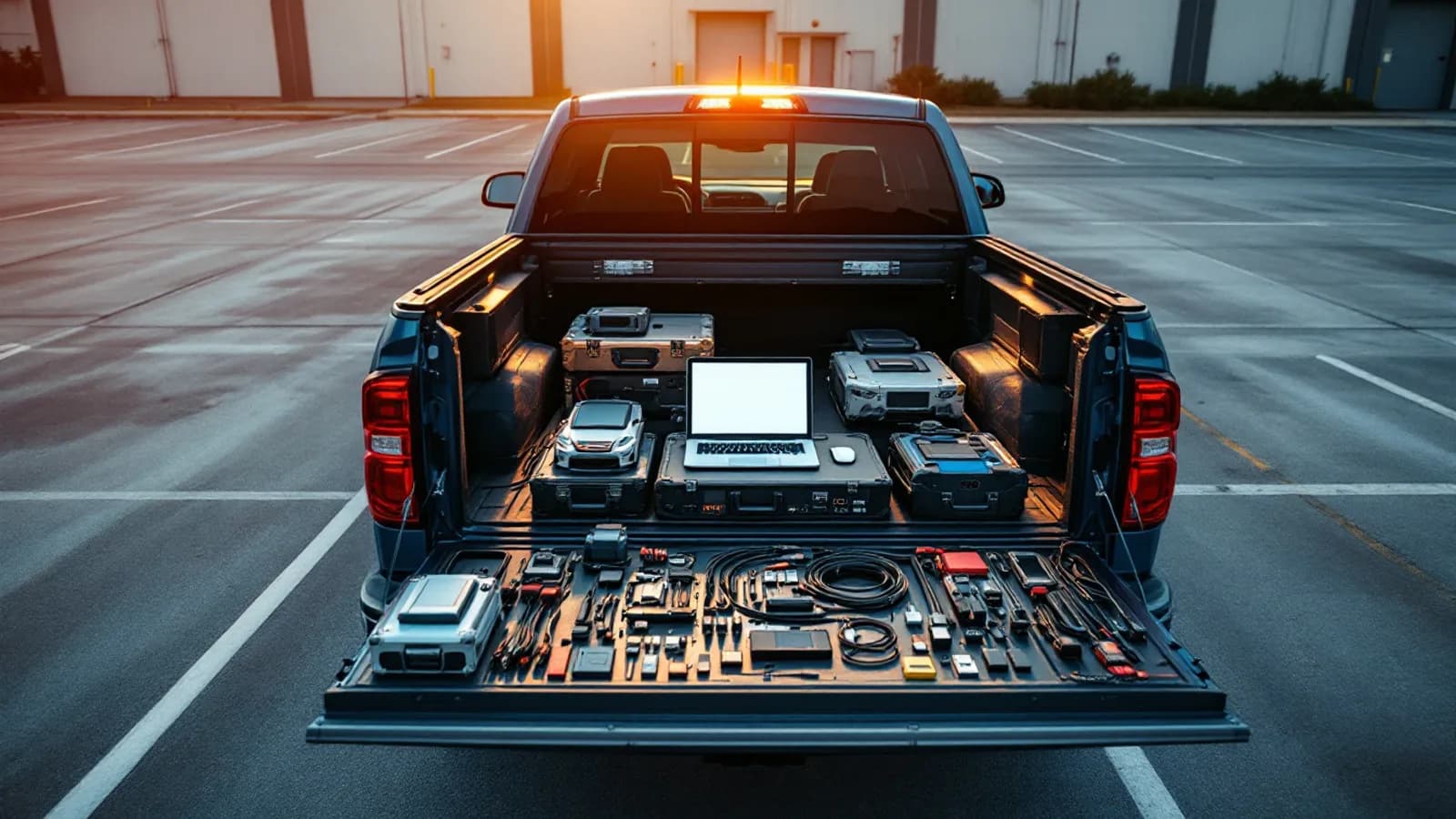
Dealer-Level Diagnostic Equipment for Car Keys in Arlington, TX: What It Buys You
As of August 2026, dealer-level equipment is what makes Mercedes, BMW, and Volvo keys possible curbside in Arlington. What it does, and what it still cannot.
Quick Answer
"Dealer-level diagnostic equipment" means tooling that can talk to a vehicle's security module directly — reading, writing, and authorizing key credentials rather than merely copying an existing key. As of August 2026 that is the difference between a Mercedes, BMW, or Volvo key job being completed in an Arlington driveway for $350 to $600+, or requiring a flatbed and a dealership appointment at $700 to $1,100+ all in. It is also the honest reason some of those jobs still cannot be done independently at all. Call (469) 896-4128 with a VIN and you will get a straight answer either way.
The Phrase Deserves an Actual Definition
Every locksmith website in North Texas uses some version of "dealer-level tools." Almost none of them explain what that means, so here is the working definition a technician would recognize.
A cheap key tool is a cloner. It reads the transponder in a key you already have and writes an identical copy onto a blank. It never speaks to the car. It is fast, it is inexpensive, and it is completely useless the moment you have no working key — which is exactly when you actually need help.
The next tier is a generic OBD programmer. It plugs into the diagnostic port and runs a canned add-key routine on supported vehicles. This handles a large slice of the mainstream fleet perfectly well. On European luxury platforms it typically stops at the security handshake, because the module is not going to grant write access to a tool that cannot authenticate itself.
Dealer-level equipment is the tier that can establish security access with the module that owns the key list, read its stored data, compute or retrieve the authorization needed, write a new credential, and invalidate the old ones. On some platforms that happens over the diagnostic port. On others it means addressing the module directly on the bench — reading the memory device that holds the immobilizer data, working on it, and putting it back.
That last capability is the real dividing line. It is why one van can produce a working key for a Mercedes with no keys at all, and the van that arrived an hour earlier could not.
What the Equipment Physically Enables
Four capabilities, in rough order of how often they decide an Arlington job.
Security access. Modern immobilizer modules require the tool to prove it is authorized before they will discuss keys. Failing this step is where most tools stop, silently, with a generic "communication error."
Key-list read and write. The module stores a finite list of accepted credentials. Dealer-level tooling can read that list, add to it, and — critically — remove from it. Invalidating a lost key so it can never start the car again is a security outcome, not a nicety.
Module-level access. When the module itself is faulty, locked out by failed attempts, or was replaced with a used unit still married to another vehicle, the fix is not a key at all. It is work on the module. That is the world our module programming and repair service covers.
Verified programming under load. These procedures run for a long time and are sensitive to voltage. Proper equipment includes stable power support so the vehicle cannot brown out mid-write, which is a failure nobody wants to explain.
Arlington Key Pricing by Capability Tier
| Capability tier | What it can do | Typical vehicles it covers | Arlington range (2026) |
|---|---|---|---|
| Key cloner only | Duplicate an existing working key | Older transponder cars, spare keys only | $120 – $200 |
| Generic OBD programmer | Add a key on supported mainstream vehicles | Domestic and Asian, working key present | $160 – $320 |
| Smart-key capable | Pair proximity fobs, passive entry calibration | Push-to-start Toyota, Lexus, Ford, GM, Genesis | $250 – $500 |
| Dealer-level, European | Security access, key-list rebuild, all keys lost | Mercedes, BMW, Volvo, Jaguar, Land Rover, Porsche | $350 – $600+ |
| Dealer-level, all keys lost | Rebuild the list from nothing, invalidate lost keys | Any of the above with zero working keys | Add $75 – $250 |
| Dealer path | Manufacturer-side authorization | Newest and gated VINs | $700 – $1,100+ all in |
The bottom two rows are the whole argument. Everything above them is available from a wide range of shops. The dealer-level rows are where the field thins out dramatically, and where the difference between a completed job and a wasted afternoon lives.
What It Enables on Mercedes-Benz
Mercedes concentrates a remarkable amount of function into one place. The EIS/EZS assembly — the electronic ignition switch — handles key authorization, ignition state, and the relationship with the electronic steering lock. When Mercedes owners describe symptoms, they are usually describing that assembly without knowing it.
Dealer-level equipment on a Mercedes enables three things a lesser tool cannot.
All-keys-lost recovery on serviceable generations. The key list lives inside the EIS, and rebuilding it requires reading and writing that module rather than asking it nicely over the port. On many C-Class, E-Class, GLC, GLE, and ML vehicles this is achievable at the curb, which is the entire reason mobile Mercedes service exists. The generational detail sits on our Mercedes key programming page.
Steering lock and ignition faults that masquerade as key faults. A Mercedes that will not turn, will not release the steering column, or reports no key while a perfectly healthy fob sits in your hand is very often an assembly problem rather than a key problem. Diagnosing that difference requires reading the module, not guessing at it. That is the domain of Mercedes EZS, ESL, and EIS issues.
Correct invalidation of lost keys. When a Mercedes key goes missing in a parking structure, removing it from the accepted list matters as much as producing a new one.
The honest limit on this make is specific and worth naming: the newest FBS4-era vehicles require manufacturer-side authorization that no independent tool legitimately produces. Equipment is not the constraint there. Authority is.
What It Enables on BMW
BMW's security has moved through distinct generations — CAS on older cars, FEM and BDC on newer ones — and the model year determines almost everything about how a key job runs. Comfort Access layers passive entry on top of whatever generation is underneath.
On CAS-era vehicles, dealer-level tooling can typically read the module, extract what is needed to generate a credential, write a new key, and clear lost keys from the list. That covers a large population of 3-Series, 5-Series, X3, and X5 vehicles still on Arlington roads, and all-keys-lost is genuinely achievable on many of them.
On FEM and BDC vehicles the picture narrows. These modules are frequently addressed on the bench rather than through the port, and the work sits closer to electronics repair than to key cutting — which is precisely why we run it as a distinct service under BMW FEM, CAS, and FRM repair rather than folding it into general key work. The by-generation breakdown lives on BMW key programming.
What this buys an Arlington BMW owner is a real answer instead of a shrug. A 2011 X5 with no keys and a 2023 X5 with no keys are not the same job, and any shop quoting them identically has not looked.
What It Enables on Volvo
Volvo gets less attention than the German marques and deserves more, because its owners are frequently quoted as though every Volvo were a dealer-only proposition.
Volvo's immobilizer relationship runs through the central electronic module and the engine controller together, and on the XC90, XC60, S60, and V60 the practical consequence is that key work is often more tractable than the badge suggests — a properly equipped shop can add keys and, on many model years, perform an all-keys-lost recovery without a tow. Our Volvo XC90 and XC60 key replacement walkthrough covers the model-specific detail for Arlington owners, and the brand overview sits at Volvo.
The constraint on Volvo is the same as everywhere else: recency. Newer platforms carry newer authentication, and the answer moves toward the dealer as the model year climbs.
What Dealer-Level Equipment Still Cannot Do
This is the section most shops leave out, and it is the reason to trust the rest of the page.
It cannot manufacture manufacturer authority. Several current European platforms gate key generation behind an authenticated request to the manufacturer's own systems. That is a permissions boundary, not a hardware boundary — no tool, at any price, legitimately routes around it. The industry framework governing secure vehicle access exists specifically to define who may perform this work and how. When your VIN falls inside that gate, the correct answer is the dealer, and we will tell you that before we quote you.
It cannot beat the newest model years. As a general rule, the last two or three model years on European luxury platforms are the hardest to service independently, and the situation moves in the manufacturers' favor over time rather than ours.
It cannot fix physical damage by talking to it. A water-damaged module, a cracked board, a corroded connector — those are repairs, sometimes replacements, and no amount of diagnostic capability converts a dead module into a live one without hands on the hardware. Range Rover owners see this pattern often enough that Range Rover no key detected exists as its own diagnostic guide, and the same logic applies to the Jaguar F-Pace and XF.
It cannot substitute for proof of ownership. Photo ID plus registration or title, checked on site, without exception. Equipment powerful enough to create a credential from nothing is exactly the equipment that must never be pointed at a car whose owner is not standing there.
A technician confirms your exact setup from the VIN before anyone is dispatched. Model year, key generation, market configuration, and whether a working key survives all change the answer. All four are knowable in a two-minute phone call and unknowable from a photograph of your dashboard.
Working This Way Around Arlington
Arlington sits between Fort Worth and Dallas with a driving population that commutes in both directions, which means a stranded European car here is rarely stranded somewhere convenient. Office lots off the I-30 corridor, apartment garages, retail parking, and long residential driveways are the usual settings, and all four are places a flatbed is a genuine hassle to arrange.
That is the practical case for mobile capability: not that it is exotic, but that it removes the tow from a job that otherwise requires one. A typical visit runs VIN triage by phone, ownership verification on arrival, cheap causes eliminated first — coin cell, vehicle battery, corroded contacts — then security access, credential write, lost-key invalidation, and a full function test at every door before the technician leaves. Our breakdown of 24/7 response times and pricing covers what after-hours looks like in practice and how Texas DPS Private Security Program licensing governs who is permitted to do this work.
We run European service across Arlington, Grand Prairie, Irving, Southlake, and Grapevine, and the full marque list is on our European car locksmith page.
Frequently Asked Questions
Q: What does dealer-level diagnostic equipment actually mean for car keys? A: It means tooling that can establish security access with the vehicle module holding the key list, then read, write, and invalidate credentials — rather than simply copying a key you already have. Cheap cloners never talk to the car at all, and generic port programmers usually fail the security handshake on European platforms. That handshake is the dividing line between an all-keys-lost job being possible curbside or requiring a tow.
Q: Can a mobile locksmith replace a Mercedes-Benz key in Arlington without the dealer? A: Yes on many serviceable model years, at $350 to $600+ for the fob with $75 to $250 added if every key is lost. The key list lives inside the EIS/EZS assembly, and dealer-level equipment can rebuild it on site for a large share of C-Class, E-Class, GLC, and GLE vehicles. The newest FBS4-era cars require manufacturer-side authorization that no independent tool legitimately produces, which is confirmed from your VIN first.
Q: Does BMW model year change whether a key can be made? A: Yes, more than any other single factor. Older CAS-generation vehicles are routinely serviceable including all-keys-lost, while newer FEM and BDC cars often require the module to be addressed directly on the bench, and the very newest narrow further. A 2011 and a 2023 wearing the same badge are genuinely different jobs, so any quote given without the model year and VIN is a guess rather than a price.
Q: Are Volvo keys really dealer-only? A: No, that is a common and expensive assumption. Volvo routes immobilizer authority through the central electronic module and engine controller together, and on many XC90, XC60, S60, and V60 model years a properly equipped shop adds keys or performs an all-keys-lost recovery on site in the $350 to $600+ European band. As with every make, the newest platforms move toward the dealer, which is settled from the VIN before dispatch.
Q: What can dealer-level equipment not do? A: It cannot create manufacturer authority. Certain current European platforms gate key generation behind authenticated requests to the manufacturer's own systems, and that is a permissions boundary no tool legitimately crosses at any price. It also cannot repair physical damage by talking to it — a water-damaged or cracked module is a hardware repair, and it can never substitute for proof of ownership.
Q: Is mobile European key service cheaper than the dealership? A: Usually by a wide margin. A dealer path commonly totals $700 to $1,100+ once you add labor at $150 to $220 per hour, an OEM key at retail, and a flatbed tow, while the mobile equivalent for a serviceable VIN runs $350 to $600+ plus any all-keys-lost surcharge. The saving is largest exactly where the tow is hardest to arrange, which in Arlington means garages, office lots, and long driveways.
The Bottom Line
Dealer-level equipment is not a marketing phrase, it is a capability threshold — the point at which a shop can negotiate with the module that owns your car's key list instead of merely copying a key it already trusts. On Mercedes, BMW, and Volvo that threshold decides whether an Arlington key job happens at your bumper or behind a tow truck. It also has an edge, and pretending otherwise is how owners end up paying for a visit that was never going to work. Have your year, make, model, and VIN handy and call (469) 896-4128. Dallas Locksmith Pros runs 24/7 mobile European service across Arlington and the wider metroplex, quotes flat-rate before dispatch, and says no out loud when no is the truth.
Written by the Dallas Locksmith Pros mobile automotive team, serving European vehicle owners in Arlington and across the metroplex 24/7.
Related articles
Dealer vs. Mobile Locksmith for European Car Keys in Dallas
2026 Dallas comparison: dealer vs mobile locksmith for BMW, Mercedes, Audi, Porsche keys. $350-$600 mobile vs $700-$1,100 dealer, tow costs, and queues.
Read moreWhy Luxury Car Keys Cost More in Dallas (2026 Explainer)
2026 guide to why luxury car keys cost more in Dallas: European smart fobs run $350-$600+ vs $120-$200 transponders. The real reasons, explained.
Read moreLuxury Car Locksmith in Highland Park: BMW, Mercedes, Porsche, Range Rover
2026 Highland Park luxury car locksmith guide — BMW, Mercedes, Porsche & Range Rover key costs, why European fobs run $350-$600+, and same-day mobile service.
Read moreNeed a Dallas locksmith right now?
Licensed mobile automotive locksmith. Same-day response across DFW.
Call (469) 896-4128