
The Emergency Key Won't Turn in My Car Door — Dallas Diagnosis Guide
A hidden blade that won't turn usually means a seized cylinder or an uncut blade. As of September 2026, Dallas cylinder service runs $95-$180. Don't force it.
Quick Answer
If the emergency blade hidden inside your key fob will not turn in the driver's door, the usual cause is a door lock cylinder that has not been turned in years — dust, dried factory grease and wafer wear, not a wrong key. As of September 2026, servicing that cylinder in Dallas runs $95 to $220, and cutting a correct blade if yours was never cut runs $25 to $75. Do not force it. A snapped blade inside the lock turns a $95 job into a $200+ one. Call (469) 896-4128.
The Lock Nobody Uses Until They Have To
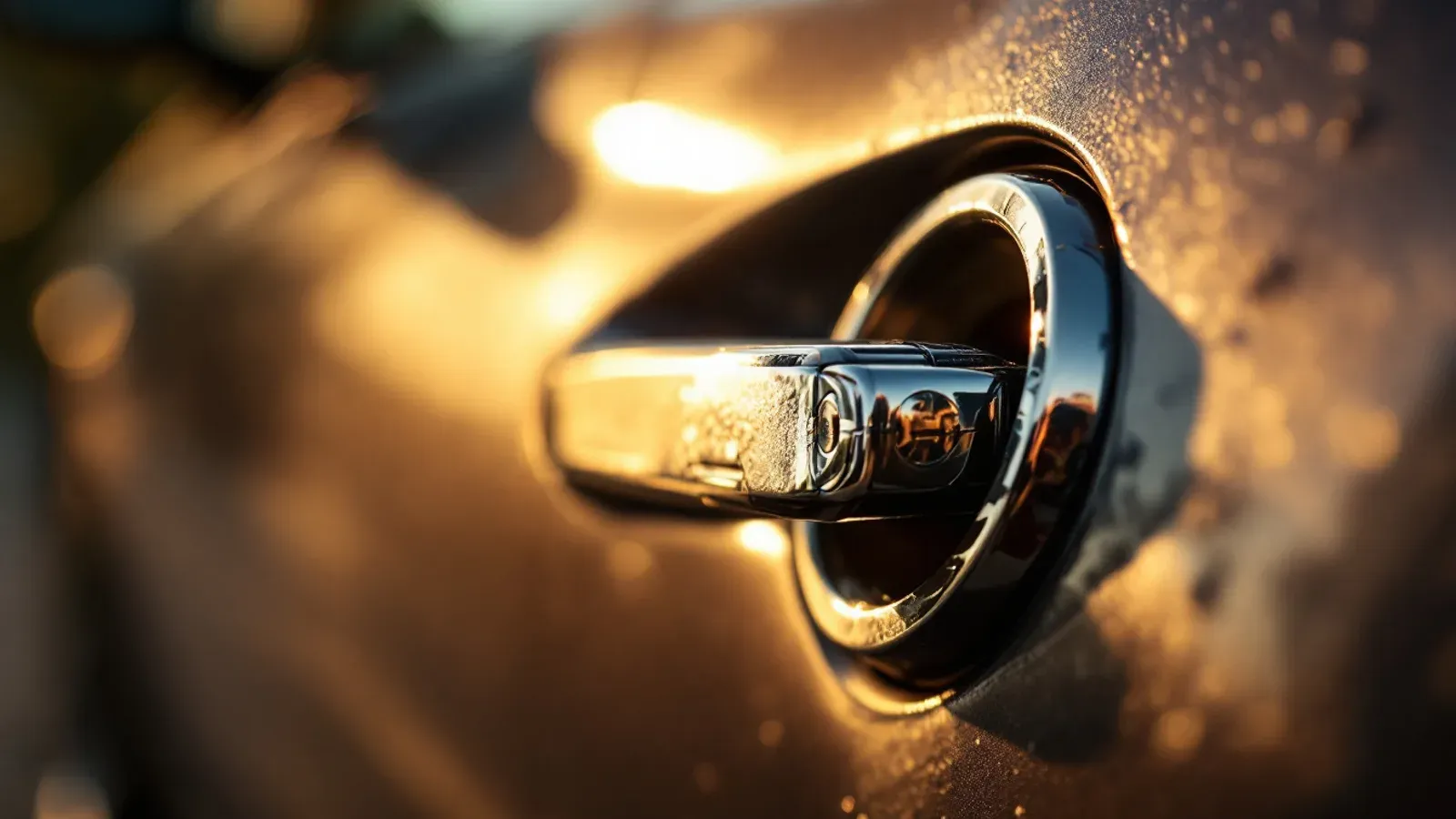
Every push-button car still has a mechanical way in. There is a slim metal blade inside the fob, and there is a keyhole in the driver's door — sometimes visible, more often hidden behind a small plastic cap on the handle.
That system exists for exactly one scenario: the electronics are not available. A flat 12-volt battery, a fob that has died, a receiver fault. And it has a specific, predictable weakness — it is the only part of the car that is designed to be used and then never used. A door cylinder on a 2015 push-button SUV in Dallas may have been turned twice since it left the factory, both times on the assembly line.
Ten years of that is enough. The grease packed into it at build has thickened, fine grit has worked past the shutter, and the wafers no longer move freely. Then one evening the 12-volt dies, you pull the blade out for the first time, and the lock will not turn.
Before Anything Else: Stop Pushing
The blade is thin, it is not hardened, and it is being asked to move wafers that have not moved in a decade. Blades snap flush with the face of the lock, and once that happens the extraction is a separate job before anyone can even attempt the original one.
Two rules while you are standing there:
- Never use pliers on it. The extra leverage is exactly enough to break it and nowhere near enough to free a seized cylinder.
- Never keep wiggling after it feels gritty. Grit under load is how wafers get gouged, and a gouged wafer that would have been a cleaning job becomes a replacement.
If anyone is locked inside the vehicle — a child, a pet — call 911 first, then call us. Emergency services in Dallas respond to that immediately and do not wait for a locksmith.
Why This Happens, in Order of Likelihood
1. The cylinder is dry and contaminated (most common)
Factory lubricant is a grease, and grease in North Texas heat migrates, thickens and collects dust. Ten summers of 100-degree afternoons in an uncovered driveway will do it. The cylinder is not broken; it is gummed. This is the majority of these calls and it is the cheapest outcome.
2. The blade was never cut
This one surprises people. On a fair number of vehicles the emergency blade arrives as a blank — a correctly shaped piece of metal with no cuts in it — and it stays that way unless someone asked for it to be cut. It slides in perfectly and will never turn, because there is nothing on it to lift the wafers.
Look at the edge of your blade against a picture of a cut key. If the profile is smooth and uniform with no notches or milled channel, it was never cut. That is a $25 to $75 fix and not a lock problem at all.
3. You are using the wrong slot
Some vehicles put the key cylinder in the driver's door only, and some hide it behind a cap you have to pop off with the blade itself. A handful put a similar-looking slot elsewhere — a trunk lock, a fuel door, a glovebox — that your blade will enter but not operate. If the blade goes in smoothly and simply spins or stops dead, check you are at the driver's door cylinder.
4. Wafer wear from years of daily use
The opposite problem, and it shows up on older cars where the door key was the everyday key. Twenty years of use rounds the wafers and the key itself; eventually the tolerance stack means a worn key can no longer lift worn wafers. Here a freshly cut key to the original code — rather than a copy of the worn one — often solves it outright. The same wear physics governs ignition cylinders, which is why a loose or wiggly ignition and a stiff door lock frequently appear on the same car.
5. Something inside the lock has failed
A broken wafer spring, a displaced retainer, or a linkage that has come off the back of the cylinder. Rarest of the five, and the only one that reliably means replacement rather than service.
What to Try Yourself, Safely
Two things, both low-risk.
Try the passenger door. It is a different cylinder on the same key. If the passenger side turns and the driver side does not, the key is correct and the driver's cylinder is the problem — which is diagnostic and free.
Use a dry lubricant, not oil. A graphite or PTFE lock lubricant is designed for this. Apply sparingly, work the blade gently in and out without turning, and try again after a minute.
What not to use: penetrating oil or general-purpose spray lubricant. It will free the lock for about a week, then attract dust into a paste that seizes it worse than before. We service cylinders every month that were sprayed with the wrong thing, and the job is longer because the residue has to come out first.
If dry lubricant and the passenger-door test do not resolve it, stop there. Everything past that point risks a snapped blade.
What It Costs in Dallas (2026)
| Job | What it covers | Dallas price range (2026) |
|---|---|---|
| Emergency blade cut to code | Blank blade cut from the VIN or the lock | $25 – $75 |
| Door cylinder service | Cleaned, wafers freed, correctly lubricated | $95 – $180 |
| Cylinder service with a re-cut key | Above, plus a fresh blade to the original code | $140 – $220 |
| Broken blade extraction | Snapped key removed without damaging the lock | $95 – $200 |
| Door lock cylinder replacement | New cylinder fitted and keyed to your existing key | $180 – $350 |
| Vehicle lockout, non-destructive entry | Daytime, 9 a.m. – 7 p.m. Central | $85 – $200 |
| Vehicle lockout, after hours | Outside 9 a.m. – 7 p.m. Central | $125 – $275 |
Prices as of September 2026 for the Dallas–Fort Worth market, quoted flat before dispatch.
Worth noting where the money goes. Servicing a neglected cylinder costs less than extracting a blade someone snapped trying to force it, and both cost less than replacing a cylinder that was gouged by repeated forcing. The cheapest version of this problem is always the one addressed before the third attempt.
The Scenario This Really Belongs To
Most people meet this fault at the worst possible moment: the car's 12-volt battery is flat, the fob does nothing, and the blade is the only remaining way in. Now the mechanical backup and the electrical system have failed together, and one of them was silently broken for years.
That combination is common enough in Dallas to plan around. A car that sits — a weekend vehicle, a third car, anything parked at an apartment or a downtown garage for weeks at a stretch — drains its 12-volt slowly, and its door cylinder seizes on exactly the same timetable, for exactly the same reason: nothing is being exercised. The electrical half of that story is in why a car key only works sometimes, and what happens when the fob's radio dies while the car still starts is in dead fob buttons with a car that still starts.
If you are locked out right now and the blade will not turn, that is a straightforward non-destructive entry for us — we open the vehicle without touching the lock, then service the cylinder while we are there so the backup works next time. Pricing and response times are set out in locked out of my car in Dallas, and the tower-garage version in high-rise garage car lockout.
Test It Now, Not at 11 p.m.
This is the rare automotive fault with a free, five-minute preventive check.
Pull the blade out of your fob. Find the driver's door keyhole — pop the handle cap if there is one. Insert the blade and turn it. Lock the door, unlock the door, put it back.
Do that today and you find out on your own terms whether the blade is cut, whether the cylinder turns, and whether the cap even comes off. Do it twice a year, especially on a car that lives in a garage and rarely moves, and the mechanism stays exercised. It is about as close to free insurance as car ownership offers.
This applies with particular force to newer luxury vehicles in Highland Park, University Park, Preston Hollow and Southlake, where second and third cars sit for long stretches and the blade genuinely has never been used. It is also worth doing after buying a used car — see the used-car one-key problem for what else to check at the same time.
What We Do at the Vehicle
We are mobile across Dallas, Highland Park, Lakewood, Addison and the rest of the metroplex, so this is done in your driveway.
The technician confirms the blade is cut and cut correctly, tests the passenger cylinder as a control, services the driver's cylinder rather than replacing it wherever the wafers are sound, and re-cuts a blade from the original code if the existing one is worn. If a blade has already broken off in the lock, extraction comes first and is done with tools made for it, not with whatever is in the truck.
Ownership is verified on every job before a lock is opened or a key is cut. Related service pages: emergency locksmith in Dallas and car key replacement.
Frequently Asked Questions
Q: Why won't the emergency key inside my fob turn in the car door? A: In most cases because that cylinder has not been turned in years. Push-button cars are unlocked electronically, so the mechanical lock sits untouched from the day it left the factory, and the grease packed into it thickens while fine dust works past the shutter. The wafers stop moving freely. It is not a wrong key and not usually a broken lock, and servicing the cylinder in Dallas runs $95 to $180. The second most common cause is that the blade was never cut in the first place.
Q: Can I force the emergency blade or use pliers on it? A: No. The blade is thin, unhardened metal and it snaps flush with the face of the lock, at which point extraction becomes a separate job at $95 to $200 before anyone can address the original problem. Pliers add exactly enough leverage to break it and nowhere near enough to free a seized cylinder. If the blade feels gritty under load, stop, because grit under pressure gouges the wafers and turns a cleaning job into a replacement.
Q: My emergency key slides in but just spins. What does that mean? A: Usually that the blade was never cut. On many vehicles the emergency blade ships as a blank, correctly shaped but with no notches or milled channel, and it stays that way unless someone asked for it to be cut. It enters the lock perfectly and can never lift the wafers. Hold the edge up and compare it to a normal cut key: if the profile is smooth and uniform, that is your answer, and cutting a correct blade runs $25 to $75. The other possibility is that you are at a slot the blade fits but does not operate.
Q: What lubricant should I use on a stiff car door lock? A: A dry lubricant made for locks, meaning graphite or PTFE. Apply sparingly, work the blade in and out gently without turning it, and try again after a minute. Do not use penetrating oil or general-purpose spray lubricant: it frees the lock for about a week, then attracts dust into a paste that seizes it worse than before. We regularly service cylinders that were sprayed with the wrong product, and the job takes longer because the residue has to be removed first.
Q: The blade broke off in my door lock. Is the lock ruined? A: Usually not. A snapped blade is extracted with tools made for the job, and in most cases the cylinder is undamaged and can be serviced in the same visit. Extraction runs $95 to $200 in Dallas. What does risk the lock is repeated attempts to fish the piece out with improvised tools, which push the fragment deeper and score the wafers. If it has broken, leave it alone and call. And if you can reach us before the third forcing attempt rather than after, the whole job is cheaper.
Q: Should I replace the cylinder or just service it? A: Service it, in the large majority of cases. If the wafers and springs are sound and the problem is contamination and dried grease, cleaning and correct lubrication restores it for $95 to $180 and it will outlast the car. Replacement at $180 to $350 is the right answer when a wafer spring has broken, a retainer has displaced, or repeated forcing has gouged the internals. A shop that reaches for replacement before opening the cylinder is not diagnosing, and that is worth pushing back on.
The Bottom Line
The emergency blade is the backup to everything else on the car, and it is the one part of the vehicle guaranteed to be neglected. A cylinder that has not turned in ten Dallas summers is gummed rather than broken, and a blade that was never cut was never going to work.
Both are cheap to fix — $25 to $75 for a cut blade, $95 to $180 to service the cylinder — and both are very expensive to discover at 11 p.m. with a dead battery. Go and test it while the sun is up.
Call (469) 896-4128. Dallas Locksmith Pros is mobile and answers 24/7, opens locked vehicles without damage, services cylinders rather than defaulting to replacement, and quotes flat before dispatch.
Written by the Dallas Locksmith Pros mobile automotive team, serving drivers across Dallas, Highland Park, Lakewood, Addison and the wider DFW metroplex 24/7.
Related articles
Key Stuck in the Ignition in Dallas? 2026 Causes & Fix Cost
2026 Dallas guide to a key stuck in the ignition: why it won't turn or come out, DIY checks that work, and whether it's the cylinder or the key.
Read moreDallas Ignition Repair vs Replacement: 2026 Cost Guide and How to Tell Which You Need
Ignition repair in Dallas runs $250-$350; replacement $180-$550. A 2026 guide to telling them apart — and why a mobile locksmith beats the dealer and the tow.
Read moreSteering Wheel Locked and the Key Won't Turn in Dallas: What It Actually Means
As of August 2026, a locked steering wheel in Dallas is often a free ten-second fix. A real ignition or ELV repair runs $180 to $550+.
Read moreNeed a Dallas locksmith right now?
Licensed mobile automotive locksmith. Same-day response across DFW.
Call (469) 896-4128