
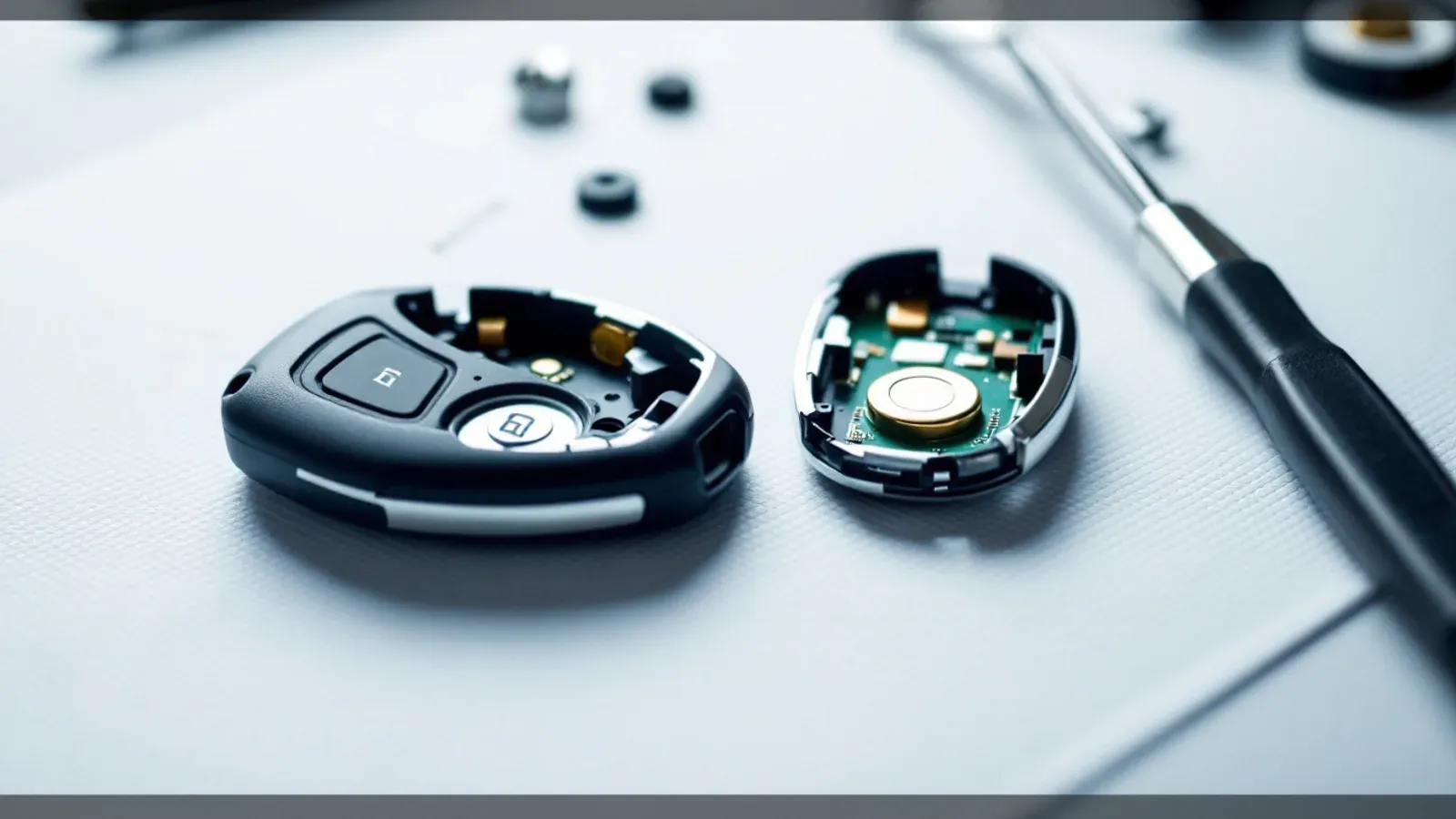
My Key Fob Buttons Stopped Working But the Car Still Starts — Dallas Diagnosis Guide
Dead fob buttons with a car that still starts means the immobilizer half is fine. As of September 2026 most Dallas fixes are $40-$95, not a new $250-$500 fob.
Quick Answer
If the buttons on your key fob have stopped working but the car still starts normally, the immobilizer side of your key is fine and the radio side is not. Those are two separate systems in one plastic shell. As of September 2026, the fix in Dallas is usually a $40 to $95 diagnosis that ends in a battery, a resync or a repair — not the $250 to $500 new fob most people assume. Call (469) 896-4128 before you order a replacement.
Two Systems, One Piece of Plastic
Almost every modern car key does two entirely unrelated jobs, and owners are rarely told this.
The immobilizer credential is a passive chip. It has no battery, no range, and no buttons. The car energizes it at close range — in the ignition, or against the start button — and it answers with an encrypted identity. That is what allows the engine to run.
The remote transmitter is an active radio. It has a battery, it broadcasts across a parking lot, and it is the thing your thumb talks to. Lock, unlock, trunk, panic, remote start: all of it lives here.
They share a shell and nothing else. So when the buttons die and the car still starts, you have not learned that "the key is failing." You have learned something much more specific and much cheaper: the passive half is healthy, and the problem is confined to the radio half or to the car's receiver.
That single fact eliminates most of the expensive possibilities before anyone touches the car. The opposite symptom — the car will not start but the buttons still work — points the other way entirely, and is covered in anti-theft light flashing and car won't start.
Work Through It in This Order
Do these in sequence. Each step is cheap and each one rules out a whole category.
1. Try the other key
If there is a second fob, use it. This is the highest-value ten seconds in the whole process.
- Second fob's buttons work → the fault is in the first fob. Battery, water, a cracked solder joint or a worn button pad. That is a repair or a replacement of one piece of hardware, and the car is fine.
- Second fob's buttons also fail → the fault is almost certainly in the car's receiver, not in either fob. Two independent radios do not fail the same week; one receiver serving both of them does.
If you only have one key, that answer is unavailable — and it is worth noticing that this is the second time this month a spare would have paid for itself. The economics are in car key cost by security generation.
2. Change the fob battery, properly
This is the single most common cause, and it is often done wrong.
The transmitter needs meaningfully more power than the passive chip does, which is exactly why the buttons fail first and the car keeps starting. A coin cell at 2.6 volts will still let the car see the chip up close while no longer pushing a usable signal across a parking lot. A fob that starts the car but will not unlock it is the textbook signature of a dying battery, not a dying key.
When you change it: match the cell type printed inside, handle the new cell by its edges (skin oil on the contact face causes intermittent contact), and make sure the shell clicks fully closed. A shell that is 90% closed lets the battery float off its contact under vibration, which produces exactly this symptom and is maddening to chase.
Buttons still dead on a fresh, correctly seated battery? Go to step 3.
3. Rule out water
A fob that got wet often keeps starting the car long after the buttons die, because the passive chip is a sealed component and the transmitter circuit is not. Corrosion on the board attacks the button traces first.
Signs to look for with the shell open: green or white powder on the board, a discoloured rubber pad, or a battery contact that has lost its shine. If any of that is present, the fob is a repair candidate rather than a battery problem — and the window for a successful repair closes as corrosion spreads. The full procedure, including why rice is not the answer, is in what to do when your key fob gets wet.
4. Check range against a wall, not across a lot
Stand close to the driver's door and press unlock. Then walk back ten feet and try again.
- Works close, fails at distance → weak transmitter. Battery, antenna trace or a failing transmitter chip.
- Fails at every distance, including touching the door → the signal is not being sent or not being received at all. That is a fob transmitter failure or a car-side receiver failure, and step 1 told you which.
Dallas adds a variable here worth knowing about. Dense radio environments — the garage levels under an Uptown tower, a hospital campus, anywhere near a large transmitter site — can swamp a low-power key remote. If the buttons work at home and fail only in one specific garage, the fob is fine and the location is the problem. That is also why high-rise garage lockouts are their own category of call.
5. Check whether the car's own systems are healthy
If both fobs fail, the receiver or the module behind it is the suspect. On most vehicles the keyless-entry receiver lives inside the body control module, so a fault there can present as "no remotes work" while the immobilizer, on a different circuit, keeps functioning normally.
Before assuming a module, check the car's 12-volt battery. Marginal system voltage produces an astonishing variety of electronic misbehaviour, and body modules are usually the first to complain. A vehicle that sits between drives — a second or third car in a Preston Hollow or Highland Park garage — is the most likely candidate. The pattern is set out in why a car key only works sometimes.
What It Costs to Fix in Dallas (2026)
| Finding | What is done | Dallas price range (2026) |
|---|---|---|
| Fob diagnosis, battery, shell reseat | Fault isolated, cell replaced, contacts cleaned | $40 – $95 |
| Remote resync to the vehicle | Transmitter re-paired to the receiver | $60 – $120 |
| Fob repair — button pad or board | Pad replaced or solder joint repaired where viable | $75 – $160 |
| Replacement remote or flip key, programmed | New hardware, immobilizer plus remote paired | $160 – $320 |
| Replacement proximity fob, programmed | New encrypted fob registered to the module | $250 – $500 |
| European proximity fob, programmed | Encrypted registration, authenticated session | $350 – $600+ |
| Receiver or body module diagnosis | Car-side fault isolated rather than a key replaced | $120 – $280 |
| Module programming, if the module is at fault | Module coded, or replaced and coded to the VIN | $250 – $600 |
Prices as of September 2026 for the Dallas–Fort Worth market, quoted flat before dispatch.
The striking thing about that table is its top: most of these calls end in the $40 to $95 row. The buttons-dead-car-starts symptom is one of the few that genuinely predicts a cheap outcome, which is the opposite of what most owners expect when they pick up the phone.
Why the Order of Operations Matters
There is a specific way to lose money on this fault, and it is common enough to name: buy a replacement fob first, then discover the receiver was the problem. Now you own a fob you did not need, you have paid to program it, and the buttons still do not work — because nothing was ever wrong with the key.
Running step 1 before spending anything prevents that entirely. If the second fob's buttons work, the problem is a piece of hardware you can hold. If they do not, the problem is in the car and no fob purchase will touch it.
This is also the reason we quote diagnosis separately from replacement rather than bundling them. A shop that only sells keys has an incentive to find that you need a key. The FTC's consumer guidance on locksmith services is worth reading on that point, and so is our own how to avoid car key replacement scams in Dallas.
When It Is Genuinely a New Fob
Sometimes it is. Replace rather than repair when:
- The shell is cracked and the board has been exposed to weather. Corrosion will keep spreading whatever is soldered today.
- Multiple buttons have failed progressively over months. That is a worn conductive pad, and replacement pads are a stopgap at best.
- The fob has been crushed, run over, or through a wash cycle. Structural damage to the antenna trace is not repairable.
- The car is European and 2018 or newer, where the fob and its credential are more tightly bound and a marginal repair is a false economy.
In those cases the repair-or-replace decision guide covers the trade-off, and if you decide to source your own part, what it costs to program a key you already bought prices the labor separately.
What We Do at Your Car
We are mobile across Dallas, Plano, Richardson, Frisco and the wider metroplex, so this is diagnosed in your driveway or your office lot rather than at a counter.
The technician tests both the passive credential and the active transmitter separately, measures the fob's output rather than guessing from behaviour, checks system voltage, and confirms whether the car's receiver is hearing anything at all. That sequence is what separates "your battery is low" from "your body module is failing" — two findings that look identical from the driver's seat and differ by several hundred dollars.
Full service detail is on the key fob programming page, and the immobilizer side of the house is on no key detected and immobilizer issues.
Frequently Asked Questions
Q: Why do my key fob buttons not work if the car still starts? A: Because those are two different systems sharing one shell. The chip that lets the engine run is passive, has no battery and only works at a few centimetres. The buttons run off an active radio transmitter with its own battery and a range of many metres. The radio needs far more power and far more intact hardware, so it fails first. A car that still starts is telling you the expensive, encrypted half of your key is healthy and the cheap half is not.
Q: Will a new battery fix key fob buttons that stopped working? A: Often, and it is the first thing to try. A coin cell that has dropped to around 2.6 volts will still let the car read the chip at close range while no longer pushing a usable signal to the doors, which produces this symptom exactly. Match the cell type printed inside the shell, handle the new cell by its edges so skin oil does not foul the contact, and make sure the shell clicks fully closed. If the buttons are still dead on a fresh, properly seated battery, the next suspects are water damage and the car's own receiver.
Q: Both of my key fobs stopped unlocking the doors. What does that mean? A: Almost certainly that the fault is in the car rather than in either key. Two independent radios with separate batteries do not fail in the same week; one receiver serving both of them does. On most vehicles that receiver lives inside the body control module, which is why the immobilizer can keep working normally while every remote goes dead. Have the 12-volt system checked first, because marginal voltage makes body modules misbehave long before it stops the engine.
Q: How much does it cost to fix a key fob whose buttons stopped working in Dallas? A: Most of these calls end at $40 to $95 for diagnosis, battery and contact cleaning. A resync runs $60 to $120, a viable board or button-pad repair $75 to $160. Only if the fob is genuinely beyond repair do you reach replacement, at $160 to $320 for a remote or flip key and $250 to $500 for a proximity fob. If the car's receiver is the fault, diagnosis is $120 to $280 and no new key is involved at all.
Q: Can I still drive the car with dead fob buttons? A: Yes. The engine will start and run normally, because the immobilizer credential is unaffected. What you lose is convenience and one layer of access: you will unlock with the emergency blade or the door key, and if your 12-volt battery ever dies you will be relying on that blade to get in. That is worth testing now rather than discovering later, since the blade on a push-button car is often decades old in service terms and has never actually been turned. See when the emergency key will not turn in the door lock.
Q: My fob works at home but not in my office garage. Is it failing? A: Probably not. Key remotes transmit at very low power, and dense radio environments — underground parking, hospital campuses, sites near large transmitters — can drown them out entirely. If the buttons are reliable everywhere except one location, the fob is healthy and the location is hostile. The practical workaround is to unlock at the door with the fob touching the handle, which is close enough to win the contest, or to use the emergency blade.
The Bottom Line
Dead buttons with a car that still starts is good news wearing bad clothes. It tells you the encrypted, expensive, hard-to-replace half of your key is working perfectly, and that whatever is broken lives in the cheap half or in the car's receiver.
Try the second fob, change the battery correctly, look for corrosion, test range at the door. Four steps, no money spent, and by the end you know whether you are holding a $9 problem or a car-side one.
Call (469) 896-4128 and Dallas Locksmith Pros will diagnose it at your vehicle — fob and receiver tested separately, flat price before dispatch, and no key sold to fix a fault that was never in the key.
Written by the Dallas Locksmith Pros mobile automotive team, serving drivers across Dallas, Plano, Richardson, Frisco and the wider DFW metroplex 24/7.
Related articles
Key Fob Replacement Near Me in Dallas: Repair It, Reprogram It, or Replace It?
Your fob is failing. As of September 2026, here is how to tell in Dallas whether you need a $5 battery, a $40-$95 fix, a $120-$280 relearn, or a new fob.
Read morePush-Button Start Not Working in Dallas? 2026 Fix Guide
2026 Dallas guide: why push-button start won't work. Most fixes are cheap (dead fob battery); a new smart fob runs $250-$500. Backup-start trick inside.
Read moreYour Car Key Only Works Sometimes: Diagnosing an Intermittent No-Start in Dallas (2026)
An intermittent key is the cheapest fault to fix and the easiest to misdiagnose. As of September 2026, Dallas diagnosis runs $40-$280 before any new key.
Read moreNeed a Dallas locksmith right now?
Licensed mobile automotive locksmith. Same-day response across DFW.
Call (469) 896-4128