
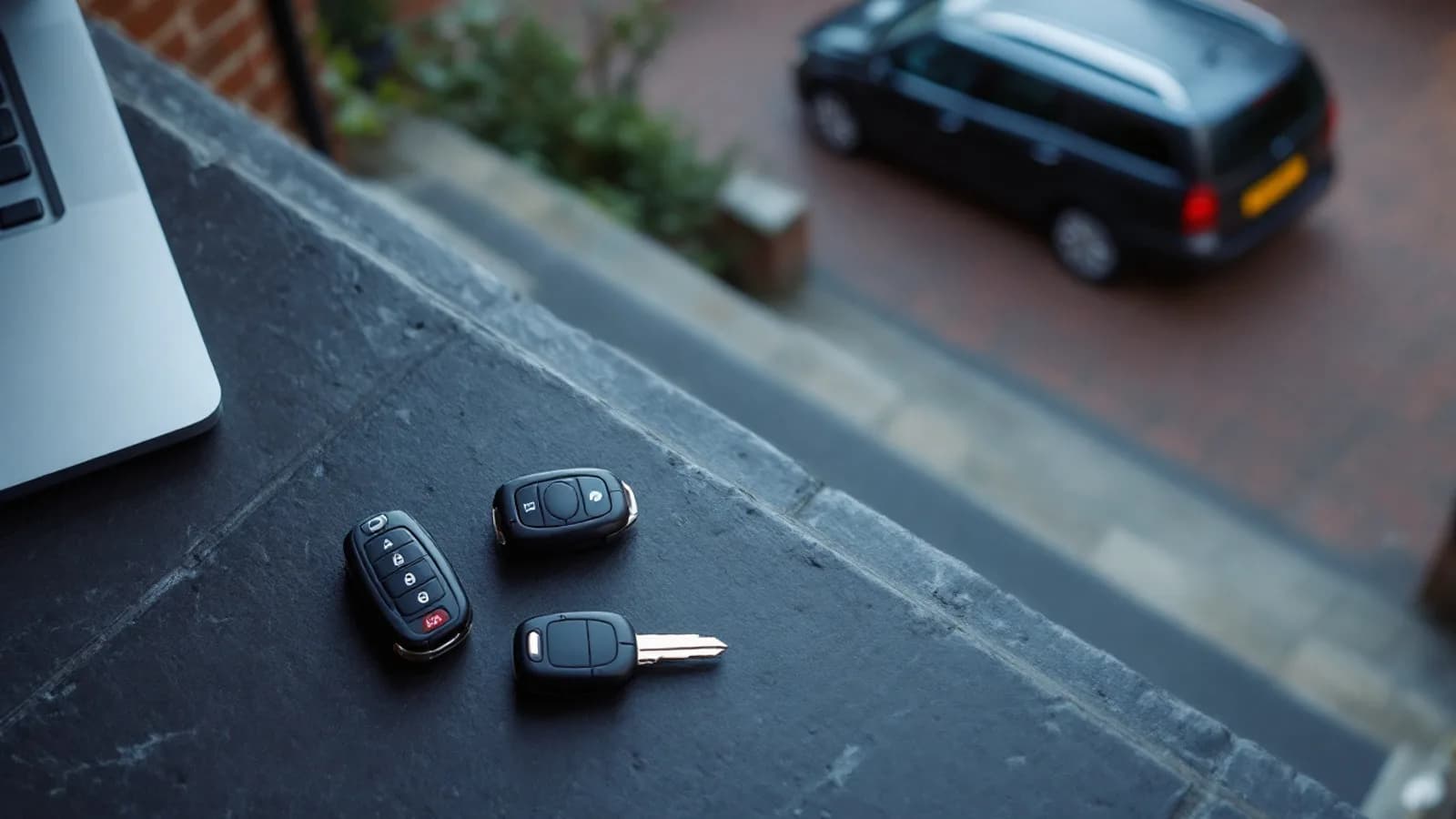
Mini Cooper Clubman & Paceman All Keys Lost in Dallas: A BMW Security System Wearing a Mini Badge
As of August 2026, a Mini Clubman or Paceman all-keys-lost recovery in Dallas runs $350-$600+ for the fob plus $75-$250, set by the CAS generation.
The Badge Says Mini. The Security System Says Munich.
An owner who has lost every key to a Clubman or a Paceman usually starts the phone call apologizing for the car. It is small, it is quirky, it has a union jack on the roof, and they assume that makes it an oddity nobody can service.
It is the opposite of an oddity. Since BMW took the marque forward, a Mini has carried BMW body-security architecture — the EWS immobilizer on the earliest cars, then CAS (Car Access System) through the R-generation, then FEM and BDC on the F-generation. That lineage is the single most useful fact about your car right now, because it means the recovery is a known, documented procedure rather than an improvisation. It also means the answer to "can this be done in my driveway" depends almost entirely on which generation of that module your particular car got.
As of August 2026, a Mini fob in Dallas runs $350 to $600+, with an all-keys-lost add-on of $75 to $250 when nothing works and authorization has to be rebuilt from zero. If your keys are fine and the car simply stopped trusting them after battery or module work, that is a relearn at $120 to $280 — a different, cheaper job. Call (469) 896-4128 with the VIN before you order a fob from anyone.
Quick Answer
Yes, a mobile European specialist can recover a Mini Clubman or Paceman with all keys lost on the large majority of model years, at your location. Expect $350 to $600+ for the fob plus the $75 to $250 all-keys-lost add-on. The decisive variable is the security generation — R55 and R61 cars run CAS, which is well-understood territory, while later F54 Clubmans run FEM or BDC and are VIN-verified before dispatch because a portion of those require access we will not pretend to have.
Mini Key & Recovery Pricing in Dallas (2026)
| Job | What it covers | Dallas price range (2026) |
|---|---|---|
| Mini smart fob or comfort-access fob | Supplied, paired to the car, emergency blade cut to code | $350 – $600+ |
| All keys lost | Add-on when no working fob exists anywhere | add $75 – $250 |
| Immobilizer relearn, no new key | Existing fobs re-paired after battery or module work | $120 – $280 |
| Fob diagnosis and battery service | Not detected, reduced range, intermittent start | $40 – $95 |
| Fob shell replacement, electronics transferred | Cracked case, worn buttons, snapped emergency blade | $40 – $95 plus the shell |
| Mini lockout entry | Non-destructive only — no drilling, no glass, no damaged trim | $85 – $200 day / $125 – $275 after-hours |
| Dealer path, all-in | Any Mini | Several hundred more once a tow and shop labor at $150–$220/hr are stacked on |
What Actually Has To Happen When Every Key Is Gone
The access module is the authority
Whatever it is called in your generation — EWS, CAS, FEM, BDC — one module owns the list of credentials the car will accept. It is the gatekeeper. Programming a Mini key means writing a new identity into that list, and an all-keys-lost recovery means doing it without a trusted credential to authenticate with first.
That is the entire difficulty, stated plainly. A spare key is an append. A recovery is a rebuild, performed against a system whose whole purpose is to refuse exactly that operation to anyone who cannot prove they belong there.
The DME countersigns
Validating the fob is not the same as permitting an engine start. The engine controller has to agree, and it holds its own paired relationship with the access module. That is why a Mini in this state will often unlock, light up the dash, run the radio and crank without ever firing. Two permissions, two conversations, and only one of them failed. We describe the same split on a different platform in our guide to why a push-button start stops working.
The steering lock has an opinion too
On the R-generation cars there is an electronic steering lock in the loop, and a Mini with a security fault can present as a wheel that will not release rather than as a key problem at all. That failure has its own repair path, which we cover in detail in our Mini Cooper R56 and F56 ignition and ELV repair guide. Diagnosing which of the two you actually have is a phone-triage question, and it is worth answering before a truck moves.
Why the Generation Decides the Job
R55 Clubman (2007–2014) and R61 Paceman (2013–2016): CAS territory
These are the cars people picture when they say Clubman and Paceman, and they are the friendlier half of this article. The R55 shares its underpinnings and its access system with the R56 hatch; the R61 Paceman is the three-door coupe-roofed sibling of the R60 Countryman and shares that car's electrical architecture almost entirely — which is why our Mini Countryman spare key guide is genuinely the same conversation if a Paceman is what is sitting in your driveway.
Practically, a CAS-generation Mini uses a fob that is read by the car rather than turned in a conventional lock, and recovery is established procedure. Most of these are a driveway job. Cars in the very late R-generation and cars that have already had a module replaced by someone else are the exceptions worth checking from the VIN.
F54 Clubman (2016–2024): FEM and BDC, and an honest caveat
The six-door F54 Clubman is a much larger, much more modern car than the R55 it replaced, and it moved to the FEM/BDC family of body controllers. Two things follow from that.
First, the procedure is different enough that quoting an F54 off an R55 conversation is how people get surprised. Second — and we would rather say this on a web page than in your driveway — a share of FEM and BDC cars require either bench-level access to the module or a manufacturer credential. Where that is the case, we tell you before dispatch and you keep your money. Where it is not, and it frequently is not, the job runs like any other European recovery.
The way to know which one you have is the VIN. Not the model year alone, not the trim, not what a forum said about a car in another market.
The concealed emergency blade nobody has ever used
Every modern Mini fob hides a mechanical blade inside the fob body, and there is a physical lock behind a cap on the driver's door for it. Most owners have never removed it and a fair number do not know it exists.
It matters for two reasons. When we cut a new fob we cut that blade to code and physically test it in the door cylinder, because a fob that opens the car electronically and cannot open it mechanically is only half a key. And it matters when the car's 12V battery is flat: with no power, the passive entry system is dead and that blade is the only way into the cabin. Owners who have never located theirs are the ones who end up calling for a lockout on a car whose key is in their pocket.
The blade is thin by design. Used as a screwdriver or a box cutter, it snaps — which is why shell replacement with the electronics transferred, at $40 to $95 plus the shell, is one of the most common small jobs we do on these cars across Dallas and Lakewood.
The Used-Fob Trap, Specifically on BMW-Group Cars
This is where Mini owners lose the most money, so it deserves its own section rather than a bullet.
On BMW-group architecture, a fob is not a blank accessory. Once it has been written into a car's access module it is, for practical purposes, married to that vehicle. A fob pulled from a wrecked Clubman in another state and sold as "OEM, tested, working" was working — on the car it was married to. On yours, the access module reads the challenge response, does not recognize the identity, and refuses it. No aftermarket tool overrides that, because overriding it is precisely the attack the system exists to defeat.
There is a second failure below that one. A meaningful share of the cheap listings are not salvage fobs at all, they are counterfeit shells with electronics that fail the challenge outright, or they are the wrong market variant on a different RF frequency than a US-market car uses.
Our position is consistent: we will attempt a customer-supplied fob, and we will tell you within minutes if the car has rejected it. What we will not do is charge you for a failed attempt and call it programming. The honest expectation to carry into that purchase is that a real portion of marketplace fobs cannot be used on your car at any price, and the money is usually gone.
When It Is Not a Key Problem at All
Three patterns account for most of the calls that turn out cheaper than the owner feared.
A flat coin cell. A fob that only works when held against the start button or the steering column has a working near-field backup path and a dead battery. That is $40 to $95 of diagnosis and battery service, not a key replacement. Our dead key fob battery and no-start guide walks through how to tell the difference before you spend anything.
A flat 12V battery. Low voltage produces a convincing imitation of a security fault: no detection at the handle, warning messages, a start button that does nothing. Nothing gets diagnosed on bad power, so we check voltage first, every time.
Loss of sync after work on the car. Disconnect or replace the 12V and the keyless system can end up out of step with itself. Everything looks like an immobilizer failure, and it prices as a $120 to $280 relearn rather than as a new key. Ruling that out first is basic diligence, not a sales step.
There is a fourth pattern specific to instrumentation. On some BMW-group platforms the cluster is part of the security conversation, and a car that has had a used or swapped cluster fitted can refuse to start for reasons that have nothing to do with the fob in your hand. That is instrument cluster programming work, and it is diagnosed rather than guessed at.
What a Dallas Mini Recovery Actually Looks Like
- Phone triage with the VIN. Generation, access-module family, fob type, and whether any working key exists anywhere — before a truck moves.
- Ownership verification on arrival. Photo ID plus registration or title. No exceptions, on any all-keys-lost call, however the request arrives.
- Non-destructive entry where the car is also locked. No drilled cylinders, no compromised glass, no damaged trim.
- Power check. 12V battery and, where one exists, the fob cell. Bad power invalidates every reading that follows it.
- Access-module work, with authorization rebuilt from nothing rather than extended from a trusted key.
- Engine-controller confirmation and a repeatable live start, not one lucky crank.
- Full verification. Detection at each door, remote functions, tailgate or split doors on the Clubman, and the emergency blade physically tested in the door cylinder.
We run this across Richardson, Addison and Plano as well as central Dallas, around the clock. The broader capability sits on our European car locksmith page, the model-by-model breakdown lives on the Mini brand page, and if you are still hoping the keys turn up, our lost car keys page covers what to do in the meantime.
A note on the money, because owners ask. Rebuilding authorization invalidates the missing credentials. If your Clubman fob vanished at a restaurant rather than behind a sofa cushion, that invalidation is not a side effect — it is the actual product you are buying. A found-later fob that no longer starts the car is the system working correctly.
Proof of ownership is mandatory here for the same reason. Creating a working credential out of nothing is the exact scenario an immobilizer is built to prevent, and it is why NHTSA's vehicle theft-prevention guidance treats immobilizer integrity as a core anti-theft feature rather than a convenience. Any locksmith willing to skip that verification on your car would skip it on someone else's.
Frequently Asked Questions
Q: Can a mobile locksmith recover a Mini Clubman with all keys lost, or is it dealer-only? A: Yes, on the large majority of model years, in your driveway. Budget $350 to $600+ for the fob plus the $75 to $250 all-keys-lost add-on. R55 Clubman and R61 Paceman cars run the CAS access system and are established procedure. Later F54 Clubmans use FEM or BDC controllers, and a share of those need access we do not claim to have — which is why we verify from the VIN before dispatching rather than after.
Q: How much does a Mini all-keys-lost recovery cost in Dallas? A: The fob itself is $350 to $600+, which includes pairing it to the car and cutting the concealed emergency blade to code, plus $75 to $250 for the recovery work of rebuilding authorization with no trusted key present. The dealer route usually lands several hundred higher once a tow and shop labor at $150 to $220 per hour are added, and it requires the car to leave wherever it is sitting.
Q: Is a Paceman the same job as a Clubman? A: Not automatically. The R61 Paceman shares its architecture with the R60 Countryman, while the R55 Clubman shares with the R56 hatch and the F54 Clubman is a different generation again with FEM or BDC controllers. Those are three different quotes hiding behind two model names. We ask for the VIN precisely so the price you are told on the phone is the price on the invoice.
Q: I bought a used Mini fob on eBay. Will it work? A: Usually not, and this is the most expensive mistake Mini owners make. On BMW-group architecture a fob is effectively married to the vehicle it was written into, so a salvage fob from another car is rejected by your access module no matter what tooling is used. Others are counterfeit shells or the wrong market frequency. We will attempt yours and tell you within minutes if the car refuses it.
Q: My Mini unlocks but will not start. Do I need new keys? A: Often no. Unlocking and starting are separate permissions, so the access module can accept your fob while the engine controller never gets or accepts authorization. That pattern shows up after a 12V battery replacement, after module work, or with a fob that was never properly registered. An immobilizer relearn at $120 to $280 fixes that class of fault without buying a single new key.
Q: How long does an all-keys-lost visit take? A: Plan on a longer visit than a spare-key appointment on any make, because rebuilding trust in a system engineered to withhold it is not quick anywhere. A spare on a working car is a short stop. A recovery involves establishing security access legitimately, writing new credentials, confirming the engine controller and then verifying every function before we leave. We give you a realistic window on the phone rather than an optimistic one.
The Bottom Line
A Clubman or Paceman with no keys is not a mystery car. It is a BMW access module in a small British body, and the whole question is which generation of that module you have. R55 and R61 cars are established, driveway-serviceable work at $350 to $600+ plus the $75 to $250 recovery add-on. F54 Clubmans get VIN-verified first, honestly, before anyone drives out. Have the VIN and your ownership paperwork ready and call (469) 896-4128. Dallas Locksmith Pros answers 24/7, quotes flat-rate before dispatch, and verifies ownership on every recovery.
Written by the Dallas Locksmith Pros mobile automotive team, serving Mini owners across Dallas and the surrounding metroplex 24/7.
Related articles
MINI Cooper Key Replacement Cost in Dallas (2026): Why the Module, Not the Badge, Sets the Price
As of August 2026, a MINI key in Dallas runs $160-$850+ depending on whether your car hosts keys in CAS, FEM or BDC. Here is what moves the number.
Read moreBMW All-Keys-Lost in Uptown Dallas: 2026 Cost & CAS/FEM Guide
As of July 2026, BMW all-keys-lost in Uptown Dallas runs $425-$850 on a serviceable car. CAS, FEM, and BDC generations explained honestly.
Read moreThe 2025–2026 Mini: What Changed About Key Work, and What It Costs in Dallas
The redesigned Mini left the CAS and FEM systems every older guide describes. As of September 2026 a Dallas spare key runs $350-$600+, and the VIN decides.
Read moreNeed a Dallas locksmith right now?
Licensed mobile automotive locksmith. Same-day response across DFW.
Call (469) 896-4128