
Push-Button Start Not Working in Dallas? 2026 Fix Guide
2026 Dallas guide: why push-button start won't work. Most fixes are cheap (dead fob battery); a new smart fob runs $250-$500. Backup-start trick inside.
When You Press Start and Nothing Happens
As of July 2026, a push-button start that suddenly won't respond is, far more often than not, a cheap and quick fix in Dallas — a dead key-fob battery, a weak 12-volt car battery, or the fob sitting too far from the sensor. The good news for your wallet: the most common cause costs a few dollars and a two-minute battery swap, and most cars have a built-in backup-start trick that gets you moving immediately. Only when a genuine key, antenna, or immobilizer module has failed does the price climb — a replacement smart fob runs $250 to $500 for domestic and Asian vehicles, $350 to $600+ for European, plus a $75 to $250 surcharge if all keys are lost. This guide walks through every cause in order of likelihood so you can diagnose your own situation before spending anything, and know what a fair repair costs if it does come to that. Our automotive locksmith service handles the whole range across Dallas, but a lot of the time you won't need us at all.
Before anything else, one non-negotiable: if a child or pet is locked inside the vehicle, call 911 first. A locksmith is the right call for a key or start-system problem, but a person or animal in a hot Texas car is an emergency for the fire department and police, who are equipped to get in immediately at no cost. Everything below assumes no one is trapped inside.
Cause One: Dead Key-Fob Battery (Most Common)
The single most frequent reason a push-button start stops working is a dead battery in the key fob — not the car. Your smart fob runs on a small coin-cell battery (usually a CR2032 or similar), and when it weakens, the fob can no longer broadcast the signal the car listens for. The dashboard may show "Key not detected," "No key detected," or "Key fob battery low," or the start button may simply do nothing.
The fix is a fresh coin-cell battery, available at any drugstore or hardware store for a couple of dollars, swapped in under two minutes. Most fobs pop open with a small flat-head screwdriver or the mechanical emergency key blade hidden inside them. Before you conclude the key is broken or the car needs service, change the fob battery — it resolves this scenario the overwhelming majority of the time. Our detailed walk-through on the dead key fob battery and no-start problem in Dallas covers exactly how to open common fobs and which battery you need. If a fresh battery brings the fob back to life, you're done, and it cost you the price of a coffee.
The Backup-Start Trick Every Push-Button Driver Should Know
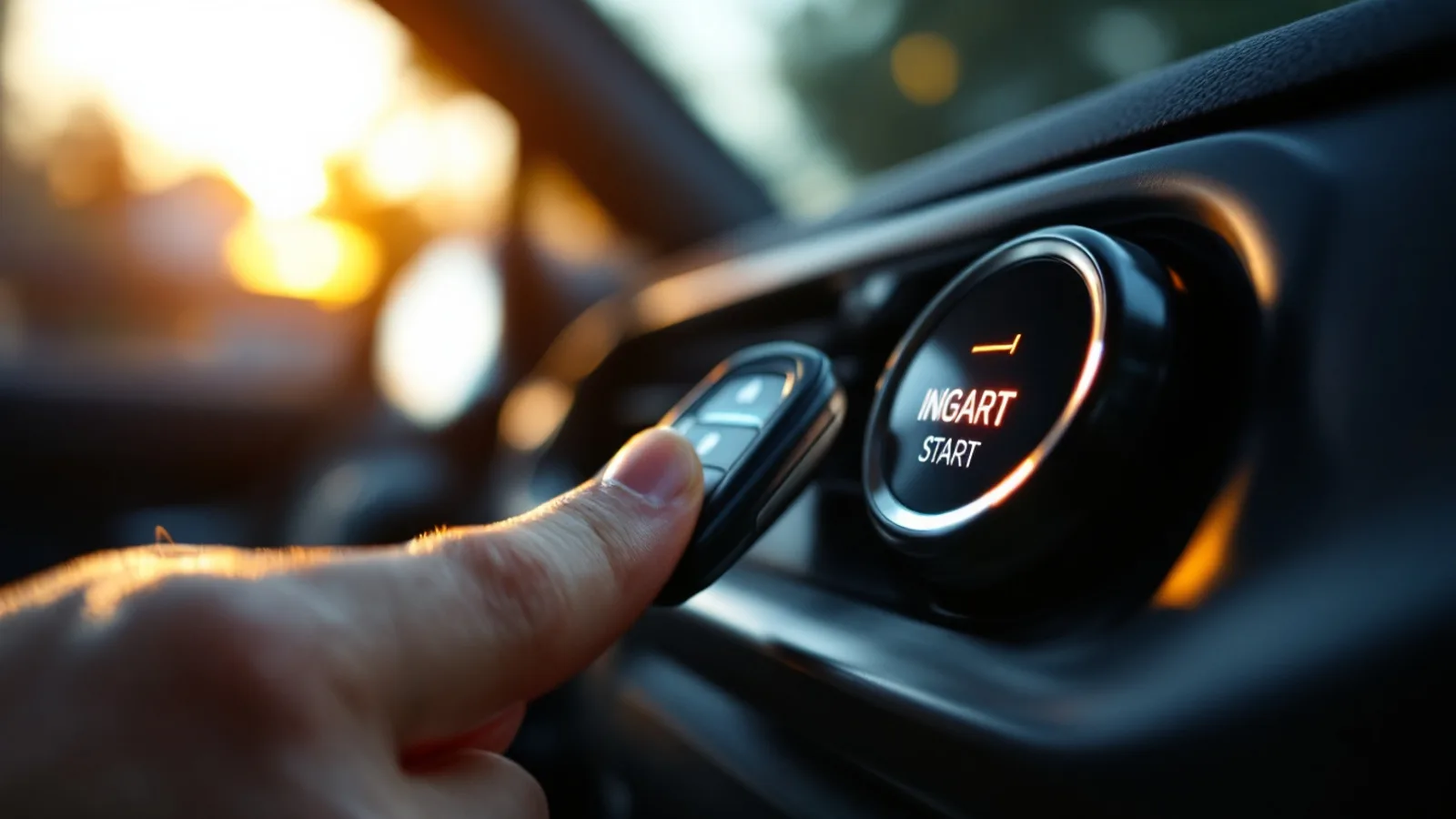
Here's the trick that gets you out of a parking lot right now, even with a fully dead fob battery: most push-button vehicles let you start the car by holding the fob directly against the start button. Manufacturers designed a backup near-field method into the system precisely for a dead fob. The exact motion varies by make — some want you to touch the fob to the button, some to a marked spot on the steering column, some ask you to press the button with the fob — but the principle is universal: the car can read the fob's chip at very close range even when the radio battery is dead.
The steps most vehicles follow: press the brake, hold the fob flat against the start button (or the labeled sensor area), and press start while the fob is touching it. Your owner's manual shows the precise location under a heading like "starting the engine with a discharged key battery." This is worth knowing before you ever need it, because it turns a dead-fob emergency into a minor inconvenience. Once you're running, drive straight to buy a coin-cell battery. If the backup method works, the problem was simply the fob battery — confirmed.
Cause Two: Dead or Weak 12-Volt Car Battery
If the backup-start trick doesn't work either, and especially if you also notice dim interior lights, a slow-cranking or silent engine, or nothing at all when you press start, the culprit may be the car's main 12-volt battery rather than the fob. The push-button system, the immobilizer, and the dashboard all need adequate voltage to operate. A depleted car battery can leave the whole starting system unresponsive, and a marginal one can cause intermittent "won't recognize key" behavior that comes and goes.
This is a car-battery problem, not a key problem — a jump-start or a battery replacement is the fix, and any roadside-assistance provider or auto shop can handle it. Per AAA's roadside and battery guidance, the 12-volt battery is one of the most common causes of a no-start, especially in Texas summers when heat shortens battery life. That seasonal pattern hits the fob itself too, which we cover in summer heat key fob failures. If a jump gets you running normally, the key system was never the issue. It's worth ruling this out before calling a locksmith, because a locksmith can't fix a dead car battery.
Cause Three: Fob Too Far, or Signal Interference
Smart keys have a limited detection range, and occasionally the car simply isn't seeing a perfectly good fob. Common culprits: the fob is in a bag or console pocket shielded from the sensor, it's near your phone or a wireless charger causing radio interference, or it's a metallic environment that blocks the signal. Some owners who keep their fob in a signal-blocking pouch (to prevent relay theft) forget to remove it before trying to start.
Try holding the fob directly next to the start button, remove any RFID-blocking pouch, and move your phone away from the fob. If the car recognizes the key once it's close, the fob and the car are both fine — it was a range or interference issue. This is the cheapest "fix" of all because nothing is actually broken.
Cause Four: Faulty Start Button or Wiring
Less common, but real: the push-button switch itself can fail. Buttons are mechanical parts that see thousands of presses, and a worn or stuck switch may respond intermittently or not at all — even when the key is recognized and the battery is fine. Signs pointing here include a button that feels mushy, sticks, or works only with a hard press, while the dashboard confirms the key is detected.
This is a component repair rather than a key job. A diagnostic scan confirms whether the car sees the key (which points to the button) or doesn't (which points to the key or immobilizer). Distinguishing the two is exactly why an on-site diagnosis is valuable before parts get thrown at the problem.
Cause Five: Antenna, Immobilizer, or Module Fault
At the deeper end, the fault can lie in the systems that read and validate the key: the antenna coil around the start button or ignition that energizes and reads the fob, or the immobilizer/smart-key control module that authenticates it. When one of these fails, the car may show a persistent "key not detected" even with a known-good fob and a fresh battery, and the backup-start trick won't help because the reader itself is the problem.
This is where honest expectations matter: a genuine module or antenna fault needs diagnostics, and it's not a two-minute fix. A qualified technician connects to the OBD-II port, reads the fault codes, and determines whether the issue is the antenna, the module, or a wiring fault. Our no-key-detected and immobilizer issues service is built for exactly this diagnosis, and our module programming and repair service handles the module-level repairs and reprogramming when that's what the scan reveals. These are the least common causes on the list — which is why you should rule out the cheap ones first — but they're real, and pretending every no-start is a $3 battery would be dishonest.
Diagnosing in Order: A Quick Checklist
Work these in sequence and you'll usually identify the problem before spending real money:
- Try the backup-start trick — hold the fob against the start button and press. If it starts, the fob battery is dead. Replace it.
- Swap the fob's coin-cell battery — a couple of dollars, two minutes. Resolves the most common case outright.
- Check the car's 12-volt battery — dim lights, slow crank, or a dead dash point here. Jump-start to confirm.
- Remove interference — take the fob out of any blocking pouch, move your phone away, hold the fob close.
- Note whether the dash says "key detected" — if yes and it still won't start, suspect the button; if no, suspect the key, antenna, or immobilizer.
- Call for diagnostics if the above don't resolve it — a scan tells you whether you need a new key or a module repair.
Most Dallas drivers never get past step two. The ones who do need professional help, and that's when knowing the real pricing protects you.
What It Costs If You Do Need a Key or Repair
Here's the honest 2026 Dallas pricing, once diagnosis confirms the fob or a module is genuinely the problem:
| Situation | What's involved | Dallas price (2026) |
|---|---|---|
| Fob coin-cell battery | DIY or at any store | A few dollars |
| Replacement smart fob (domestic/Asian) | New fob programmed on-site | $250 – $500 |
| Replacement smart fob (European) | High-security fob + brand tooling | $350 – $600+ |
| All-keys-lost surcharge | No working key exists | +$75 – $250 |
| Immobilizer/module diagnosis & repair | Scan + module programming | Varies by fault; quoted after diagnosis |
| Dealer path (key + programming + tow + queue) | Full dealership route | $700 – $1,100+ all-in |
The pattern to notice: the fix is cheap until an actual electronic component needs replacing. A dead fob battery is dollars; a genuinely failed smart fob is $250 to $500 domestic or $350 to $600+ European; and all-keys-lost adds $75 to $250 because the technician has to register a new key with no existing key to authenticate against. A reputable locksmith quotes flat-rate after confirming which scenario you're in — and if it's just a battery, an honest one tells you so. For fob replacement and reprogramming specifically, our key fob programming service covers the on-site process across every make.
We run this service throughout the metro — Dallas, Plano, Frisco, Richardson, and Addison — and answer 24/7, because a no-start rarely happens at a convenient hour.
When to Call a Professional
Call a locksmith once you've ruled out the two cheap causes — the fob battery and the car battery — and the car still won't recognize the key, or the dashboard shows a persistent immobilizer or "key not detected" warning that a fresh fob battery didn't clear. Call immediately, without troubleshooting, if you've genuinely lost the fob entirely (that's an all-keys-lost job) or if the car is stranded somewhere unsafe. An on-site technician diagnoses whether you need a new key, a button, or a module repair, and quotes accordingly — no tow to a dealership, no multi-day queue.
And once more, because it matters most: a person or pet locked inside means 911 first. Locksmith service is for the key and start-system problem, not for an occupancy emergency.
Frequently Asked Questions
Q: Why is my push-button start not working all of a sudden in Dallas? A: The most common reason by far is a dead battery inside the key fob, which stops it from broadcasting to the car and typically shows a "key not detected" message. Replace the fob's coin-cell battery for a couple of dollars first, and use the backup-start trick of holding the fob against the start button to get moving immediately while you confirm it.
Q: How do I start my car if the key fob battery is dead? A: Hold the fob directly against the push-button start, or against the labeled sensor spot on the steering column, then press the brake and press start while the fob is touching it. Most push-button vehicles include this near-field backup method for exactly a dead fob battery, and your owner's manual shows the precise location under starting with a discharged key.
Q: How much does a replacement smart fob cost if mine has failed in Dallas? A: A replacement smart proximity fob runs $250 to $500 for domestic and Asian vehicles and $350 to $600+ for European makes, programmed on-site, and all-keys-lost adds $75 to $250 when no working key exists. A dead fob battery, by contrast, costs only a few dollars, so confirm the fob is truly failed before paying for a replacement.
Q: The dash says "key not detected" but the battery is fresh. What now? A: When a fresh fob battery does not clear a persistent "key not detected" message, the fault has likely moved to the reader side, meaning the antenna coil, the immobilizer, or the smart-key module rather than the key itself. That needs an OBD-II diagnostic scan to pinpoint, and the repair is quoted after diagnosis rather than being a simple flat-rate key swap.
Q: Could my push-button start problem just be the car battery? A: Yes, a dead or weak 12-volt car battery can leave the entire push-button start system unresponsive, especially in Texas summer heat, and it often comes with dim interior lights or a slow crank. A jump-start confirms it, and if the car then runs normally the key system was never the issue, so rule this out before calling a locksmith who cannot fix a car battery.
Q: My child is locked inside and the car won't start. Who do I call? A: Call 911 immediately, because a child or pet locked in a vehicle is an emergency that the fire department and police are equipped to resolve at no cost and without delay. A locksmith is the right call for a key or start-system fault, but never wait on one when a person or animal is trapped inside, particularly in Texas heat.
The Bottom Line
A push-button start that won't work is usually a small, cheap problem wearing a scary disguise. Run the checklist: try the backup-start trick, swap the fob battery, check the car battery, clear any interference. Most Dallas drivers solve it in those first steps for a few dollars. If it turns out to be a genuinely failed fob ($250 to $500 domestic, $350 to $600+ European, plus $75 to $250 for all-keys-lost) or a module fault that needs diagnostics, now you know what fair pricing looks like — and you know to rule out the free fixes first.
Call (469) 896-4128 if the cheap fixes don't solve it — Dallas Locksmith Pros answers 24/7, diagnoses on-site, and quotes flat-rate before any work. And if someone is locked inside, call 911 first, every time.
Related articles
Dead Key Fob Battery vs. No-Start: What's Wrong in Dallas Heat
2026 Dallas guide: dead key fob battery vs. real no-start immobilizer fault. Coin-cell fix, backup start method, and $85-$500 repair pricing.
Read moreYour Car Only Starts When You Hold the Fob Against the Start Button (Dallas, 2026)
As of October 2026, this symptom has four causes in Dallas costing $5 to $600+. It is a warning, not a workaround — here is how to tell which one you have.
Read moreLexus RX and ES No-Start in Dallas: Immobilizer Fault, Key Detection, or Just a Flat Battery?
As of August 2026, most Lexus RX and ES no-start calls in Dallas are not immobilizer failures. The correct triage order, and what diagnosis costs.
Read moreNeed a Dallas locksmith right now?
Licensed mobile automotive locksmith. Same-day response across DFW.
Call (469) 896-4128