
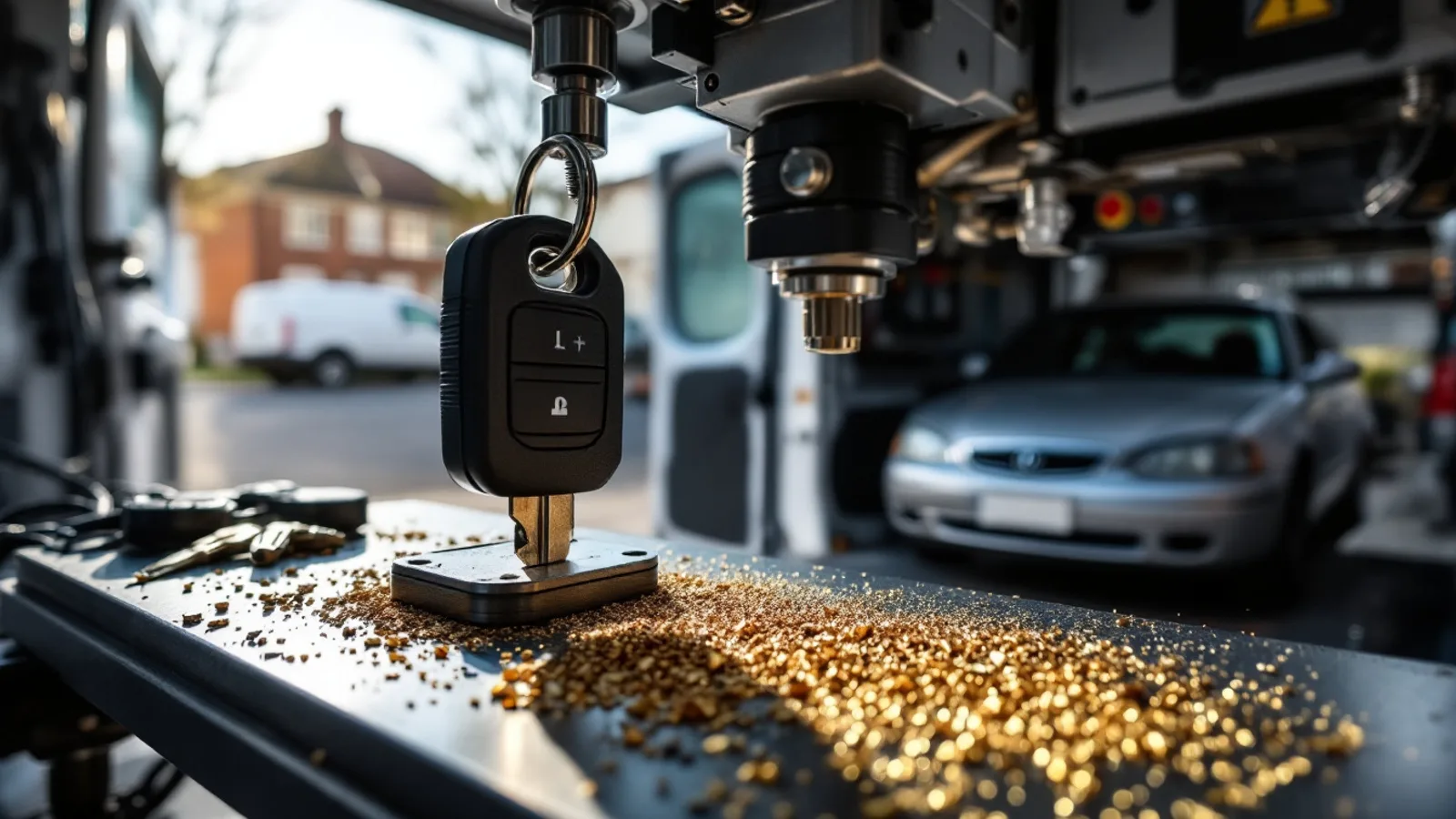
Toyota Camry & Corolla All Keys Lost in Dallas: The G-Chip and H-Chip Split
As of August 2026, a Camry or Corolla all-keys-lost in Dallas runs $195-$650, depending on whether the car is a turn-key transponder or a push-button smart key.
The Two Most Common Lost-Key Calls in Dallas Are the Same Car Twice
There is no mystery about why the Camry and the Corolla dominate our all-keys-lost board. They are simply everywhere. Any apartment lot in Richardson, any school pickup line in Garland, is a rolling census of the two best-selling nameplates in North Texas, and at those numbers the ordinary rate of lost keys produces an extraordinary volume of calls.
What surprises people is that "Camry" and "Corolla" are not one job. They are two jobs wearing the same badge, and which one you have depends on a single question: does your car start with a key you turn, or a button you press? That answer determines the tooling, the procedure, the time on site, and roughly half the price.
As of August 2026, an all-keys-lost recovery on a turn-key transponder Camry or Corolla in Dallas runs $195 to $450 — the key at $120 to $200 plus the $75 to $250 recovery add-on. A push-button smart-key car runs $325 to $650 — a proximity fob at $250 to $400 plus the same add-on. Both routes happen in your parking spot. Neither requires a flatbed. Call (469) 896-4128 with your VIN and model year and we will tell you which car you own before anyone is dispatched.
Quick Answer
Yes, a properly equipped auto locksmith in Dallas can recover a Camry or Corolla with every key gone, on-site, on effectively every model year from 2007 forward. Budget $195 to $450 on a turn-key transponder car and $325 to $650 on a push-button smart-key car, against a dealer path that commonly lands several hundred dollars higher once a tow and shop labor at $150 to $220 per hour are stacked on top of the parts. Proof of ownership — photo ID plus registration or title — is mandatory before any key is generated.
Toyota All-Keys-Lost Pricing in Dallas (2026)
| Scenario | Typical vehicles | Dallas price range (2026) |
|---|---|---|
| Transponder chip key, cut and programmed, working key present | Corolla 2009-2013, Camry 2007-2011, Tacoma 2005-2015 | $120 – $200 |
| Remote head key, working key present | Camry 2012-2017, Corolla 2014-2019, Highlander 2008-2013 | $160 – $280 |
| Smart proximity key, working key present | Camry 2018-present, RAV4 2019-present, Highlander 2014-present | $250 – $400 |
| All keys lost, transponder car | Older Corolla, Camry, Tacoma | $195 – $450 |
| All keys lost, remote head key car | Mid-generation Camry, Corolla, Highlander | $235 – $530 |
| All keys lost, smart key car | Current Camry, RAV4, Tundra, 4Runner | $325 – $650 |
| Immobilizer or Smart Key ECU relearn, no new key | Any Toyota | $120 – $280 |
| Ignition cylinder service, blade-key models | Turn-key Camry, Corolla, Tacoma | $250 – $350 |
| Lockout entry, keys visible inside | Any Toyota | $85 – $200 day / $125 – $275 after-hours |
The add-on is not a surcharge for urgency. The section below explains exactly what extra work it buys.
How Toyota's Immobilizer Actually Works
The turn-key generation: a transponder and an antenna ring
On a Camry or Corolla you start with a physical key, there is a coil of wire wrapped around the ignition lock cylinder. Insert the key, and that antenna ring energizes a passive chip embedded in the plastic head. The chip answers with an identity. A transponder ECU checks that identity against a stored list and, if it matches, releases the engine ECU to allow fuel and spark.
That is the whole security model on these cars, and it has two practical consequences. First, a blade cut at a hardware kiosk turns the lock and does nothing else — the doors work, the steering unlocks, the engine cranks and never catches. Second, the list of authorized identities is what a technician has to reach and rewrite, which is a data operation, not a cutting operation.
G-chip versus H-chip: the honest distinction
Toyota did not use one transponder generation across the entire run. The earlier cars carry what the trade calls a G-chip. Later cars moved to an H-chip, and that was a genuine security generation change, not a part-number refresh.
Here is the part worth being straight about: the difference does not usually change whether an all-keys-lost is possible. It changes how long it takes. On a G-chip car, establishing access with no trusted key present is a comparatively short procedure. On an H-chip car, the same operation involves a longer authenticated sequence, and the vehicle enforces waiting periods that no tool skips. A technician who tells you an H-chip Corolla is a fifteen-minute job either has not done one or is not telling you the truth.
That extra time is the single largest driver of the recovery add-on on later cars, and it is why we ask for the model year on the phone rather than after arrival.
The push-button generation: Smart Key ECU and antenna coverage
Push-button Camrys, RAV4s, Highlanders and Tundras carry a Smart Key ECU alongside the transponder and engine controllers. The fob is no longer read by a coil at the ignition. Instead, a set of antennas around the cabin and near the doors establishes where the fob is, and the Smart Key ECU decides whether a start is permitted from that position.
This is why smart-key faults look so different from transponder faults. A dead coin cell inside a proximity fob usually produces "Key Not Detected" rather than a no-crank, and most Toyotas of this era still allow a backup start by holding the fob against the start button so the system can read it inductively. An owner who knows that trick avoids a tow. An owner who does not assumes the car is dead.
Techstream and what factory tooling actually represents
The manufacturer diagnostic platform here is Toyota Techstream, and it is where the factory's key registration and immobilizer relearn routines are defined. Independent tooling that legitimately reaches those same procedures is what makes mobile recovery possible on a car most owners assume is dealer-only. Where that reach genuinely stops is covered further down. The deeper controller work sits on our Toyota ECU and immobilizer programming page.
Common Toyota Problems We See
Camry: the second key that quietly disappeared
The Camry is the archetypal one-key used car. A 2014 sedan on its third owner very often has exactly one remote head key, and nobody involved in any of those transactions thought about the spare. That car has been one bad afternoon away from a full recovery for years. We add the second key for $160 to $280; the recovery costs two to three times that. The math has never been complicated.
Corolla: the transponder key that stops starting the car
A Corolla owner describes a key that used to work and now needs several tries. This is rarely the chip. Chips do not degrade gradually — they answer or they do not. What degrades is either the blade, worn down by a decade of turning wafers, or the antenna ring's connection at the lock cylinder. Both are diagnosable in minutes and neither requires a new key to be programmed first.
RAV4 and Highlander: smart key not detected
The most common smart-key complaint is a fob the car has stopped seeing. Order of causes, by frequency: dead coin cell, then a fob that has physically failed from a washing-machine trip, then an antenna or Smart Key ECU fault. Only the last of those is expensive, and it prices as a relearn or module diagnosis at $120 to $280 rather than as a key job. Diagnosing before selling anybody a fob is basic diligence. Our key fob programming page covers the diagnostic-first approach.
Tacoma and Tundra: fob buttons dead, key still starts
A truck key whose blade and chip work perfectly while the lock and unlock buttons do nothing is a remote-function fault, not an immobilizer fault. These are two separate radio conversations sharing one plastic housing. The fix is often a battery or a re-sync, occasionally a fob replacement, and never a full recovery. We wrote the spare-key case for these trucks separately in our Tacoma and Tundra spare key guide.
4Runner: immobilizer fault after a battery change
Disconnect a 12V battery on a 4Runner or Highlander and you can come back to warning lamps, a fob that behaves oddly, and an intermittent no-start. That is usually a synchronization issue rather than a lost credential, and it prices as an immobilizer relearn, not a key replacement. Weak voltage also fakes security faults convincingly, which is why nothing gets diagnosed on a marginal battery.
Spare Key Versus All Keys Lost: Why the Gap Is So Wide
Adding a spare works with the car's cooperation
When a working key is present, the vehicle already trusts something. The technician presents that credential, the system opens a registration window, and a new identity is appended to the authorized list. On most Toyotas this is a short, well-defined routine, which is why a Camry spare is $160 to $280 and takes a fraction of an hour.
Recovery works against the car's design
With every key gone there is nothing trusted to present. Security access has to be established legitimately, with the vehicle engineered to make that difficult, then identities generated from nothing, registered, and the engine controller confirmed to agree. On H-chip cars the enforced waiting periods add real minutes that no amount of skill removes. That difference is the entire content of the $75 to $250 add-on. It is not a premium for calling at midnight.
What happens to the missing keys
As new keys are registered during a recovery, the lost credentials are invalidated. A key that later resurfaces, or one that was taken rather than lost, will no longer start the car. Owners rarely think about that until they consider where the key might actually be. Adding a spare does the opposite: your existing key stays fully active alongside the new one. Our spare car key page makes the preventative case in full.
The Honest Boundary on Toyota Recoveries
Proof of ownership is mandatory, without exception. Photo ID plus registration or title, every single all-keys-lost call, regardless of how urgent it sounds or how the request arrives. Manufacturing a working key for a car from nothing is precisely the capability an immobilizer exists to restrict, and the verification step is consistent with NHTSA's vehicle theft-prevention guidance that the whole system was built around. Any locksmith who skips it is telling you something about how they operate.
A physically failed Smart Key ECU or transponder ECU is a different job. Replacing a controller and binding a replacement is not key work. Some of those cases are serviceable in the field and some genuinely belong at a franchise dealer, and we say which on the phone rather than after we arrive.
The newest model years get VIN-verified first. Toyota, like every manufacturer, tightens security access on current-generation vehicles. Most remain fully serviceable in the field. We check by VIN before dispatching, because the alternative is a technician discovering a limit in your driveway at your expense.
Nobody should quote your car without knowing the model year. A 2010 Corolla and a 2022 Corolla share a name and almost nothing else that matters here. A flat quote given without that question is a guess.
What a Dallas Toyota All-Keys-Lost Call Looks Like
- Phone triage with the VIN and model year. Turn-key or push-button, chip generation, feasibility and a flat quote before a truck moves.
- Ownership verification on arrival. Photo ID plus registration or title, every time, no exceptions.
- Non-destructive entry if the car is also locked — no drilled cylinders, no compromised glass, no damaged trim.
- Battery and voltage check. A weak 12V produces convincing imitations of a security fault, and nothing gets diagnosed on bad voltage.
- Blade cut to the VIN on turn-key and remote head key cars, so the mechanical side works in the doors and the ignition.
- Security access and key registration, including the vehicle's own enforced wait sequence on later chip generations.
- Verification before we leave — engine start, remote lock and unlock at range, passive detection at each door on smart-key cars, trunk release, and the emergency blade physically tested in the driver's door.
We run this across Dallas, Richardson, Garland, Plano and Carrollton, plus the rest of the metroplex, at any hour. The full make-specific capability is on our Toyota all keys lost page, the general recovery service on lost car keys, and the model-by-model breakdown on our Toyota brand page. The luxury division runs closely related architecture, which we covered in our guide to Lexus RX and ES immobilizer no-starts.
Frequently Asked Questions
Q: Can an auto locksmith in Dallas make a Toyota key with no key at all? A: Yes, on effectively every Camry and Corolla from 2007 forward, and on the RAV4, Tacoma, Tundra, Highlander and 4Runner across their modern runs. With nothing trusted present the technician establishes security access, cuts the blade to your VIN where the car uses one, generates and registers new key identities, and confirms the engine controller accepts the start. It all happens where the car sits. Photo ID and registration or title are required first, without exception.
Q: How much does a Camry or Corolla all-keys-lost cost in Dallas? A: Budget $195 to $450 on a turn-key transponder car — the key at $120 to $200 plus a $75 to $250 recovery add-on. A push-button smart-key Camry or RAV4 runs $325 to $650, with the proximity fob at $250 to $400 plus the same add-on. Remote head key cars land in between at $235 to $530. All three sit below the dealer route once a tow and shop labor at $150 to $220 an hour are added on top of parts.
Q: What is the difference between a G-chip and an H-chip Toyota key? A: They are two transponder security generations, with the H-chip arriving on later model years as a genuine step up rather than a part revision. For an owner the practical difference is time, not feasibility: recovery on an H-chip car involves a longer authenticated sequence and vehicle-enforced waiting periods that no tool bypasses. That extra time is the main reason the all-keys-lost add-on sits higher on newer cars than on older ones.
Q: My Toyota cranks but will not start after I changed the battery. Do I need a new key? A: Usually no. A 12V disconnect can leave the immobilizer and the fob out of sync, which produces warning lamps and an intermittent no-start that looks exactly like a key failure. That resolves as an immobilizer or Smart Key ECU relearn at $120 to $280, with no new key purchased. Weak voltage also imitates security faults convincingly, so the battery gets checked before anything else is diagnosed or sold.
Q: My smart key is not detected. Can I still start the car? A: Often yes, and it is worth trying before calling anyone. Most push-button Toyotas allow a backup start by holding the fob physically against the start button, which lets the system read it inductively when the coin cell is too weak for the radio side. If that works, you have a battery, not a fob failure, and fob diagnosis with battery service runs $40 to $95. If it does not, the fob or an antenna is the likely cause.
Q: Why does adding a spare Toyota key cost so much less than a recovery? A: Because a spare works with the car's cooperation and a recovery works against its design. With a working key present, the vehicle opens a registration window and the new key is appended to a list it already maintains. With every key gone there is nothing trusted to present, so security access must be established from nothing and the later chip generations enforce their own waiting periods. A Camry spare at $160 to $280 is genuinely a different procedure from a $325 to $650 recovery.
The Bottom Line
A Camry or Corolla with no keys left is not waiting on a key cutter. It is waiting on someone who can reach a transponder or Smart Key ECU with nothing trusted in hand, write new identities into a list the car defends, and get the engine controller to agree afterward. On a turn-key car that is $195 to $450 in your parking spot. On a push-button car it is $325 to $650. Neither needs a flatbed, and both are cheaper than the dealer path once towing and hourly labor are counted. Have your VIN and model year ready and call (469) 896-4128. Dallas Locksmith Pros answers 24/7, verifies ownership on every recovery, and quotes flat-rate before anyone is dispatched.
Written by the Dallas Locksmith Pros mobile automotive team, serving Toyota owners across Dallas and the surrounding metroplex 24/7.
Related articles
Maserati Grecale & MC20 Spare Key in Dallas (2026): What It Takes and What It Costs
As of September 2026, a spare key for a Grecale or MC20 in Dallas runs $350-$600+ while a working key exists. After that, the price and the wait both change.
Read moreMaserati Key Replacement Cost in Dallas (2026): The Six-Figure Badge With a Chrysler-Family Key
As of August 2026, a Maserati key in Dallas runs $350-$850+. The badge does not set the price — which body-security family your car belongs to does.
Read moreAcura MDX & RDX Spare Key in Dallas: The Cheapest Key You Will Ever Buy Is the Second One
As of August 2026, an Acura MDX or RDX spare smart fob in Dallas is $250-$500. Losing the last one adds $75-$250 and a much longer visit.
Read moreNeed a Dallas locksmith right now?
Licensed mobile automotive locksmith. Same-day response across DFW.
Call (469) 896-4128