
Volkswagen MQB All Keys Lost in Dallas: Immobilizer, Cluster & Component Protection
As of July 2026, VW MQB all-keys-lost immobilizer work in Dallas runs $350-$600+ plus a $75-$250 surcharge. Cluster, immo-5 and Component Protection explained.
The Atlas That Cranks Forever and Never Fires
A Volkswagen with no key left in the world does not behave like a dead car. The doors still unlock with the blade, the dash still lights up, the starter still spins the engine happily. It just never fires — because somewhere between the instrument cluster and the engine control unit, a conversation is failing, and the engine computer has been told, politely and permanently, not to deliver fuel. As of July 2026, resolving that on an MQB-platform Volkswagen in Dallas runs $350 to $600+ for the key itself, with an all-keys-lost surcharge of roughly $75 to $250 on top, because this is not a key job with an immobilizer footnote. It is an immobilizer job that happens to end with a key.
That distinction is the whole point of this article. On a 2015-and-newer Golf, GTI, Atlas, or Arteon, "all keys lost" is module-level work — closer in nature to computer and module programming than to cutting a spare. It still beats the $700 to $1,100+ all-in dealer path that stacks an OEM key at retail, dealership labor, a flatbed tow, and a service queue, but only when it is done by someone who actually understands what MQB changed.
What MQB Actually Is, and Why It Matters to Your Key
MQB is Volkswagen Group's modular transverse platform, rolled out across the mainstream lineup from roughly 2015 onward. Owners mostly hear about it in the context of shared parts and packaging efficiency. For a locksmith it means something narrower and more consequential: a standardized electrical and security architecture shared across a huge swath of Volkswagen, Audi, and sibling vehicles.
Standardized does not mean simple. MQB arrived alongside a tightened immobilizer generation — commonly discussed in the trade as the immo-5 era — and the security design moved away from the older approach where a determined technician could read a component's stored secret and derive what was needed. The newer generation encrypts and distributes trust differently, ties components to one another more tightly, and layers Component Protection on top of the whole thing.
The practical outcome for a Dallas owner is blunt. Pre-MQB Volkswagens were often approachable jobs. MQB cars require a different class of access, more time, and more honesty about which VINs are in scope. Our Volkswagen brand page lays out that capability picture by model, and the dedicated Volkswagen immobilizer repair service is where these jobs actually get scheduled.
The Instrument Cluster Is the Vault
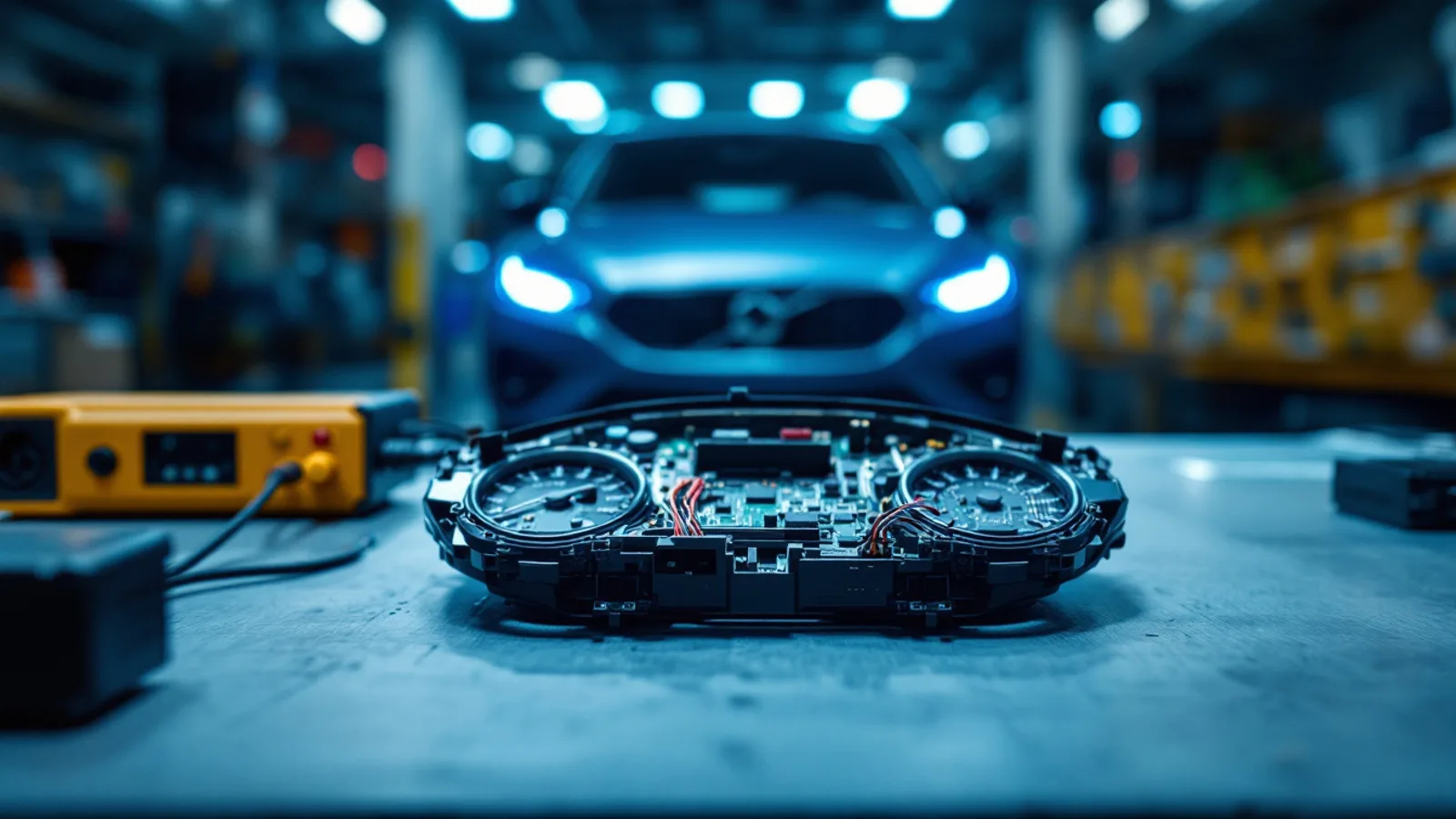
The single most useful fact for a VW owner to carry around is this: on these cars, the instrument cluster hosts the immobilizer. Not a separate black box under the dash. The gauge cluster you look at every day is the component storing the immobilizer identity, holding the roster of authorized keys, and brokering the handshake with the engine control unit.
That has several consequences that surprise people.
A used cluster is not a spare part. Buy a cluster from a wrecked Golf and install it in yours, and you have imported another car's immobilizer identity into your vehicle. It will not simply adopt your keys. This is the number-one reason a "cheap fix" from an online parts listing turns into a much larger bill.
Cluster faults present as key faults. When the cluster's immobilizer function misbehaves, the dashboard tells you the key is not recognized — because from the car's point of view, that is exactly what is happening. The key may be perfect. This symptom family is common enough across German makes that it gets its own diagnostic path on our no key detected and immobilizer issues page, and the same pattern on the Audi side is walked through in our Audi no key detected guide.
All-keys-lost is a cluster operation. Since the roster of valid keys lives there, rebuilding that roster from nothing means working with the cluster — through the diagnostic port with proper security access on serviceable cars, or with the module itself on some.
Component Protection: The Second Lock on the Door
Component Protection is Volkswagen Group's anti-theft measure for modules, not keys — and it is the thing most often misunderstood in a phone quote.
The idea is straightforward. A control module knows which vehicle it belongs to. If a protected module is removed from car A and installed in car B, it recognizes it is in the wrong home and refuses to operate normally until it is properly adapted to the new vehicle. That kills the market for stolen electronics, which is genuinely good for owners. It also means that any work touching a protected module — including some key and cluster scenarios — has to be handled correctly rather than forced.
Two things follow.
First, Component Protection is not something a legitimate shop "removes" casually. It is adapted, through the proper channel, when the work justifies it. A shop that speaks about it as a trivial bypass is telling you something about how it works.
Second, Component Protection is one of the places the newest MQB VINs get gated, which is covered in the honest-boundary section below.
Common Volkswagen Problems We See
Golf and GTI: the key that "just stopped" after a battery change
Enthusiast cars sit. A GTI that spends two weeks parked, gets a jump or a fresh battery, and then throws an immobilizer warning is a call we take constantly. Frequently this is a synchronization issue rather than a lost credential, and it resolves without any all-keys-lost drama. It is worth ruling out before anyone opens a wallet.
Atlas: three-row family car, two keys, both misplaced
The Atlas is the archetypal all-keys-lost VW in Dallas, and not because of any defect. It is a family SUV that gets handed between drivers, and the second key often went missing months before anyone noticed. Owners discover they are down to one key only when that one fails — at which point the cheap fix window has already closed.
Arteon: proximity fob detection at the handle
The Arteon's keyless entry brings the same failure mode every proximity system shares. Detection weakens at the door handles first while the backup near-field start position still works, which reads to the owner like the car is dying and is usually a coin cell. Change the battery before authorizing module work.
Any MQB car: cranks, won't start, no obvious cause
The signature symptom. Strong crank, no fire, dash otherwise normal or showing a key or immobilizer icon. That is the engine control unit declining to run because it has not received a valid authorization from the cluster. It is the same underlying story described in our immobilizer repair walkthrough, and it is the reason a competent shop asks about symptoms rather than jumping straight to cutting a key.
What ODIS-Level Access Means
You will see the term ODIS attached to Volkswagen Group work. It is the manufacturer's own diagnostic platform, and "ODIS-level access" is shorthand for a specific standard of capability: the ability to talk to these modules the way the factory system does, including the credentialed paths that guarded operations require.
Why does that phrase matter to a customer? Because MQB drew a hard line between generic scan tools and real security work. A parts-store code reader can read fault codes on your Golf all day and cannot write a key credential into the cluster. When a shop describes its capability in these terms, it is claiming a tooling and access standard — and it should be willing to tell you plainly which of your specific scenarios sit inside it and which do not.
The corollary matters too: this is credentialed work performed on the owner's own vehicle with proof of ownership, not a bypass. The National Automotive Service Task Force publishes the industry framework governing secure vehicle access for exactly this class of job.
All Keys Lost vs. Adding a Spare on MQB
The gap between these two scenarios is wider on MQB than on almost anything else a Dallas mobile locksmith touches.
Adding a spare with a working key in hand is comparatively contained. The car already trusts a live credential, the cluster is cooperative, and adding a second authorized key is a much shorter operation. On MQB this is the version of the job where the customer says "that was faster than I expected."
All keys lost means the technician has to establish trust from zero against a security design whose entire purpose is to prevent exactly that. There is no working credential to lean on, the cluster has to be worked with directly, Component Protection considerations may enter, and the entire authorized-key roster is rebuilt rather than appended to. That is what the surcharge pays for, and on the newest cars it is also where the capability boundary appears.
The advice writes itself. If you own an MQB Volkswagen and you are down to one key, get the spare now. Our car key replacement page covers the straightforward spare-add, while lost car keys covers the harder version.
VW MQB Immobilizer & Key Cost in Dallas (2026)
| MQB scenario | Typical models | Dallas price range (2026) |
|---|---|---|
| Spare key added, working key exists | Golf, GTI, Jetta, Tiguan, Atlas | $250 – $450 |
| Replacement proximity fob, programmed | Atlas, Arteon, Tiguan | $350 – $600+ |
| All keys lost, serviceable MQB | Golf, GTI, Atlas, Arteon | $450 – $800 (fob band plus $75 – $250 surcharge) |
| Cluster-hosted immobilizer fault, key is fine | Any MQB | Module-level diagnosis and programming |
| Newest MQB VIN / Component Protection gated | Latest model years | OEM online access may be required |
| Dealer path, all-in | Any Volkswagen | Commonly $700 – $1,100+ |
The spare-add row sits lower than the all-keys-lost rows for exactly the reason described above — a live key is the cheapest tool in the technician's kit. The gated row is intentionally unpriced. Module-level security programming is skilled work of the kind the Bureau of Labor Statistics groups among specialized installation-and-repair trades, and what you are buying is tooling, access, and judgment.
The Honest Boundary on the Newest MQB Cars
For a large share of MQB Volkswagens on Dallas roads, a properly equipped specialist performs all-keys-lost recovery on-site, no tow required, with the same end result as the dealership.
But the boundary is real and it is not negotiable by confidence. On a subset of the newest MQB VINs, and in certain Component Protection scenarios, the operation requires manufacturer online access through Volkswagen's secured systems. No independent tool legitimately routes around that. For those cars the honest answer is dealer or manufacturer-authorized service, and a technician confirms your exact setup from the VIN before dispatch rather than discovering it in your driveway.
Be skeptical of any shop that promises same-day all-keys-lost on any Volkswagen regardless of year without asking a single question. On MQB specifically, the year and the VIN are the entire conversation. Owners comparing the two routes across German makes generally will find the tradeoffs laid out in our European car locksmith service overview.
What a Dallas MQB Visit Looks Like
- Phone triage. Model, year, and VIN identify the platform generation and whether your specific scenario is serviceable mobile. This is where a gated VIN gets flagged — before anyone is dispatched.
- Ownership verification. All-keys-lost creates a working credential from nothing, so photo ID plus registration or title is required. That restriction is the immobilizer's entire purpose, consistent with NHTSA's theft-prevention guidance.
- Non-destructive entry if the car is also locked, without damaging the door, handle, or trim.
- Rule out the cheap causes. Coin cell, desynchronization after a battery event, and interference are checked before any module work.
- Cluster-level immobilizer work. Security access established, the authorized-key roster rebuilt, and the new credential written.
- Verification. Start, run, remote functions, and — where fitted — proximity detection at each handle, all confirmed before the technician leaves.
We run this service across Dallas, Plano, Richardson, Garland, and Irving. If you are stranded right now rather than planning ahead, the emergency locksmith line is the faster route, and general scoping questions go through contact.
Frequently Asked Questions
Q: How much does a Volkswagen all-keys-lost job cost in Dallas in 2026? A: An MQB all-keys-lost recovery generally lands between $450 and $800 for a serviceable car, built from the $350 to $600+ fob band plus the $75 to $250 all-keys-lost surcharge that reflects the module-level work involved. Adding a spare while one key still works is meaningfully cheaper. Both routes come in under the $700 to $1,100+ all-in dealer path that adds a tow and a service queue.
Q: Why does my VW's instrument cluster matter for key programming? A: On these Volkswagens the instrument cluster hosts the immobilizer, meaning it stores the immobilizer identity and the roster of authorized keys and brokers the handshake with the engine control unit. That is why a used cluster from another car cannot simply be swapped in, why cluster faults show up on the dash as key faults, and why an all-keys-lost job is fundamentally cluster work rather than key cutting.
Q: What is Volkswagen Component Protection? A: Component Protection is a Volkswagen Group anti-theft measure applied to control modules rather than keys, where a protected module recognizes which vehicle it belongs to and refuses to operate normally if installed in a different car. It kills the resale value of stolen electronics, and it means module-related work has to be adapted properly through the correct channel rather than forced or bypassed.
Q: Can a mobile locksmith recover an MQB Volkswagen with no keys at all? A: Yes for a large share of Golf, GTI, Atlas, Arteon, and related MQB cars, where a properly equipped specialist rebuilds the immobilizer's key roster on-site with no tow needed. The exception is a subset of the newest VINs and certain Component Protection scenarios that require Volkswagen's online access, and an honest shop identifies those from the VIN during phone triage rather than at your curb.
Q: My Golf cranks strongly but will not start. Is that the immobilizer? A: Very likely yes, because a strong crank with no fire is the classic signature of the engine control unit declining to run after failing to receive a valid authorization from the cluster. It can also be a synchronization issue following a battery replacement rather than a genuinely lost credential, which is why a technician should triage symptoms before assuming you need a full all-keys-lost recovery.
Q: I found a used instrument cluster online for my Atlas. Will that fix my immobilizer? A: No, and it will usually make the situation worse and more expensive. A used cluster carries the immobilizer identity of the car it came from, so installing it imports the wrong identity into your vehicle rather than restoring yours, and Component Protection means it will not simply adapt itself. Have the fault properly diagnosed before buying any module from a marketplace listing.
The Bottom Line
MQB tightened Volkswagen's security model in a way that changed what "make me a key" means. The instrument cluster is the vault, Component Protection guards the modules, the immo-5 generation removed the old shortcuts, and all-keys-lost became module-level work rather than a longer version of cutting a spare. That is precisely why the spare you add today, while one key still works, is the single best money a Golf, GTI, Atlas, or Arteon owner can spend. Have your model, year, and VIN ready and call (469) 896-4128 — Dallas Locksmith Pros answers 24/7 and quotes flat-rate before dispatch.
Written by the Dallas Locksmith Pros mobile automotive team, covering Volkswagen immobilizer and module work across Dallas 24/7.
Related articles
Volkswagen Key Replacement Cost in Dallas (2026): Priced by Immobilizer Generation, Not by Model
As of September 2026 a Volkswagen key in Dallas runs $150-$600+, and the immobilizer generation sets the price far more than the badge on the tailgate.
Read moreVolkswagen Passat & Golf Ignition Repair in Dallas: Two Faults Owners Keep Confusing
As of August 2026, VW ignition repair in Dallas runs $250-$350 to re-pin a cylinder. A cluster-hosted immobilizer fault is a different job entirely.
Read moreAudi All-Keys-Lost in Preston Hollow: Immobilizer and Cost Guide
As of July 2026, Audi all-keys-lost in Preston Hollow runs $350-$600+ plus a $75-$250 surcharge. Component protection and ownership verification explained.
Read moreNeed a Dallas locksmith right now?
Licensed mobile automotive locksmith. Same-day response across DFW.
Call (469) 896-4128