
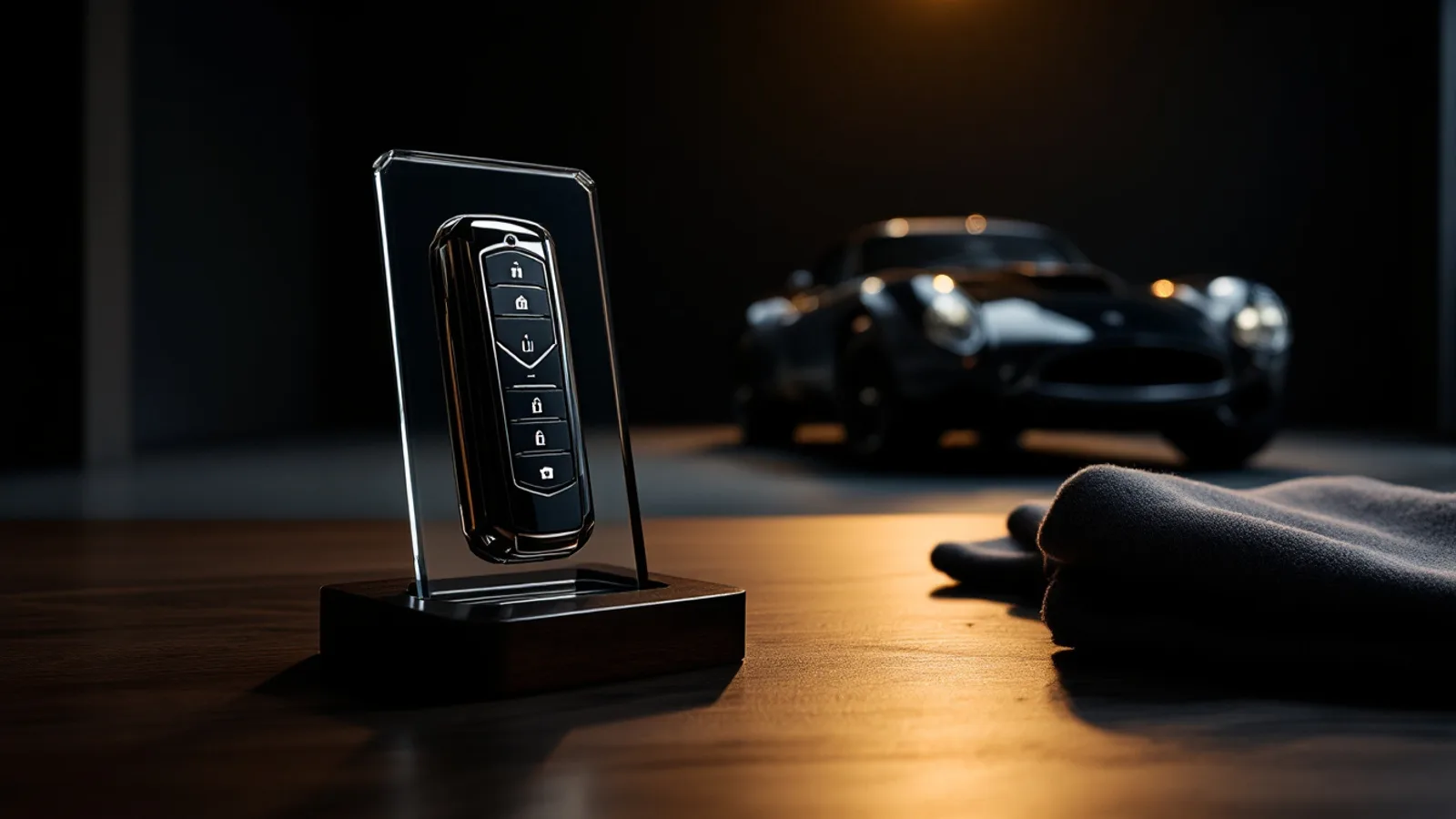
Aston Martin Key Replacement in Dallas: What's Actually Under the Badge
As of August 2026, an Aston Martin key in Dallas runs $350-$600+ on supported VINs, plus $75-$250 all-keys-lost. Two eras, two different jobs.
Quick Answer
As of August 2026, Aston Martin key work in Dallas runs $350 to $600+ on supported VINs, plus $75 to $250 when every key is gone. The era decides the path. Ford-stewardship cars carry Ford-lineage immobilizers and are genuinely tractable for a mobile technician. Mercedes-era cars run Mercedes-family security, where late-generation key programming is dealer-gated. We confirm which one you have from the VIN before dispatch.
The Badge Is Bespoke. The Security Electronics Are Not.
Owners assume an Aston Martin key is an exotic problem because everything else about the car is hand-finished. It is a reasonable assumption and it is wrong, and the reason it is wrong is company history rather than engineering.
Aston Martin has spent the last twenty years borrowing electronics from whoever owned or partnered with it. The immobilizer behind your dashboard is not a boutique one-off — it is a mass-production system from a mass-production parts bin, wrapped in a body worth many times the sum of its modules. Which parts bin depends entirely on when your car was built.
That is the most useful thing an Aston owner in Dallas can know before picking up the phone. It decides whether your key is a driveway job or a flatbed and a dealer appointment, and it is knowable from your VIN in a couple of minutes. Call (469) 896-4128 with the VIN and model year and we will tell you which category you are in before anyone quotes a price.
Aston Martin Key & Fob Pricing in Dallas (2026)
| Job | What it covers | Dallas price range (2026) |
|---|---|---|
| Key or fob on supported VINs | Sourced, programmed to the car, blade cut to code, all functions verified | $350 – $600+ |
| Conventional transponder key (earliest Ford-era cars) | Chipped mechanical key cut and programmed, no proximity hardware | $120 – $200 |
| All keys lost (supported VINs only) | Add-on when nothing working exists and key data is rebuilt | add $75 – $250 |
| Immobilizer relearn, no new key | Existing keys re-paired after a battery, module or ignition event | $120 – $280 |
| Fob and glass-key diagnosis, battery service | Not detected, dead remote, intermittent start, dock not reading | $40 – $95 |
| Fob shell swap, electronics transferred | Cracked glass key, worn buttons, snapped emergency blade | $40 – $95 plus the shell |
| Ignition lock cylinder replacement | Worn barrel that binds or will not turn on older cars | $180 – $400 |
| Lockout entry, non-destructive only | Keys shut inside — no drilling, no glass, no pried trim | $85 – $200 day / $125 – $275 after-hours |
| Dealer path, all-in | Key plus programming plus tow plus queue time | $700 – $1,100+ |
One note on that table: some VINs need a manufacturer credential an independent tool cannot legitimately provide. On those cars the dealer is the correct answer, and we say so before you pay anyone anything.
Two Astons, Two Parts Bins
The Ford-stewardship cars: roughly 2005 to 2016
Ford owned Aston Martin for the better part of two decades, and the cars built in that window drew heavily on the Ford corporate parts bin — with Volvo, another Ford property of the same period, contributing to the shared electronics pool. The DB9, the VH-platform V8 and V12 Vantage, the Rapide and the DBS all live here, and the DB7 sits just ahead of them on the same lineage.
Practically, these cars carry PATS-family transponder immobilizers — the same security lineage that shipped in millions of Ford products. Tooling follows volume, so a system that appeared in an enormous number of ordinary vehicles is thoroughly understood by independent equipment. That is why spare keys, worn keys and even many all-keys-lost calls on these VINs are realistic mobile jobs rather than dealer-only exotica.
It is the same family of work described on our Ford PATS key programming page. That sounds like a downgrade to an Aston owner. It is the opposite — it is the reason your key does not cost what the badge suggests.
The modern cars: DB11, DBX, Vantage from 2018
From the DB11 onward, Aston Martin's technical partnership with Mercedes-Benz put Mercedes-family electronics at the heart of the cars — infotainment, switchgear, and critically the ignition and start-authorization security. The DBS Superleggera, the second-generation Vantage and the DBX all sit in this family.
So a modern Aston behaves like a modern Mercedes when it comes to keys. It is not a boutique supercar problem; it is a Mercedes problem, and that is a well-documented one. The mechanics, the failure modes and the diagnostic approach are all covered on our Mercedes key programming page, and the symptom owners actually call about is the one we break down in our guide to Mercedes no key detected.
Here is where honesty matters more than optimism. Late-generation Mercedes-family key programming is effectively dealer-gated, and we do not promise programming or all-keys-lost on those VINs. What genuinely remains in reach on those cars is substantial and worth having: non-destructive lockout entry, fob battery and split-side diagnosis, antenna and range-fault isolation, and a written module-level assessment that shortens the dealer visit when the dealer is the answer.
Which one is in your driveway
Model year first, badge second. The rough dividing line is the DB11's arrival in the middle of the last decade, but rough lines are not good enough to quote against — a late Ford-era car and an early Mercedes-era car can share a model year. We confirm that from the VIN before dispatch. The full model-by-model breakdown sits on the Aston Martin brand page.
The Glass Key Is a Beautiful Object Around Ordinary Logic
The Emotion Control Unit — the sapphire-crystal key of the DB9, DBS, Rapide and VH-era Vantage — is one of the more remarkable objects any carmaker has handed a customer. It is also a wear item.
Inside it is transponder logic of an entirely conventional sort. The theatre is the packaging: a crystal slab you press into a dash dock rather than a key you twist. That packaging is what fails — the crystal cracks, the docking interface ages on both sides, and the internals wear the way any key carried in a pocket for a decade wears.
Two things follow, and both save owners money.
A car that no longer reads its glass key has two possible faults, not one. The key can be dead, or the dock's reader interface can be degraded, and those are very different repairs. Diagnosing which side has failed before anything is replaced is the entire value of the $40 to $95 diagnosis. Treating a dock fault as a dead key is how owners spend the price of a key and fix nothing.
A cracked shell is not a dead key. If the electronics are healthy and the housing is the casualty, the electronics transfer into a replacement shell for $40 to $95 plus the shell. That is a genuinely common outcome on a fifteen-year-old car, and it is worth asking about before anyone quotes you a full replacement.
There is also a blade you have probably never found. Aston Martin conceals a mechanical emergency key cut to the VIN in or alongside the fob. It exists for exactly one scenario: the car's 12V battery is flat, the electronic locks will not respond, and you need the driver's door open before anything else can happen. Locate yours this week, while it is a curiosity rather than an emergency.
The Most Likely Cause Is the Least Exotic One
This is the single most common Aston Martin call we take, and it is not a key failure at all.
An Aston is usually a weekend car. It covers a modest number of miles a year and spends the rest of its life parked in a garage in Preston Hollow or Highland Park under a cover. That schedule produces one predictable failure.
The 12V battery discharges. Modern electronics draw a small parasitic current continuously, and a car that never runs long enough to recharge slowly loses that fight. Then the owner presses the start button after six weeks and gets a warning that the key is not detected — because low system voltage produces an extremely convincing imitation of a security fault. Marginal power scrambles module communication before it fully kills the car, so the symptom you get is the confusing one rather than the obvious one.
The key's coin cell dies on the shelf too. A key sitting in a drawer discharges anyway — a small cell doing a small job for a long time.
The order of investigation saves real money: car battery first, key battery second, antenna third, pairing fourth. Anyone who quotes you an Aston key before checking the first two is guessing with a very expensive wallet. The full pattern is documented in our guide to a dead key fob battery and no start.
The proximity-equipped cars carry the same near-field fallback every modern keyless car has: hold the fob flat against the start button and press, and the backup coil reads the transponder directly with no battery power required. If your car only starts that way, the coil is working and the passive path has failed. That is a diagnosis, and it usually ends at a coin cell.
The permanent fix is unglamorous — a quality battery maintainer on any Aston that sits more than a couple of weeks. It is the cheapest insurance on this page by a wide margin.
Spare Now or Recovery Later — the Math Is Not Close
A spare is an append operation. The car already trusts a credential. A technician authenticates with the key the vehicle accepts, writes an additional identity alongside it, cuts the emergency blade to code, and verifies every function. The security system cooperates throughout because it has already been satisfied.
All keys lost is a rebuild. With nothing trusted present, access has to be established legitimately against a system specifically engineered to refuse exactly that, the stored key data reconstructed rather than extended, and start authorization re-confirmed before a crank becomes a start. That is what the $75 to $250 add-on describes, and it sits on top of the key price rather than replacing it.
For an Aston owner the arithmetic is stark. A spare made today while your existing key works is $350 to $600+. The identical key made after the last one is gone is that band plus the recovery add-on, on a car where the recovery may not be available at all depending on the VIN. On a Ford-era car it is a straightforward decision. On a Mercedes-era car, where late-generation recovery is dealer-gated, making the spare while you still can is the only version of this decision that is fully in your control.
The rebuild does carry one dividend worth naming: reconstructing the key data invalidates the missing key, so a car whose fob vanished at a valet stand stops answering to a credential someone else may be holding.
The Honest Boundaries
Proof of ownership is mandatory on every all-keys-lost call. Photo ID plus current registration or title, verified on arrival, before any programming happens. Creating a working credential for a car from nothing is precisely the capability an immobilizer exists to deny. A locksmith willing to skip that step on your Aston would skip it on someone else's.
Some VINs need a manufacturer credential. On late Mercedes-family security in particular, certain operations sit behind access an aftermarket tool does not legitimately provide. We check that against the VIN before dispatch and route you honestly when the dealer is the answer, rather than discovering it in your driveway at your expense.
We will not promise blanket capability on this brand. Any shop that quotes an Aston Martin key over the phone without asking for the VIN is telling you something about how carefully they work.
A physically failed module is not key work. We diagnose it, document it and say so rather than selling keys that cannot fix it.
Non-destructive entry only. No drilled cylinders, no compromised glass, no pried trim. Swan doors, frameless glass and hand-finished trim punish force, and we do not drill Aston Martin locks. If a child or pet is locked inside a hot car, call 911 first, then call us.
What a Dallas Aston Martin Call Looks Like
- Phone triage with the VIN and model year — era, key type, whether any working key exists, and whether the car has power at all, before a truck moves.
- An honest category answer — Ford-era tractable, Mercedes-era entry-and-diagnosis, or dealer-gated with the reason stated.
- Ownership verification on arrival, on every recovery, every time.
- Power established first, then non-destructive entry if the car is also locked.
- Battery and key-cell checks before anyone discusses programming.
- Full verification — passive detection at both doors, remote functions, the start button, and the emergency blade physically tested.
We work University Park, Southlake, Preston Hollow and Highland Park along with the rest of the metroplex, around the clock. Related exotic work: Bentley and Rolls-Royce key fob service, the Bentley brand page, and Ferrari and Lamborghini key and immobilizer service. Where the money goes on cars like these is broken down in luxury car key cost explained; the rest of our work sits on the European car locksmith page.
Frequently Asked Questions
Q: Can a locksmith make an Aston Martin key in Dallas? A: On the Ford-stewardship cars, frequently yes. The DB7, DB9, VH-platform Vantage and Rapide carry PATS-family Ford-lineage immobilizers that independent tooling supports well, so spares and many all-keys-lost calls are realistic on-site jobs at $350 to $600+. The Mercedes-era cars are different, and we confirm which era your VIN belongs to before dispatch.
Q: How much is an Aston Martin key replacement? A: Budget $350 to $600+ on supported VINs, which covers sourcing the key, programming it to the car, cutting the concealed emergency blade to code, and verifying every function. Add $75 to $250 when nothing working exists and the stored key data has to be rebuilt. The earliest conventional transponder keys sit lower, at $120 to $200.
Q: Is a DB11 or DBX key really dealer-only? A: Late-generation Mercedes-family key programming is effectively dealer-gated, and we will not promise programming or all-keys-lost on those VINs. What we do deliver on those cars is non-destructive lockout entry at $85 to $200, fob diagnosis at $40 to $95, antenna and range-fault isolation, and a written assessment that shortens the dealer visit.
Q: My glass Emotion Control Unit key is not being recognized. Is it dead? A: Not necessarily, and assuming so is how owners overspend. Both the key and its dash dock age, so the fault can sit on either side and the symptoms look identical from the driver seat. A $40 to $95 diagnosis identifies which one failed first. If only the crystal housing is cracked, the electronics often transfer to a new shell for $40 to $95 plus the shell.
Q: My Aston sat for two months and now says the key is not detected. What is wrong? A: Check the car 12V battery before anything else. Low system voltage produces an extremely convincing imitation of a security fault, because marginal power scrambles module communication before it fully kills the car, and a garaged weekend car discharges steadily between drives. That is a $40 to $95 diagnosis rather than a key, and a battery maintainer prevents the whole problem.
Q: Should I make a spare Aston Martin key now? A: Yes, and on this brand the argument is stronger than on most. A spare made while a working key exists is a straightforward append operation the car cooperates with. All keys lost is a rebuild carrying the $75 to $250 add-on, and on late Mercedes-era VINs that recovery may only be available through the dealer at $700 to $1,100+ all-in.
The Bottom Line
An Aston Martin that will not recognize its key is almost never waiting on something bespoke. It is waiting on stable voltage, a fresh coin cell, or a technician who knows whether your VIN carries Ford-lineage security or Mercedes-family security — because that answer, not the badge, decides everything. On supported VINs that happens in your driveway for $350 to $600+, plus $75 to $250 when every key is gone. Where a VIN genuinely requires a manufacturer credential we tell you before anyone drives out. Have your VIN and model year ready and call (469) 896-4128. Dallas Locksmith Pros answers 24/7, verifies ownership on every recovery, and quotes flat-rate before dispatch.
Written by the Dallas Locksmith Pros mobile automotive team, serving Aston Martin owners across Dallas and the surrounding metroplex 24/7.
Related articles
Chevrolet Corvette C7 & C8 Key Replacement in Dallas: The Body Module Decides
As of August 2026, a Corvette C7 or C8 smart proximity fob in Dallas runs $250-$500, plus $75-$250 when every key is gone.
Read moreVolvo XC40 & C40 Recharge Key Replacement in Dallas: The CEM Decides, Not the Fob
As of August 2026, a Volvo XC40 or C40 Recharge key in Dallas runs $350-$600+, and the Central Electronic Module is what actually has to accept it.
Read moreMaserati Quattroporte & GranTurismo Key Programming in Dallas: Italian Body, Familiar Bones
As of August 2026, a Maserati Quattroporte or GranTurismo key in Dallas is $350-$600+ of module work, plus $75-$250 when every fob is gone.
Read moreNeed a Dallas locksmith right now?
Licensed mobile automotive locksmith. Same-day response across DFW.
Call (469) 896-4128