
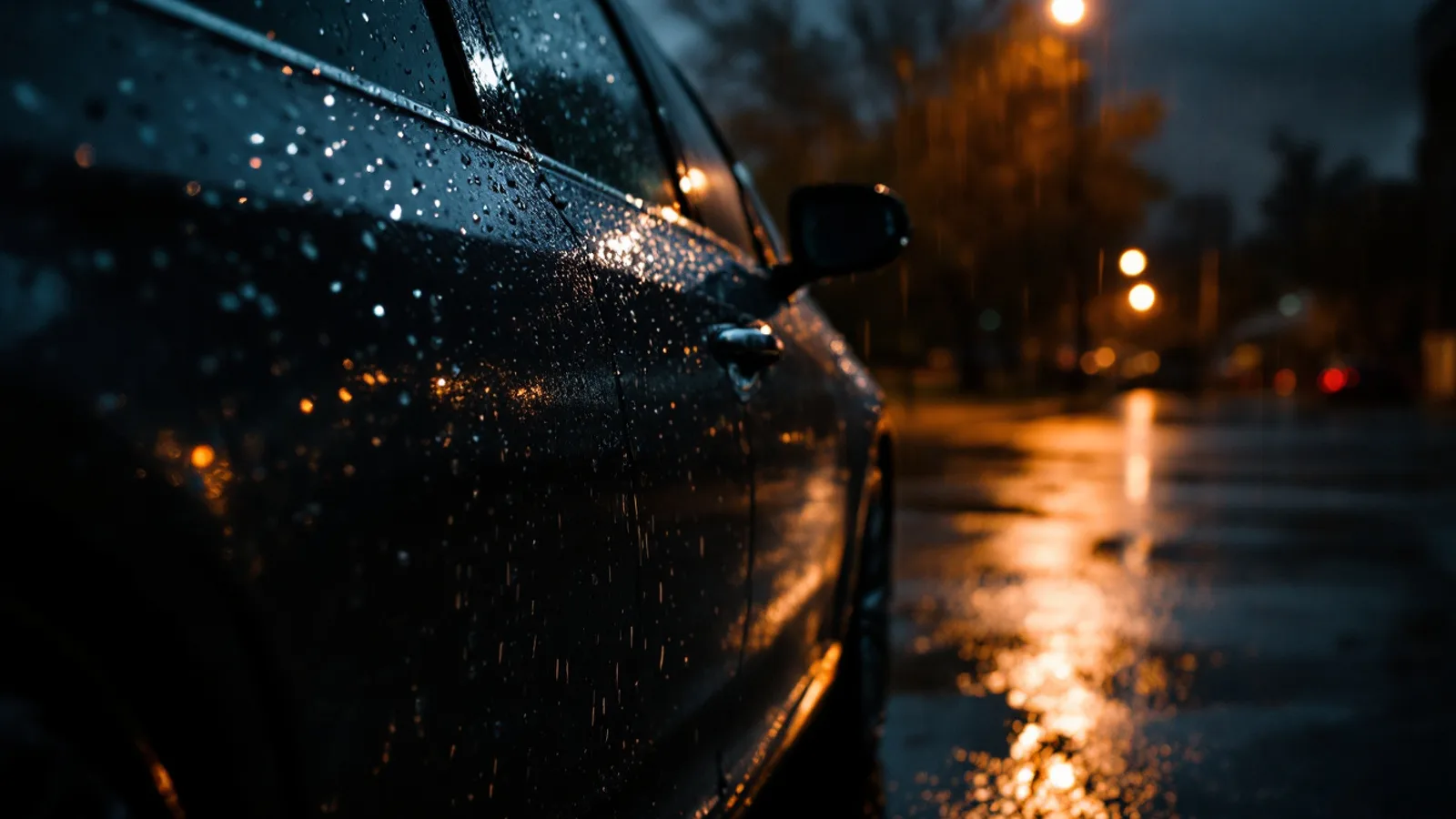
Car Won't Detect the Key After Rain or a Car Wash (Dallas Fix)
As of September 2026: if your Dallas car only says No Key Detected when it's wet, the fault is usually the car, not the fob. How to tell in five minutes.
Quick Answer
As of September 2026: if your car says No Key Detected only when it has been raining or just came out of a car wash, and works fine on dry days, the fault is almost always in the car, not the fob — water in a door-handle antenna, its connector, or a request sensor. A dry fob that works in dry weather is not the problem. Diagnosis in Dallas runs $40 to $95, a handle antenna or sensor repair $150 to $350, and module-level work $250 to $600. Call (469) 896-4128 and mention that it is weather-dependent — that detail changes what a technician brings.
The Symptom, Precisely
The pattern that identifies this fault is narrow, and the narrowness is what makes it diagnosable:
- The car fails to detect the key after rain, a wash, or a humid overnight — and works normally once it dries out.
- It may fail at one door only (very often the driver's) while another door still senses the fob.
- The dash reads No Key Detected, Key Not Found, Smart Key System Malfunction or similar, and pressing the start button does nothing.
- The fob itself is dry and its buttons still lock and unlock the car from a distance.
That last point is the one people skip, and it is the most informative. If the unlock button still works from across the parking lot, the fob's battery and its transmitter are fine. What has stopped working is the car's ability to interrogate the fob at close range — a different system entirely.
Two Different Systems, One Confusing Symptom
Modern push-to-start cars use two separate radio paths, and understanding the split is what separates a $40 diagnosis from a $500 guess.
The button path (RF). When you press unlock, the fob transmits to a receiver inside the car. Long range, one direction, works from fifty feet.
The passive path (LF). When you touch the handle or press start, the car transmits a low-frequency wake-up signal from antennas built into the door handles, the cabin and sometimes the trunk. Your fob hears it, wakes up and answers. Short range, two directions, and it depends on antennas sitting in the wettest, most exposed part of the vehicle.
Water kills the second path while leaving the first untouched — which is exactly the symptom above. A fob that still unlocks by button but cannot be detected at the handle is pointing directly at the car's LF side.
This is also what separates this problem from a fob that got wet itself, where the failure follows the fob to every door and does not clear when the car dries. If you dropped the fob in a puddle or ran it through a wash cycle in a pocket, that page is the one you want. If the fob stayed dry and the car got wet, keep reading.
Where the Water Actually Gets In
Four places, in the order we find them.
The door-handle antenna and its connector. The most common by a wide margin. The LF antenna sits inside the handle assembly, a few millimetres from the outside world, and its connector lives in the door cavity. Door seals age, drain paths clog with dust and pollen, and a car wash pushes water where rain merely trickles. One door failing and the others working is close to a signature for this.
Corroded pins rather than standing water. After enough wet-dry cycles, a connector does not need to be wet to fail — the pins have already oxidised. This is the version that starts as "only when it rains" and gradually becomes "most mornings." If your fault is spreading from wet days to damp ones, it is likely here, and it will not fix itself.
Water tracking to a module. Less common, more serious. Water follows a harness to the body control module or a receiver. Symptoms broaden beyond keys — interior lights, locks, windows behaving oddly — and the job moves into module territory.
A trim or seal disturbed by earlier work. If a window, mirror, door speaker or glass was replaced recently and the fault started afterward, a seal or drain was probably left open. That is a repair, not a coincidence.
Five Minutes of Free Diagnosis
Before anyone is dispatched, this sequence tells you most of what a technician needs to know. Do it in the order given.
1. Does the button still work? Press unlock from ten feet. If the doors respond, the fob is transmitting — skip any thought of a dead battery.
2. Try every door and the trunk. If one handle senses the fob and another does not, you have localised the fault to a handle. Write down which door failed; that single fact can cut the diagnosis in half.
3. Use the backup start. Almost every push-to-start car has a dead-fob procedure — holding the fob against the start button, a marked spot on the column, or a pocket in the console. If the car starts that way, the fob's transponder is healthy and the LF antennas are the problem. Your owner's manual has the exact location for your model.
4. Let it dry and retest. A few hours in a garage, or a dry afternoon. If the fault clears completely, you have confirmed moisture and ruled out the fob. If it doesn't clear, this is not a water fault at all — see car key only works sometimes for the intermittent-contact version.
4b. On a Mercedes, check the generation before anyone mentions a module. The same symptom on a Mercedes gets attributed to the EIS far more often than it should — Mercedes "No Key Detected" in Dallas separates the cheap causes from the expensive ones, and Range Rover no key detected covers the equivalent on JLR.
5. Check for a second fob. If you have a spare and it fails the same way at the same door, the car is confirmed. If the spare works everywhere, the first fob is the problem after all.
Those five steps cost nothing and are the difference between arriving with a diagnosis and arriving with a question.
What It Costs in Dallas
| Work | What it covers | Dallas price (2026) |
|---|---|---|
| Diagnosis | Fault isolated, written finding, path confirmed | $40 – $95 |
| Dry-out and connector service | Water cleared, contacts cleaned and protected | $95 – $200 |
| Door handle antenna or request sensor | Component replaced and verified | $150 – $350 |
| Receiver or antenna module | Module addressed, keys re-verified | $250 – $600 |
| New key or fob, if the fob turns out to be the fault | Cut and programmed | $120 – $500 |
| All keys lost, if the fault masked a dead key | Immobilizer accessed directly | Add $75 – $250 |
Prices as of September 2026 for the Dallas metro, quoted flat before dispatch once the symptom is described.
Where the honest boundary sits: we handle the key, fob, antenna, receiver and immobilizer side of this. If the diagnosis turns out to be a blocked door drain, a failed window seal or body-side water intrusion, that is body-shop work — we will tell you that plainly rather than replacing parts on the key side that were never the fault.
Why Dallas Sees This More Than You'd Expect
Two local factors, neither exotic.
Dallas summers bake door seals. Months of heat above a hundred degrees harden the rubber that keeps water out of a door cavity, and the damage shows up the first time a real storm arrives. Our summer heat and key fob failures page covers the heat side of the same story; this is its autumn sequel.
And the storms here are not gentle. Wind-driven rain reaches places a vertical drizzle never would, which is why a car that survived a wet spring can fail in a single September evening.
The practical consequence: if your car has just started doing this after a big storm, it is not a coincidence, and it is not going to be the last time unless the water path is found.
What to Do Tonight, Before Anyone Comes Out
If you are standing at a car that will not detect the key right now:
- Use the backup start method to get moving — it is designed for exactly this and it is not a workaround you will damage anything with.
- Park under cover if you can. Drying out is diagnosis and mitigation at once.
- Do not spray anything into the handle. Lubricants and water-displacing sprays in an electrical connector make the repair harder and can turn a cleanable contact into a replaceable one.
- Do not start replacing fobs. A fob that unlocks by button is not the fault, and a second fob will fail the same way at the same door.
Then call in the morning with the two facts that matter: which door failed, and whether it cleared when the car dried.
Where We Work
Same-day across the metro — Dallas, Plano, Frisco, Southlake, Coppell and the surrounding cities. Weather-dependent faults are easiest to confirm while the car is still wet, so sooner is genuinely better than later on this one.
Frequently Asked Questions
Why does my car say No Key Detected only when it rains? Because the detection system that reads your fob at the door uses low-frequency antennas built into the handles, and water in a handle or its connector blocks that signal. The fob's unlock button uses a different, longer-range path that water does not affect — which is why the button still works while the car insists there is no key.
Can a car wash break my key fob? It rarely breaks the fob itself if the fob stayed with you. What a wash does is force water into door handles and seals at a pressure ordinary rain never reaches, disabling the car's detection antennas. The fault usually clears as the car dries, then returns with the next wash.
My fob unlocks the doors but the car won't start — is the battery dead? Almost certainly not. A dying fob battery fails the long-range button first, not the short-range detection. If buttons work and detection doesn't, look at the car's antennas rather than the fob's battery.
Will it fix itself when the car dries out? Often, the first few times — and that is exactly the warning. Repeated wet-dry cycles corrode the connector pins, and the fault migrates from "only in heavy rain" to "most damp mornings" to permanent. It is much cheaper to clean and seal a contact than to replace a corroded handle assembly.
How do I start my car in the meantime? Nearly every push-to-start vehicle has a backup procedure that reads the fob at very close range — held against the start button, a marked spot on the steering column, or a pocket in the console. Your owner's manual gives the exact location for your model. It is a designed feature, not a workaround.
How much does this cost to fix in Dallas? Diagnosis is $40 to $95. A dry-out and connector service is $95 to $200, a handle antenna or request sensor $150 to $350, and module-level work $250 to $600. A quote is flat from your VIN once the symptom is described.
The Bottom Line
A car that detects its key perfectly on dry days and not on wet ones has already told you where the fault is. The fob is fine; the car's eyes are wet.
Call (469) 896-4128 and lead with the two details from the five-minute test — which door failed, and whether it cleared when the car dried. That is usually enough for a technician to arrive with the right part on the truck.
Related articles
Push-Button Start Not Working in Dallas? 2026 Fix Guide
2026 Dallas guide: why push-button start won't work. Most fixes are cheap (dead fob battery); a new smart fob runs $250-$500. Backup-start trick inside.
Read moreYour Car Only Starts When You Hold the Fob Against the Start Button (Dallas, 2026)
As of August 2026, this symptom has four causes in Dallas costing $5 to $600+. It is a warning, not a workaround — here is how to tell which one you have.
Read moreYour Key Fob Got Wet: What to Do in the First Ten Minutes (Dallas, 2026)
As of September 2026, a water-damaged key fob in Dallas costs $40-$600+ to resolve. What you do in the first ten minutes decides which end of that you pay.
Read moreNeed a Dallas locksmith right now?
Licensed mobile automotive locksmith. Same-day response across DFW.
Call (469) 896-4128