
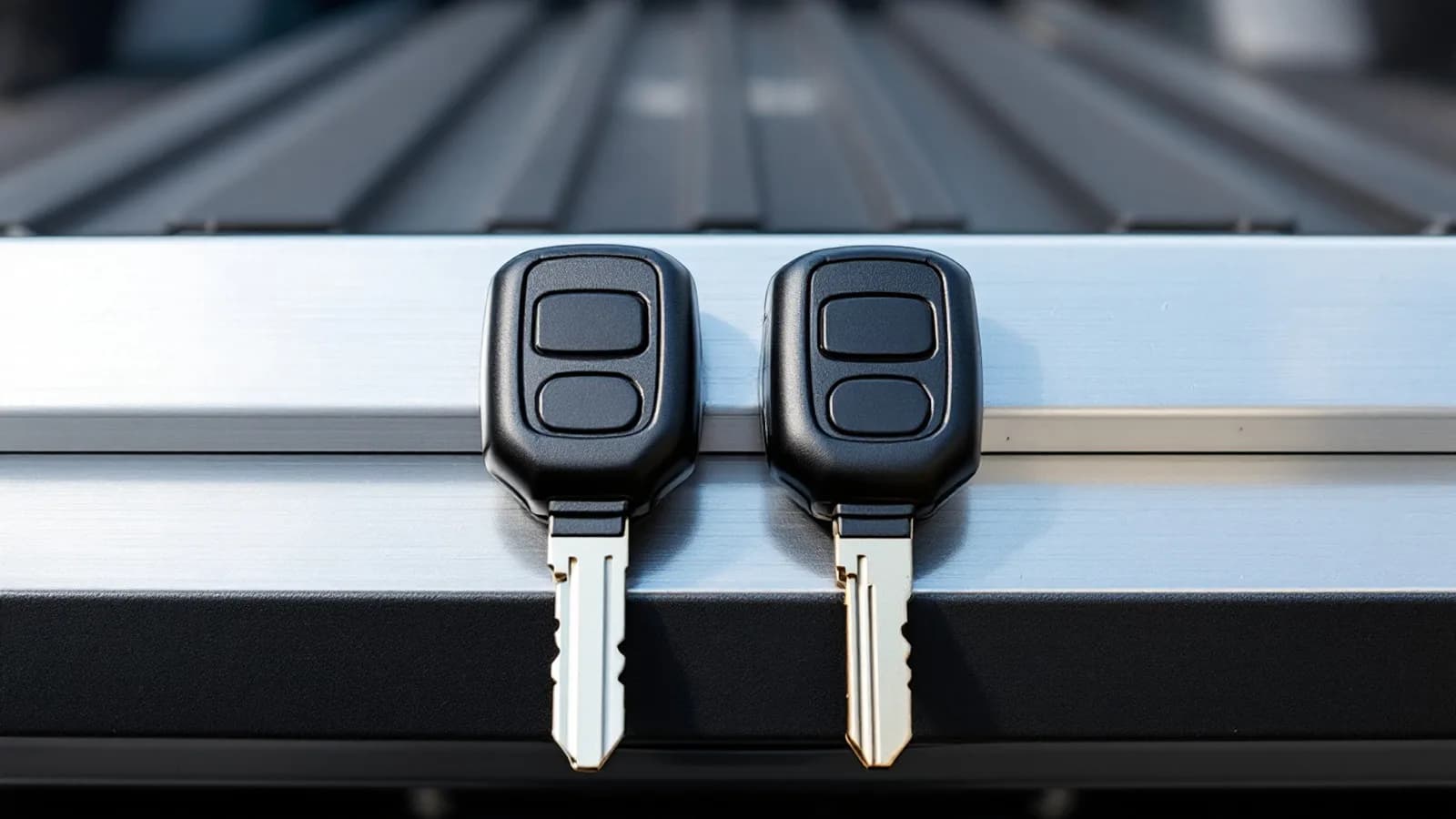
Chevrolet Silverado Spare Key in Dallas: The Cheapest Job We Do, and Why That Matters
As of August 2026, a Silverado spare key in Dallas runs $120-$300 by type. The all-keys-lost version of the same truck costs multiples more.
The Truck Most Likely to Be Running on One Key
Work trucks do not get spare keys. That is not a criticism, it is just how they live. A Silverado gets bought, driven, loaded, lent to a crew member, parked at a jobsite, and at no point in that sequence does anyone stop and think about the second key. Ten years later there is exactly one key in existence for a truck the household genuinely cannot function without.
We see it constantly. The Silverado is, by a wide margin, the vehicle most likely to arrive at a no-start situation with no backup at all, and the reason matters: the gap between a spare and a recovery on this truck is larger than most owners would guess. A spare programmed against a working key is $120 to $300 depending on the key type. The same truck with every key gone runs $195 to $550, because the procedure changes entirely once the vehicle has nothing left to trust.
As of August 2026, a Silverado spare in Dallas is $120 to $200 for a PK3 or PK3+ transponder cut and programmed, $180 to $300 for a folding flip key with an integrated remote, and $250 to $300 for a smart proximity fob on the push-button-start trucks. It is the cheapest line item any automotive locksmith in Dallas TX quotes, and it is also the only one that is genuinely optional right up until the moment it is not. Call (469) 896-4128.
Quick Answer
Yes, a mobile locksmith cuts and programs a Silverado spare key at your location, usually in well under an hour. Budget $120 to $200 for a PK3 or PK3+ transponder key, $180 to $300 for a flip key with a built-in remote, or $250 to $300 for a smart proximity fob including cutting the concealed emergency blade. Add $75 to $250 if you have already lost every key, which is the version of this job worth avoiding.
Chevrolet Silverado Key Pricing in Dallas (2026)
| Silverado key scenario | Typical years and trims | Dallas price range (2026) |
|---|---|---|
| PK3 or PK3+ transponder, cut and programmed | Silverado 1500 2007-2013 | $120 – $200 |
| Remote head key, working key present | Silverado 1500 2007-2018 | $160 – $280 |
| Folding flip key with integrated remote | Silverado 1500 2014-2018 | $180 – $300 |
| Smart proximity fob, includes emergency blade cut | Silverado 1500 2019-present, push-button start | $250 – $300 |
| All keys lost, transponder truck | Older Silverado | $195 – $450 |
| All keys lost, flip or proximity truck | Newer Silverado | $255 – $550 |
| Theft-deterrent relearn, no new key | Any Silverado | $120 – $280 |
| Lockout entry, keys visible inside | Any Silverado | $85 – $200 day / $125 – $275 after-hours |
| Dealer path, all-in | Any Silverado | Several hundred more once a tow and shop labor are stacked on |
Rehousing the electronics you already have into a fresh flip-key shell lands at the low end of that flip range, because you are paying for the shell, the blade cut and the sync rather than for a whole new remote.
How the Chevrolet Theft-Deterrent System Actually Works
PK3 and PK3+: the pellet in the plastic
On the transponder-era trucks, the security system is called Passlock or PK3 depending on generation, and the mechanism is straightforward once you see it. The key carries a transponder that answers a challenge from a coil around the ignition lock. The BCM, the body control module, hosts the theft-deterrent function and holds the list of transponder identities the truck accepts. When the answer matches, the BCM authorizes the ECM to deliver fuel and spark.
That is why a correctly cut but unprogrammed key turns the ignition, cranks the engine and produces nothing. Mechanically it is a perfect key. Electronically it is a stranger. The blade and the identity are two separate things and both have to be right.
The BCM is the host, not a bystander
Almost every confusing GM security symptom traces back to the fact that the theft-deterrent function lives inside the body control module rather than in a dedicated security box. That is why the Service Theft Deterrent System message on the instrument cluster is not always about keys at all, and why a BCM replacement leaves a truck that rejects keys which were perfectly good the day before. The module changed, so the accepted-key list went with it. That whole failure class is covered on our GM theft-deterrent no-start page.
The IPC, the instrument panel cluster, matters here too because it is where the messages you actually read are generated, and the keyless entry receiver handles the remote-lock side independently of the immobilizer side. Understanding that those are separate paths explains a symptom owners find baffling: a key that locks and unlocks the truck perfectly but will not start it.
The proximity generation
From 2019 the Silverado 1500 offers push-button start with a smart proximity fob, and the same architectural split applies with more sophistication. The truck listens passively for the fob rather than reading a transponder in a lock cylinder. There is still a concealed mechanical blade inside the fob and a lock cylinder in the driver's door, and that blade still has to be cut to the truck when a new fob is supplied. That cut is included in the $250 to $300 range, which is why the proximity fob costs more than a flip key even though it has fewer moving parts.
The rest of the family
The same platform logic covers the Tahoe and Suburban from 2015 to 2020, the Equinox from 2018 on and the Camaro from 2016 on. We wrote about the full-size SUVs separately in our Tahoe and Suburban spare key guide, because the second-key economics on those trucks follow exactly the same curve.
Common Chevrolet Problems We See
Silverado: the security light and a truck that cranks but will not run
This is the flagship GM symptom. Strong crank, no catch, theft-deterrent indicator lit. Fuel and spark are being withheld deliberately because authorization failed. Causes range from a worn ignition lock that no longer reads the transponder cleanly, to a degraded key pellet, to a genuine BCM fault. It is diagnosed by reading the module, not by guessing, and it resolves anywhere from a $120 to $200 key up to a $120 to $280 relearn depending on what the read shows.
Silverado: "Service Theft Deterrent System" on the cluster
Owners understandably read this as a demand for a new key. Often it is not. It is the truck reporting that the security subsystem has a stored fault, which can follow a battery event, a jump-start, a module replacement or a wiring issue. Diagnosis separates the cheap version from the expensive one, and going straight to new keys skips the step that would have told you whether keys were ever the problem.
Silverado: keys that stopped working after a BCM replacement
If a shop replaced the body control module and the truck now rejects your existing keys, nothing is wrong with the keys. The new module arrived without the accepted-key list. The fix is programming the existing keys into the replacement module, which is a relearn rather than a purchase, and it is worth knowing that before somebody sells you a set of new ones.
Silverado: the flip key that flops
The folding flip key is a hinge, a spring and a circuit board that live in a work truck. The hinge loosens, the spring gives up, the blade flops open in a pocket. In many of these cases the electronics are still perfectly healthy, and rehousing them into a fresh shell with a freshly cut blade sits at the low end of the $180 to $300 range rather than the top of it.
Silverado: the used truck with one key and a mystery history
A truck bought at auction or from a private seller with a single key may also have keys still out there in someone else's hands. That is a different concern from convenience, and it is one of the better arguments for a proper key operation rather than just adding a copy. If that matters to you, say so on the call, because the approach changes.
Spare Key Versus All Keys Lost
The pricing gap on this truck is not arbitrary, and it is worth seeing the mechanism.
Adding a spare is programming against trust. The truck already accepts a key. The technician presents it, the BCM opens for authorized programming, and the new identity is appended to a list that already exists. That is a short, clean, low-risk visit, which is why it prices at $120 to $300.
All keys lost removes the trusted credential entirely. Now security access has to be established with nothing to authenticate against, the accepted-key data has to be rebuilt rather than extended, new keys generated and cut, and the engine controller confirmed in agreement afterward. The $75 to $250 add-on describes that work. It is a different procedure, not a surcharge for bad luck.
There is a security dimension as well. When new keys are registered during a recovery, the missing ones are invalidated. On a truck that has been to jobsites, been lent out and changed hands, that outcome has real value. If you are only adding a spare, your working key stays fully active alongside the new one.
Proof of ownership is required on every all-keys-lost job. Photo ID plus registration or title, no exceptions, at any hour. Making a working key for a vehicle that has none is precisely the capability an immobilizer exists to restrict, and it aligns with the NHTSA vehicle theft-prevention guidance that the entire system is designed around.
The Honest Boundary on Silverado Key Work
A worn ignition lock cylinder is not fixed by a new key. If the barrel no longer reads the transponder reliably, a fresh key buys a short reprieve. The diagnosis has to separate a worn key from a worn cylinder, and only one of those is a key purchase.
A failed BCM is a module job. Replacing the body control module and restoring the accepted-key list is not key work and does not price like it. When the read says the module has failed, we say so.
The newest trucks get VIN-verified before dispatch. Access requirements have tightened across the industry, and we check feasibility from the VIN rather than finding out in your driveway at your expense.
A dead fob battery is not a fob failure. Fob diagnosis and battery service is $40 to $95, and it resolves a meaningful share of the calls that arrive convinced a $300 replacement is required.
What a Dallas Silverado Spare Key Call Looks Like
- Phone triage with the VIN and model year. Key type, whether a working key exists, and a flat-rate quote before a truck moves.
- Ownership verification on arrival. Photo ID plus registration, every time, whether it is a spare or a recovery.
- Key identification. PK3 transponder, remote head, flip or proximity, confirmed against the vehicle rather than assumed from the year.
- Blade cutting to the vehicle, including the concealed emergency blade on proximity fobs.
- Programming into the BCM, appending the new identity to the accepted list.
- Full verification. Live start, remote lock and unlock, tailgate release where fitted, passive detection at each door on proximity trucks, and the emergency blade physically tested in the driver's door lock.
- A second key you actually keep somewhere sensible. Not in the truck.
We cover Dallas, Mesquite, Garland, Duncanville and Cedar Hill plus the rest of the metroplex, at any hour. The service detail sits on our spare car key and transponder key programming pages, the full model list is on the Chevrolet brand page, and if you drive something else with the same one-key problem, our Tacoma and Tundra spare key guide makes the identical argument for the import trucks.
Silverado pricing sits inside the wider GM picture, which is laid out alongside every other key type in how much car key replacement costs in Dallas.
Frequently Asked Questions
Q: How much does a Chevrolet Silverado spare key cost in Dallas? A: Between $120 and $300 depending on which key your truck uses. A PK3 or PK3+ transponder key cut and programmed is $120 to $200. A remote head key is $160 to $280. A folding flip key with an integrated remote is $180 to $300, landing at the low end if we rehouse your existing electronics. A smart proximity fob for a push-button-start truck is $250 to $300 including cutting the concealed emergency blade.
Q: Why is a Silverado spare so much cheaper than a lost-key replacement? A: Because they are different procedures. A spare is programmed against a key the truck already trusts, so the technician simply appends a new identity to an existing accepted-key list. With every key gone, security access has to be established with nothing trusted present, the key data rebuilt rather than extended, and the engine controller re-confirmed. That is what the $75 to $250 all-keys-lost add-on pays for, which puts a recovery at $195 to $550.
Q: My Silverado says "Service Theft Deterrent System" and will not start. Do I need a key? A: Not necessarily, and buying one first is a common expensive mistake. That message means the security subsystem has a stored fault, which can follow a battery event, a jump-start, a module replacement, a worn ignition lock or a genuinely degraded key. Reading the module separates them. Depending on what it shows, the answer is a $120 to $280 relearn, a $120 to $200 key, or module-level work that no key purchase would have solved.
Q: Can you cut and program a Silverado key at my house or jobsite? A: Yes, that is the standard visit. Cutting is done on-site to your truck's key code or by decoding the existing lock, and programming happens through the diagnostic port, so the truck never moves. A spare typically takes well under an hour. An all-keys-lost takes longer because security access has to be established from nothing. We work across Dallas and the metroplex 24/7, including jobsite calls.
Q: I bought my Silverado used with only one key. How urgent is a second one? A: Urgent enough that the price difference makes the decision for you. A spare today is $120 to $300. The same truck after that single key is lost is $195 to $550, plus whatever the delay costs you if it happens on a workday. There is no maintenance schedule that flags this and no warning light for it, which is exactly why so many work trucks run for a decade one bad afternoon away from the expensive version.
Q: Will programming a new key stop my old key from working? A: Not when you are adding a spare. Programming against an existing working key appends the new identity to the accepted list, and your original key continues to work exactly as before. That changes on an all-keys-lost, where the key data is rebuilt and the missing credentials are deliberately invalidated so a lost or stolen key can no longer start the truck. Say which situation you are in on the call and we will confirm the outcome before any work starts.
The Bottom Line
The Silverado is the truck most likely to be one key away from a bad week, and it is also the truck where the second key is cheapest to buy. A PK3 transponder is $120 to $200. A flip key is $180 to $300. A proximity fob with its emergency blade cut is $250 to $300. Wait until every key is gone and the same truck becomes $195 to $550 and a much longer visit, because the procedure stops being programming and becomes recovery. Have your VIN and model year handy and call (469) 896-4128. Dallas Locksmith Pros answers 24/7, comes to your driveway or your jobsite, verifies ownership, and quotes flat-rate before anyone is dispatched.
Written by the Dallas Locksmith Pros mobile automotive team, serving Chevrolet owners across Dallas and the surrounding metroplex 24/7.
Related articles
Chevrolet Tahoe and Suburban Spare Key in Dallas: Make It Before You Need It
As of July 2026, a Tahoe or Suburban spare key in Dallas runs $160-$500 versus $75-$250 more in an all-keys-lost. The math on making the second key now.
Read moreAnti-Theft Light Flashing and the Car Won't Start in Dallas: A Diagnosis Guide
As of August 2026, a flashing security light with a no-start in Dallas is an immobilizer authentication failure. Diagnosis $40-$95, relearn $120-$280.
Read moreAcura MDX & RDX Spare Key in Dallas: The Cheapest Key You Will Ever Buy Is the Second One
As of August 2026, an Acura MDX or RDX spare smart fob in Dallas is $250-$500. Losing the last one adds $75-$250 and a much longer visit.
Read moreNeed a Dallas locksmith right now?
Licensed mobile automotive locksmith. Same-day response across DFW.
Call (469) 896-4128