
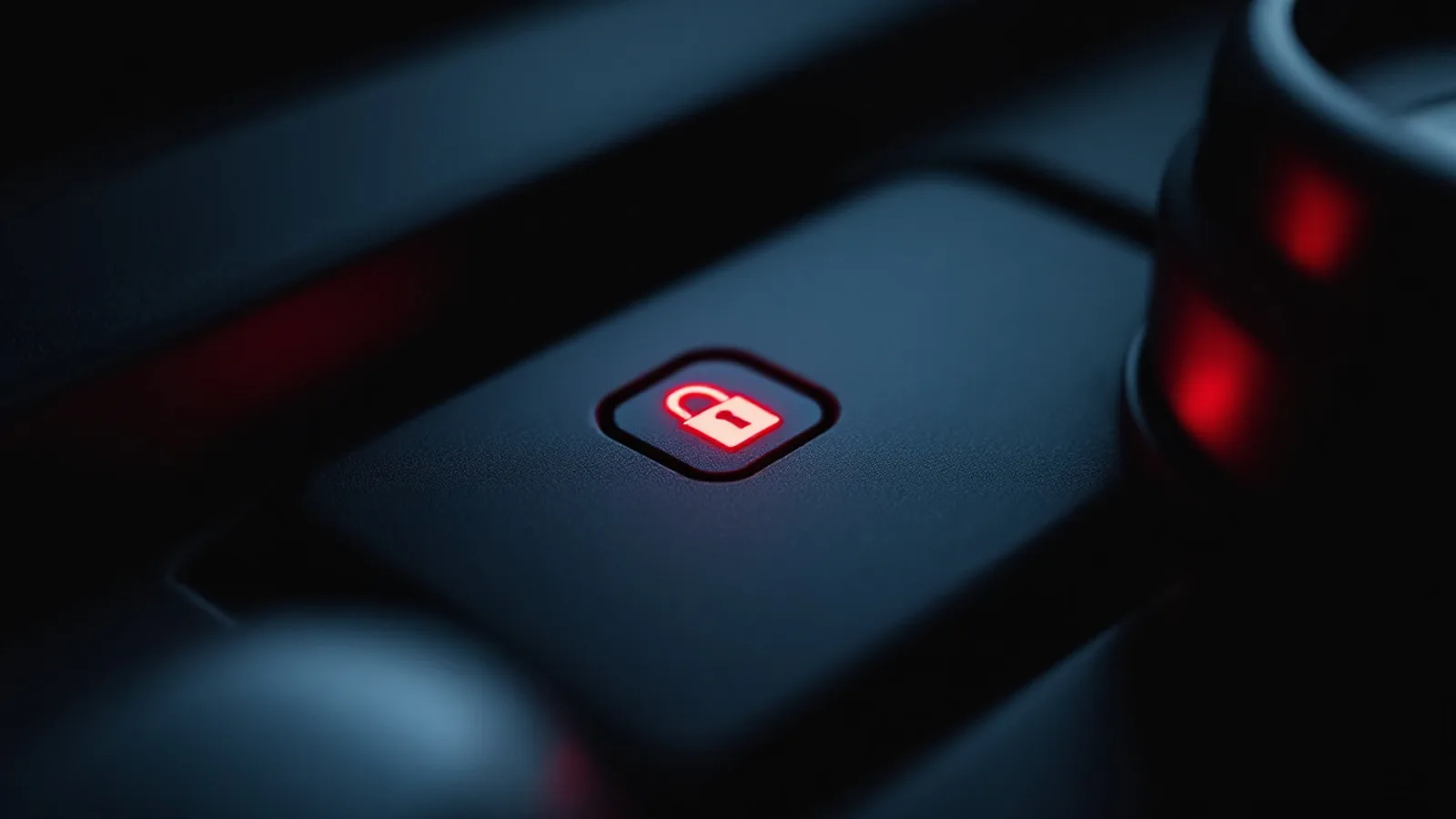
Anti-Theft Light Flashing and the Car Won't Start in Dallas: A Diagnosis Guide
As of August 2026, a flashing security light with a no-start in Dallas is an immobilizer authentication failure. Diagnosis $40-$95, relearn $120-$280.
The Short Version, Because You Are Probably Standing Next To The Car
A blinking anti-theft or security light with a car that cranks but will not start means one thing: the immobilizer asked your key to prove who it was, and it did not get an acceptable answer. The engine computer then withheld fuel, spark, or both. Nothing mechanical has failed. The car is refusing on purpose.
As of August 2026 in Dallas, that is fixed by a mobile automotive locksmith far more often than by a mechanic, and it is usually cheaper than people brace for. Diagnosis runs $40 to $95. If your key hardware is fine and only the pairing fell out of step, an immobilizer relearn is $120 to $280 with no new key at all. If you genuinely need a key: transponder $120 to $200, remote head key $160 to $280, smart proximity fob $250 to $500, European smart fob $350 to $600+. When no working key exists, add $75 to $250. The dealer path — part, programming, tow and shop queue — is $700 to $1,100+.
Have your year, make, model and VIN ready and call (469) 896-4128.
Quick Answer
A flashing security light plus crank-no-start is an immobilizer authentication failure, not an engine fault. In Dallas the four common causes, in order, are a weak fob cell or weak 12V battery, a lost or drifted key credential, a failed antenna ring at the ignition, and a failed security module. Diagnosis is $40 to $95; a relearn with your existing keys is $120 to $280; a new key is $120 to $600+ by type.
Blinking Versus Solid — They Do Not Mean The Same Thing
This distinction is genuinely diagnostic and almost nobody knows it.
A solid or steadily-lit security light with the car off usually means armed and normal — the lamp telling a passer-by the car is protected. Some cars show it steady for a few seconds at key-on as a bulb check, then extinguish it. That is healthy.
A blinking, flashing or rapidly pulsing light is the car reporting a failure. It is not arming, it is complaining. The pattern varies by manufacturer, but the meaning is consistent: authentication did not succeed.
The signature that confirms it is crank-but-no-start. The starter spins the engine normally, the battery is clearly strong enough, and the engine will not catch — or catches for half a second and dies. That start-and-die is especially telling: the computer allowed the beginning of the sequence and cut fuel the instant the immobilizer said no.
What it is not: if the engine does not crank at all — a click, or silence — you have a battery, starter or ignition-switch problem. Immobilizers almost never block the starter; they block fuel and spark. Get that right and you have halved the possible causes. If your push-button does nothing at all, start with our guide on push-button start not working.
The Four Real Causes, In Order Of How Often We Find Them
1. Weak power — the fob's coin cell or the car's 12V battery
First because it is both the most common cause and the cheapest to rule out.
A proximity fob transmits on a tiny cell. As that cell fades, the fob still lights its buttons and unlocks the doors at short range but no longer has enough transmit power for the challenge-and-response the immobilizer needs. Doors work; starting does not. That combination confuses owners, and it should not — they are different power demands. The whole story is in our guide on a dead key fob battery causing a no start, and in Dallas the failure clusters in summer for reasons in the summer heat key fob failures guide.
The car's own 12V battery does the same from the other direction. Modules brown out before a car goes fully dead, and a browned-out module produces communication errors that look exactly like a security fault. If the battery still cranks but is four or five years old, load-test it before spending a dollar. Cost to rule both out: $40 to $95 — the cheapest money on this page.
2. The key credential drifted, or the car lost it
Every transponder key holds a cryptographic identity the car stores on its side, and two events knock that out of step.
The key's stored value can desynchronise. Rolling-code systems advance a counter on both sides. A key that sits unused for a long stretch, or gets pressed hundreds of times out of range, can drift far enough that the car stops accepting it.
The car can lose its side. This is the one that catches people. After a dead battery, a jump start, a module replacement or shop programming work, a vehicle can come back with its stored key credentials missing or scrambled. The keys in your pocket are perfect; the car has no record of them.
Both are immobilizer relearns at $120 to $280 — no new key, no new hardware. If a shop just told you to buy keys after unrelated electrical work, get a second opinion. This is the single most over-sold repair in the category.
3. A failed antenna ring or receiver
The transponder in your key has no battery. It is powered by induction — the car energises it through a coil and the key answers using that borrowed energy. That coil is the antenna ring, and on a turn-key car it sits around the ignition lock cylinder. On push-button cars the equivalent antennas live in the cabin and doors.
When that coil or its wiring fails, the key is never energised, never answers, and the car reports an authentication failure. The key is perfect. The reader is deaf. The confirming test is simple: a second key fails identically. If two different keys produce the same flashing light and the same no-start, the problem is on the car's side and a third key buys you nothing.
4. A genuinely failed security module
Least common, most expensive. The module that owns the immobilizer decision — a body control module, an ignition module, or a dedicated theft-deterrent unit depending on the manufacturer — can fail outright or lose its stored data. That is module work rather than key work, and it belongs on our module programming and repair page. An honest technician tells you when you are here instead of selling keys that cannot help.
Make-Specific Fingerprints — What Your Car Is Actually Telling You
Different manufacturers built genuinely different systems, and they fail in recognisable ways.
Ford (PATS). Ford's Passive Anti-Theft System is one of the longest-running and best-documented immobilizers on the road. The classic presentation is the theft indicator flashing rapidly at key-on and an engine that starts and stalls within a second. Given proper access it is unusually straightforward, which makes Ford PATS key programming one of the more predictable jobs here.
General Motors (Passlock and VATS). Older VATS keys carried a resistor pellet in the blade — the car measured a resistance value, no radio involved. Later Passlock systems moved the sensing into the ignition lock housing. Both fail through wear and contact degradation as much as anything electronic, which is why GM no-starts often present as intermittent and position-sensitive rather than absolute. See GM theft deterrent no-start and GM VATS and Passkey bypass.
Toyota and Lexus. Toyota's immobilizer is famously reliable, so when it complains there is usually a real reason. The tell is a security lamp that changes behaviour the moment a valid key is present — if it keeps blinking unchanged, the key was never recognised. All-keys-lost work has its own procedure on our Toyota all keys lost page, and hybrids have their own quirks in the Prius and Camry hybrid smart key guide.
Nissan and Infiniti. These use a body control module working with a separate immobiliser unit, and the two have to agree. That arrangement means a Nissan can produce a security no-start where neither the key nor the BCM alone is at fault — it is the relationship between them. See Nissan and Infiniti BCM issues.
Chrysler, Dodge, Jeep and Ram (SKIM and WIN). The Sentry Key immobiliser and the later Wireless Ignition Node are a known conversation. The WIN integrates the ignition function and the immobiliser antenna into one assembly, so a failing WIN can present as a no-start, a key that will not turn, or a key that will not come out. See Dodge, Chrysler and Jeep WIN and RF hub issues and Pacifica and Town and Country all keys lost.
Mercedes-Benz. The EZS, also called the EIS, is the ignition module the key talks to and it owns authentication. Because that module is tangled up with the steering lock, a Mercedes fault can present as a no-start, a key that will not turn, or a dark cluster. Start with Mercedes no key detected and the EZS, ESL and EIS issues page.
BMW. Access is owned by the CAS, FEM or BDC module depending on generation, and these units store the key credentials themselves — so a BMW no-start is frequently a module-data conversation rather than a key conversation. See BMW FEM, CAS and FRM repair.
Volkswagen and Audi. Beyond the immobiliser, the group uses component protection, pairing certain modules to a specific vehicle. A module that was fine in another car refuses to function until properly adapted, which is why VW and Audi faults after parts swaps behave unlike every other brand here. See Volkswagen immobilizer repair.
Where a model year needs a manufacturer credential rather than aftermarket access, we confirm that from the VIN before dispatch.
Do These In Order Before You Call Anyone
Free steps first. This ladder costs nothing until the last line.
- Try your spare key. If the spare starts the car, your daily key is the problem. If both fail identically, the fault is on the car's side.
- Replace the fob's coin cell. Under five dollars, two minutes, and it resolves a meaningful share of these.
- Hold the fob against the documented backup spot. Nearly every push-to-start car has a near-field position — often the start button itself or a marked point in the console — where a dead fob can still be read. If the car starts that way, the fob battery is the fault and nothing else is.
- Have the 12V battery load-tested. Free at any parts counter in Dallas. Age matters more than whether it currently cranks.
- Write down the exact light behaviour — steady, slow blink, fast blink, or a repeating count — and whether the engine starts and dies or never catches.
- Check for the obvious contaminant. A heavy ring pressed against a phone, another transponder key, or a metal fob can interfere with the read. Try the key alone.
- Call. With those observations in hand, phone triage gets specific fast.
Dallas Pricing (2026)
| Job | What it covers | Dallas price range (2026) |
|---|---|---|
| Fob diagnosis and battery service | Confirms whether the fault is the key, the car, or the battery | $40 – $95 |
| Immobilizer relearn, no new key | Existing keys re-paired after drift, battery or module work | $120 – $280 |
| Basic transponder / chip key | Cut to code and programmed | $120 – $200 |
| Remote head key | Chipped key with integrated remote buttons | $160 – $280 |
| Flip / switchblade key | Folding blade with integrated remote | $180 – $320 |
| Smart / proximity fob | Push-to-start vehicles | $250 – $500 |
| European smart fob | BMW, Mercedes, Audi, Porsche, JLR, Volvo and similar | $350 – $600+ |
| All keys lost | Add-on when nothing working exists and authorization is rebuilt | add $75 – $250 |
| Dealer path, all in | Part, programming, tow and shop queue | $700 – $1,100+ |
The headline is worth repeating: if your keys are physically fine and only the pairing broke, this is a $120 to $280 relearn, not a key purchase. More on the category sits on our no key detected and immobilizer issues page.
Why The Dealer Path Costs $700 to $1,100+ — And When It Is Right Anyway
The dealer number is not padding. It is arithmetic.
A car that will not start has to be towed, and that line item lands before anyone looks at anything. Then the part is ordered at list price. Then the vehicle sits in a queue, because a security no-start is not an emergency to a service department with a full board, and cars routinely wait days. Then diagnostic and programming labour bills at dealer rates. That is how a fault a mobile technician resolves in your driveway becomes a four-figure week.
But the dealer is genuinely the right call in three situations, and we will tell you so:
- The module has physically failed on a platform where replacement requires manufacturer-level access no aftermarket tool legitimately provides.
- The vehicle is very new and under a warranty a third-party repair could jeopardise.
- The fault is not actually security-related — a fuel, spark or sensor failure that merely has a warning lamp lit alongside it. We say so, and we do not sell you a key you do not need.
Proof Of Ownership Is Not Optional
On any all-keys-lost job, photo ID plus current registration or title, verified on arrival, before any programming happens. No exceptions, regardless of how the request arrives or how urgent it sounds.
Creating a working credential for a vehicle from nothing is precisely the capability an immobilizer exists to deny. The verification is the ethical floor of the trade, not paperwork friction. A locksmith who is willing to skip it on your car is telling you exactly how they would treat someone else's.
What A Dallas Call Looks Like
Phone triage first — year, make, model, VIN, whether the engine cranks, what the light does, whether a spare exists — plus a VIN check on whether your model year is on-site work or a manufacturer-credential job. Ownership is verified on arrival for anything all-keys-lost. Power and fob checks come before anyone discusses programming, and the actual stored fault gets read rather than guessed from the lamp. Then a flat-rate quote, then verified repeatable starts: lock, unlock, start, shut down, restart, not one lucky crank.
We run these calls across Dallas, Plano, Garland, Mesquite and Richardson, plus the rest of the metroplex, around the clock. General key work sits on our car key replacement in Dallas page.
Frequently Asked Questions
Q: My security light is blinking and my car will not start — what is it and who fixes it in Dallas? A: It is an immobilizer authentication failure: the car asked your key to identify itself, got no valid answer, and withheld fuel and spark on purpose. A mobile automotive locksmith fixes it, usually on site. Diagnosis is $40 to $95, a relearn with your existing keys is $120 to $280, and a replacement key runs $120 for a basic transponder up to $600 or more for a European smart fob.
Q: Does a flashing anti-theft light always mean I need a new key? A: No, and assuming so is the most expensive mistake in this category. A weak fob cell, a weak 12V battery, a credential the car lost after unrelated electrical work, or a failed antenna ring all produce the same flashing light and no-start. If two different keys fail identically, the fault is on the car and a third key changes nothing. Diagnose for $40 to $95 first.
Q: Why does my car crank but not start when the security light is on? A: Because immobilizers block fuel and spark, not the starter. The starter is on a separate circuit the security system does not interrupt, so the engine spins normally while the computer refuses to let it run. A start that lasts half a second and dies is the clearest version. If the engine does not crank at all, look at the battery, starter or switch instead.
Q: Can a dead car battery trigger the anti-theft light and stop the car starting? A: Yes. Modules brown out well before a car goes fully dead, and low voltage corrupts communication between the key reader and the module that authorises the start, producing a genuine authentication failure with a perfectly good key. It happens in reverse too: a jump start or battery replacement can leave the vehicle with scrambled stored credentials, which is a $120 to $280 relearn.
Q: How much does it cost to fix an immobilizer problem in Dallas? A: Diagnosis is $40 to $95 and tells you which path you are on. If your keys are fine and only the pairing broke, the relearn is $120 to $280 with no new hardware. A transponder key is $120 to $200, a remote head key $160 to $280, a smart proximity fob $250 to $500, and a European smart fob $350 to $600 or more. All keys lost adds $75 to $250.
Q: Should I go to the dealer instead for a security light no-start? A: Usually not, because a car that will not start has to be towed there and then waits in a queue, which is how the all-in cost reaches $700 to $1,100 or more. The dealer is genuinely right when the module has physically failed on a platform needing manufacturer-level access, when warranty is a real concern, or when the fault is not security-related at all.
The Bottom Line
A blinking security light is not a mystery and rarely a disaster. It is a car saying it could not verify the key, and the four candidates — weak power, a lost credential, a deaf antenna, a failed module — are diagnosable in a driveway for $40 to $95. Many end at a coin cell or a $120 to $280 relearn rather than a new key, and anyone quoting hardware before checking the cheap causes is guessing with your wallet. Call (469) 896-4128 with your year, make, model and VIN. Dallas Locksmith Pros answers 24/7, verifies ownership on every all-keys-lost job, and quotes flat-rate before dispatch.
Written by the Dallas Locksmith Pros mobile automotive team, serving drivers across Dallas and the surrounding metroplex 24/7.
Related articles
Lexus RX and ES No-Start in Dallas: Immobilizer Fault, Key Detection, or Just a Flat Battery?
As of August 2026, most Lexus RX and ES no-start calls in Dallas are not immobilizer failures. The correct triage order, and what diagnosis costs.
Read moreVolkswagen Says "Immobilizer Active" or SAFE and Won't Start: Dallas Diagnosis Guide
As of October 2026: what Immobilizer Active or SAFE means on a Volkswagen, the checks to run in order, and Dallas repair costs from $40 to $600.
Read moreCar Starts Then Immediately Dies in Dallas: The Two-Second Immobilizer Stall
As of September 2026, a car that fires then stalls in two seconds is usually an immobilizer rejection, not a fuel fault. Dallas causes, tests and real costs.
Read moreNeed a Dallas locksmith right now?
Licensed mobile automotive locksmith. Same-day response across DFW.
Call (469) 896-4128