
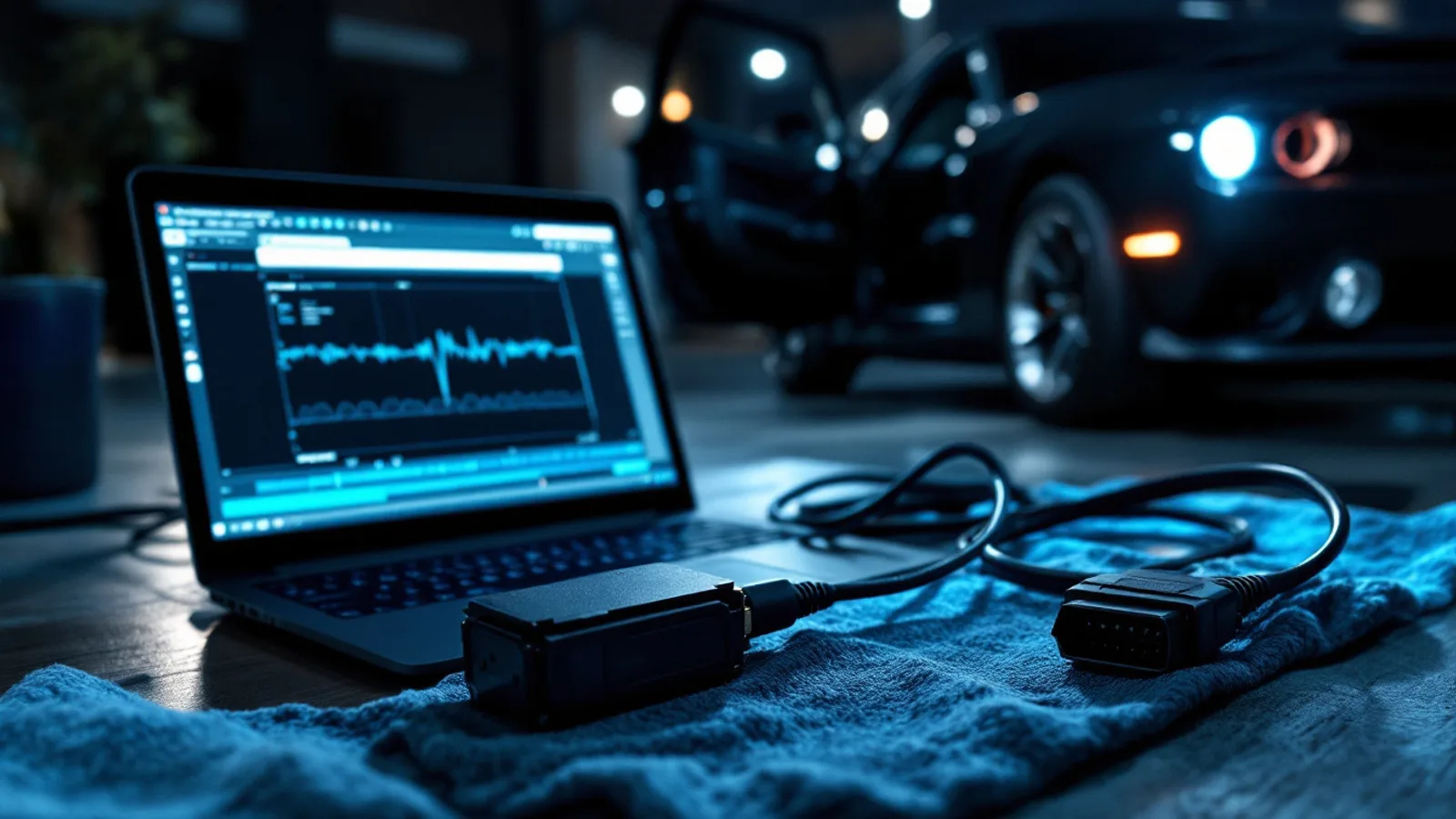
Dodge Charger & Challenger WIN Module Programming in Dallas: When New Keys Cannot Fix It
As of August 2026, a failed Dodge WIN module is module work, not key work. Relearn $120-$280, FOBIK $150-$300, smart prox $250-$400 in Dallas.
The Third Key Will Not Fix It Either
There is a specific Dodge story we hear several times a month, and it always ends in the same place. The Charger or Challenger started refusing the FOBIK. The owner bought a replacement, which did not help. A second shop programmed another one, which also did not help. By the time the phone rings, three keys have been purchased to solve a fault that never lived in a key.
The WIN, or Wireless Ignition Node, is the part of a Chrysler-family vehicle that holds the ignition switching, the fob receiver and the immobilizer key table in one housing. On the newer architecture the radio side moved out to an RF Hub. Either way, the module is the authority. It decides which key identities the vehicle accepts and it tells the PCM whether a start is permitted. When that module itself has failed, adding key identities to a broken table changes nothing at all.
As of August 2026, this class of work in Dallas prices honestly and separately from key sales: $120 to $280 for an immobilizer or module relearn with no new key, $150 to $300 for a FOBIK, $250 to $400 for a smart proximity fob, and $120 to $200 for an older blade transponder, with $75 to $250 added when every key is gone. Diagnosis comes before parts, every time. Call (469) 896-4128 with your VIN.
Quick Answer
If your Charger or Challenger reports Key Not Detected or No Fob Detected and refuses to start, the first question is whether the key or the module is at fault, and only a module read answers it. A relearn with no new hardware runs $120 to $280. A replacement FOBIK is $150 to $300 and a proximity fob is $250 to $400. If the WIN has physically failed, the fix is the part plus re-binding, which is genuine module work and not something a fourth key will solve.
Dodge WIN, RF Hub and Key Pricing in Dallas (2026)
| Dodge scenario | What is actually happening | Dallas price range (2026) |
|---|---|---|
| Immobilizer or module relearn, no new key | Key identity lost sync, module still healthy | $120 – $280 |
| Blade transponder key, working key present | Older Charger, Grand Caravan | $120 – $200 |
| FOBIK programmed to the WIN | Charger and Challenger 2008-2014, Durango | $150 – $300 |
| Smart proximity fob | Charger and Challenger 2015-2023, Durango | $250 – $400 |
| All keys lost, FOBIK vehicle | Security access with nothing trusted | $225 – $550 |
| All keys lost, proximity vehicle | Security access with nothing trusted | $325 – $650 |
| WIN module diagnosis | Read the module before buying anything | Quoted on the call, before dispatch |
| Lockout entry, keys visible inside | Any Dodge | $85 – $200 day / $125 – $275 after-hours |
| Dealer path, all-in | Any Dodge | Several hundred more once a tow and shop labor are stacked on |
A physically failed WIN needs the part plus re-binding, and that is quoted after diagnosis rather than guessed at from a symptom description. Anyone quoting a module replacement over the phone without reading the vehicle is selling you a coin flip.
How the Dodge Security System Is Actually Built
The WIN does three jobs, which is why its symptoms are confusing
On the FOBIK generation the WIN replaced the conventional ignition lock cylinder with an electronic node. Insert the FOBIK, twist, and no mechanical wafer stack is involved. The module is simultaneously the ignition switch determining which electrical positions are live, the receiver reading the fob, and the immobilizer host holding the accepted-key table.
Collapse those three roles into one failing part and you get symptoms that appear unrelated. Accessories behave oddly. The fob is recognized intermittently. The engine cranks and will not catch. Owners reasonably conclude they have three problems. They have one, and it lives in a module the size of a paperback. We keep a dedicated page for it at Dodge, Chrysler and Jeep WIN and RF Hub issues.
The RF Hub: the newer split
From roughly the 2015 model year, the Charger and Challenger moved the radio-frequency function into a separate RF Hub while the vehicle adopted push-button start and a proximity fob. The immobilizer authority is now distributed across the network with a gateway in the middle rather than concentrated in a single node.
That changes the failure signature. On an RF Hub vehicle, a car that will not detect the fob when it is in the cup holder but will start when the fob is physically pressed against the start button is telling you the passive antenna path is weak. That is not the same fault as a WIN that has stopped honoring its own key table, and it does not carry the same fix.
The PCM is the authorization partner
Neither the WIN nor the RF Hub starts the engine on its own. The security module authorizes, and the powertrain control module obeys. That pairing has to agree, which is why a PCM replacement on a Dodge is not a plug-and-play part swap: the new controller has to be introduced to the vehicle's security identity or the car will crank indefinitely with two healthy modules disagreeing about who is in charge. That relearn is the work described on our Chrysler and Dodge PCM programming page, and it needs no new keys at all.
Which generation is which
Charger and Challenger split at roughly the same place. The 2008 to 2014 Charger and the 2008 to 2014 Challenger are FOBIK vehicles built around the WIN. The 2011 to 2023 Charger and the 2015 to 2023 Challenger moved into the newer architecture with proximity fobs and an RF Hub, with 2011 through 2014 being the transition years where the answer genuinely depends on trim and build date. The Durango from 2011 on and the Grand Caravan from 2008 to 2020 sit across the same family. This is why we ask for the VIN rather than the model name.
Common Dodge Problems We See
Charger: intermittent no-start that gets worse
The signature WIN failure is not a clean death. It is a vehicle that starts nine times out of ten, then twelve times out of thirteen, then not at all. Owners describe it as "it does it when it is hot" or "only in the morning," and both can be true, because a degrading module often responds to thermal expansion. An intermittent no-start on a FOBIK Charger with a healthy battery and a fob that works some of the time is a WIN suspect until a module read says otherwise.
Challenger: FOBIK buttons dead, vehicle still starts
Two separate systems live in one fob. The immobilizer transponder function is what lets the vehicle start. The remote-control buttons are a different radio path. When the buttons stop working but the car starts normally, the immobilizer side is healthy and the problem is the remote side, which is frequently a battery or a cracked board after a drop rather than anything requiring programming.
Charger and Challenger: "Key Not Detected" with a good fob
The message is the vehicle telling you it cannot complete the handshake. It does not tell you why. A dead fob battery, a fob that has lost synchronization, a failing antenna, a weak 12V system and a failing WIN all produce it. Fob diagnosis and battery service at $40 to $95 clears the cheapest cause. A relearn at $120 to $280 clears the next one. Only after those does module replacement become the honest answer.
Durango and Grand Caravan: everything went strange after a battery replacement
A flat or disconnected 12V battery can leave a Chrysler-family vehicle with warning lights, a fob that appears to have forgotten itself and an intermittent no-start. That is very often a synchronization problem rather than a hardware failure, and it prices as a relearn rather than as a module. Ruling it out first is basic diligence and it saves owners real money.
Any Dodge: all keys lost on a car that was already misbehaving
This is the hardest combination, and it is worth naming. When the last key disappears from a vehicle that had already been refusing keys intermittently, you are dealing with two problems at once. We diagnose the module before generating keys, because writing new identities into a failing table produces exactly the same complaint two weeks later.
Module Work Versus Key Work: Where the Line Sits
The distinction is not academic and it is not marketing. It determines who can help you.
Key work means the module is healthy and simply does not know your key yet. The technician establishes access, writes the identity into the accepted table, and confirms the powertrain controller agrees. Price follows the key type: $120 to $200 for a blade transponder, $150 to $300 for a FOBIK, $250 to $400 for a proximity fob.
Relearn work means the module is healthy, the key hardware is fine, and the two have lost their relationship. Common after a battery event, a PCM replacement or a jump-start gone wrong. $120 to $280 and no new parts.
Module work means the WIN or RF Hub itself has failed. That requires the part and a re-binding procedure so the replacement inherits the vehicle's security identity. It is the same skill set behind our broader module programming and repair capability, and it is why the same team that handles a Land Rover KVM or a Ford PATS module and PCM relearn is the team you want on a Chrysler-family WIN. The label on the module changes. The nature of the conversation does not.
A shop that only cuts and programs keys will keep selling you keys, because that is the tool in its hand. The reason to ask what a shop reads before it quotes is that the answer tells you which category of work it is actually equipped for.
The Honest Boundary on Dodge Module Work
A physically failed WIN needs the part plus re-binding. No number of keys, no amount of programming and no relearn recovers a module that has failed in hardware. When the read says the node is gone, we say so and quote the replacement rather than selling another fob.
The newest secure-gateway vehicles get VIN-checked before dispatch. Late-model Chrysler-family vehicles sit behind a security gateway with tightened access rules. We verify feasibility from the VIN first, because discovering a limitation in your driveway is an expensive way to find out.
A PCM swap needs a relearn, not new keys. If a shop replaced the powertrain controller and the vehicle now cranks without starting, buying keys is the wrong purchase entirely. The fix is re-introducing the controller to the vehicle's security identity.
Proof of ownership is mandatory on every all-keys-lost call. Photo ID plus registration or title, no exceptions, at any hour. Generating a working credential for a vehicle with none is exactly the capability an immobilizer exists to restrict, and it aligns with the NHTSA vehicle theft-prevention framework the whole system is built around.
What a Dallas Dodge Module Call Looks Like
- Phone triage with the VIN and model year. WIN or RF Hub, key type, symptom pattern, and whether any key currently works.
- Ownership verification on arrival. Photo ID plus registration or title, every time.
- Battery and voltage check first. A weak 12V system imitates a security fault convincingly, and nothing is diagnosed on bad voltage.
- Module read. The WIN or RF Hub is interrogated before anyone discusses parts, so you learn whether this is key work, relearn work or module work.
- The cheapest correct fix, offered first. If a $120 to $280 relearn resolves it, that is the quote, not a fob sale.
- Key generation and pairing where new credentials are genuinely required, including cutting the emergency blade on proximity vehicles.
- Full verification. Live start, remote functions, passive detection at each door on proximity cars, and a re-check that no security fault has been left stored.
We cover Dallas, Garland, Mesquite, Irving and Grand Prairie plus the rest of the metroplex around the clock. The full model breakdown lives on the Dodge brand page and the shared-platform detail on the Chrysler brand page, and when the node itself is the fault the specifics are on our Chrysler and Dodge WIN module replacement page.
Frequently Asked Questions
Q: How do I know if my Dodge needs a new key or a new WIN module? A: From the driver's seat you cannot, which is the honest answer. A dead fob battery, a lost key synchronization and a failing WIN all produce Key Not Detected and a no-start. The separation comes from reading the module. Fob diagnosis and battery service is $40 to $95, a relearn is $120 to $280, and module replacement is quoted after the read. Any shop that names a module replacement before interrogating the vehicle is guessing with your money.
Q: What does a Dodge WIN module relearn cost in Dallas? A: An immobilizer or module relearn with no new key runs $120 to $280. That covers the common case where the hardware is healthy but the security relationship between the key, the WIN and the powertrain controller has been lost, usually after a battery event, a jump-start or a controller replacement. If new keys are genuinely required, add $150 to $300 for a FOBIK or $250 to $400 for a smart proximity fob.
Q: My Charger cranks but will not start and the security light is on. Is that the immobilizer? A: Very likely, yes. A vehicle that cranks strongly but never catches, with a security indicator lit, is describing an authorization failure rather than a fuel or starter problem. The WIN or RF Hub is refusing to tell the powertrain controller that a start is permitted. That is diagnosed by reading the module, and depending on what the read shows it resolves as a $120 to $280 relearn, a new key at $150 to $400, or module replacement.
Q: I replaced the PCM and now no key works. Do I need new keys? A: No, you need a relearn. A replacement powertrain control module does not inherit the vehicle's security identity automatically, so the vehicle ends up with two healthy modules that disagree about authorization. The fix is introducing the new controller to the existing security data, priced at $120 to $280, and your current keys keep working afterward. Buying keys in this situation solves nothing.
Q: Can you do a Dodge all-keys-lost at my house? A: Yes, on the large majority of Charger, Challenger, Durango and Grand Caravan model years, without a tow. Budget $225 to $550 on a FOBIK vehicle and $325 to $650 on a proximity vehicle. The visit takes longer than a spare because security access has to be established with no trusted credential present. Photo ID plus registration or title is required before any work begins, on every recovery, at any hour.
Q: Why does the dealer say the whole ignition assembly has to be replaced? A: Sometimes that is correct and sometimes it is the default answer for a symptom nobody has read the module to understand. When the WIN has genuinely failed in hardware, replacement plus re-binding is the only route and we will tell you so. When the fault is a lost relearn or a fob, replacing the assembly is an expensive way to fix a $120 to $280 problem. The distinction is decided by the diagnostic read, not by the symptom description.
The Bottom Line
A Dodge that refuses its keys is asking one question: is the key wrong, or is the authority wrong? Buying keys answers only the first, which is why three fobs later so many Chargers and Challengers are still sitting. Read the WIN or RF Hub first, and the answer is usually a $120 to $280 relearn, sometimes a $150 to $400 key, and occasionally a module replacement that no amount of key programming would ever have covered. We quote in that order because that is the order the vehicle actually fails in. Have your VIN and model year ready and call (469) 896-4128. Dallas Locksmith Pros answers 24/7, verifies ownership on every recovery, and quotes flat-rate before anyone is dispatched.
Written by the Dallas Locksmith Pros mobile automotive team, serving Dodge owners across Dallas and the surrounding metroplex 24/7.
Related articles
Nissan BCM and NATS Immobilizer No-Start in Dallas: Rogue, Pathfinder, Titan
As of July 2026, Nissan BCM and NATS immobilizer work in Dallas runs $300-$700. Why a Rogue, Pathfinder or Altima no-start is programming, not parts.
Read moreMercedes No Key Detected in Plano: Diagnose the No-Start (2026)
2026 Mercedes 'no key detected' in Plano: telling a $5 dead fob battery from an EZS/EIS module fault, plus fob replacement $350-$600+ and on-site diagnosis.
Read moreVolkswagen Passat & Golf Ignition Repair in Dallas: Two Faults Owners Keep Confusing
As of August 2026, VW ignition repair in Dallas runs $250-$350 to re-pin a cylinder. A cluster-hosted immobilizer fault is a different job entirely.
Read moreNeed a Dallas locksmith right now?
Licensed mobile automotive locksmith. Same-day response across DFW.
Call (469) 896-4128