
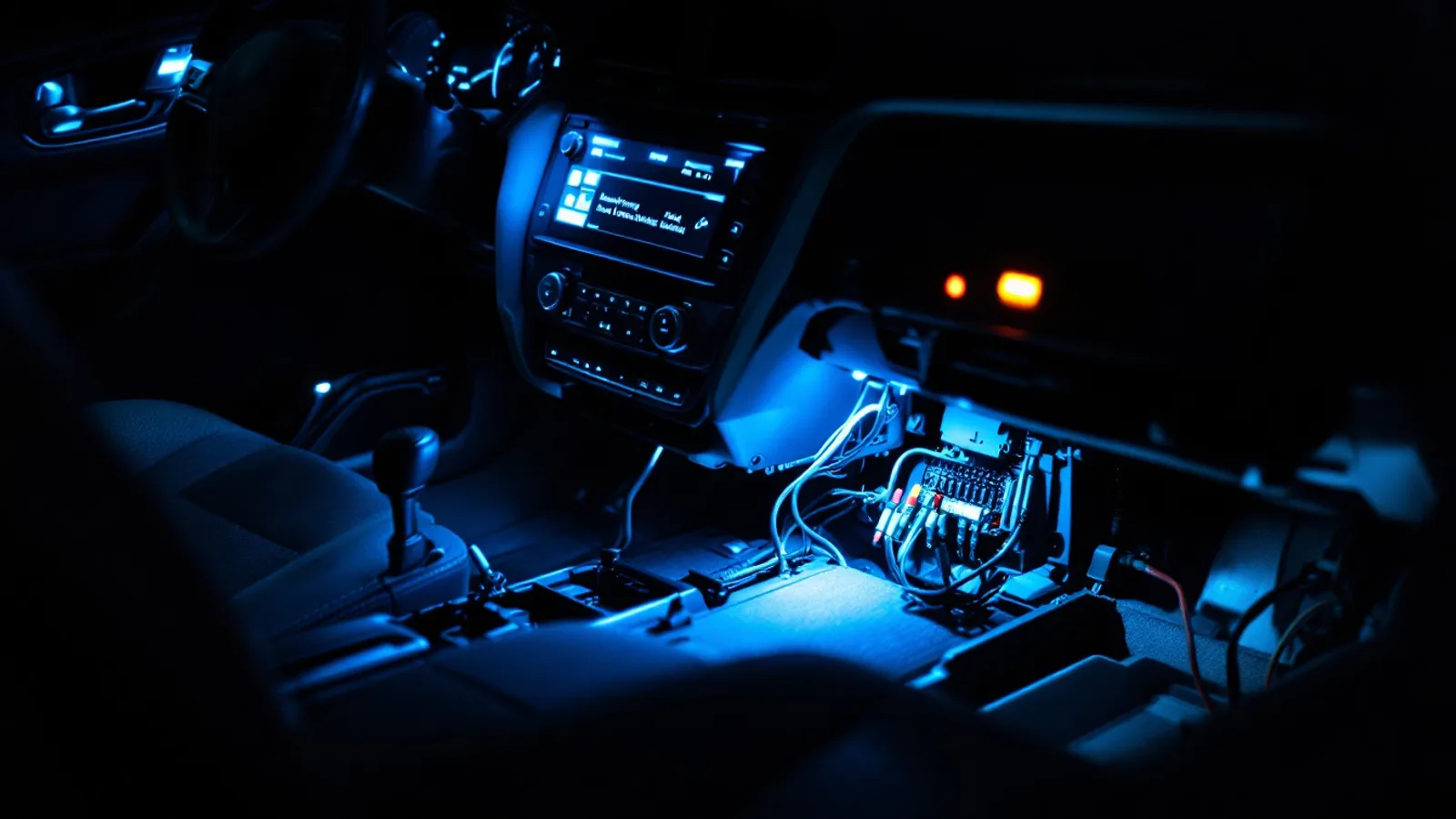
Nissan BCM and NATS Immobilizer No-Start in Dallas: Rogue, Pathfinder, Titan
As of July 2026, Nissan BCM and NATS immobilizer work in Dallas runs $300-$700. Why a Rogue, Pathfinder or Altima no-start is programming, not parts.
Start With the Light: What the Flashing Security Icon Is Telling You
That small red or amber icon on a Nissan dash — a key outline, a car with a padlock, sometimes just the word SECURITY — is not decorative and it is not vague. It has two distinct states, and knowing which one you are looking at cuts the diagnostic field in half before anyone touches the vehicle.
Slow, steady blinking with the vehicle off is normal. That is the immobilizer armed and standing watch, exactly as designed. Rapid flashing, or the icon staying lit while you try to start, means the system interrogated a credential and rejected it. The engine may crank strongly and never fire, or refuse to crank at all. Either way, the vehicle is not broken in a mechanical sense; it has decided you are not authorized.
As of July 2026, Nissan immobilizer and body-module work in Dallas typically runs $300 to $700 depending on whether the fix is a key, a relearn, or module-level programming, with an Intelligent Key proximity fob sitting in the $250 to $500 band, a transponder key at $120 to $200, and an all-keys-lost recovery adding $75 to $250. The dealer path commonly totals $700 to $1,100+ all-in once you count part, labor, tow, and queue. This guide explains NATS, the BCM's real role, the steering-lock interaction that traps push-button owners, and why this work is programming rather than parts-swapping.
NATS: Nissan's Anti-Theft System in Plain Terms
NATS — the Nissan Anti-Theft System — is the family name for the immobilizer that has been standard on these vehicles for a long time. Like every immobilizer, its single job is to prevent the engine from running unless a credential it already trusts is present. It does not sound alarms, it does not detect break-ins, and it has no opinion about your doors.
The mechanism depends on your generation. On key-turn Nissans, a transponder chip in the key head is energized by an antenna ring at the ignition, answers with an encrypted code, and gets checked against stored records. On push-button Nissans, the Intelligent Key is a battery-powered proximity fob detected by low-frequency antennas positioned around the cabin, the doors, and the trunk area. The car works out where the key is standing from relative signal strength, which is what lets it unlock at the handle but only allow starting when the fob is genuinely inside.
The verification result then has to travel. NATS is a chain, not a single box: the credential is read, the record is checked, and an authorization is passed to the engine controller, which alone can deliver fuel and spark. Break any link and you get the same outward symptom — a truck or SUV that cranks and will not run. That is why immobilizer diagnosis is about isolating which link failed, and why our no key detected and immobilizer issues service is organized around symptom patterns rather than parts.
The BCM Is the Hub, Not a Bystander
On Nissan, the BCM (Body Control Module) is where key recognition lives. It holds the enrolled key records, drives or coordinates the antennas, makes the accept-or-reject decision, and passes the verdict onward. It also runs a long list of things that have nothing to do with keys — lighting, wipers, door locks, chimes, power accessories, and communication with the IPDM (Intelligent Power Distribution Module) that switches high-current loads.
That dual role is why a genuinely failing BCM is so confusing to own. Symptoms scatter. Interior lights behave oddly on Tuesday, the remote works intermittently on Thursday, and the following week the vehicle will not start at a grocery store. Owners chase each symptom separately, replace a fob, replace a battery, and never connect them — because from the driver's seat there is no reason to think interior lighting and engine starting share a computer. They do.
Two practical rules follow. First, when a Nissan presents with multiple unrelated electrical oddities plus an immobilizer complaint, the module deserves suspicion far earlier than the key does. Second, a BCM diagnosis should always be preceded by verifying the vehicle's own battery and charging health, because a chronically undercharged battery produces module misbehavior that mimics failure and clears the moment the electrical system is healthy. Deep detail on this platform lives on the Nissan brand page, and the module work itself is covered by our Nissan and Infiniti BCM issues service.
The Steering Lock Trap on Push-Button Nissans
Here is the interaction that catches owners of push-button Rogues, Pathfinders, and Altimas off guard, and it is worth understanding before you are standing next to it.
Push-button vehicles have no mechanical connection between your hand and the steering column lock. Instead an electronic steering lock — the ELV, sometimes called the steering lock unit — motors a pin in and out of the column on command. Every start sequence includes a release: the vehicle verifies your credential, then tells the steering lock to unlock the column, then permits the engine to start.
That means a steering-lock fault presents exactly like an immobilizer fault. The wheel stays locked, the start button does nothing useful, and the dash may throw a key-related message even though the key is perfectly fine. Owners buy a new fob and solve nothing.
The distinguishing signs are worth memorizing. A steering-lock failure often produces an audible click or buzz from the column at start attempt, with the wheel remaining rigidly locked. A credential failure is usually silent from the column, with the security icon doing the talking. And a steering-lock issue tends to be more reproducible than a key issue, which is often intermittent.
If you have already been down this road with a dead fob battery, the overlapping symptom set is separated in our guides to push-button start not working in Dallas and to a dead key fob battery causing a no-start. Rule the cheap causes out first, always.
Why BCM Work Is Programming, Not Parts-Swapping
Owners reasonably assume that a failed module means buying a module. On a security host like the Nissan BCM, the part is often the smaller half of the job — and sometimes not needed at all.
A BCM arrives, whether new or from a donor vehicle, carrying identity: a vehicle it believes it belongs to, a configuration matched to that vehicle's trim and options, and key records for somebody else's Altima. Install it as-is and the immobilizer chain rejects it, because the whole design intent of an immobilizer is that security identity cannot float freely between vehicles. The module has to be configured for your vehicle, aligned with the rest of the network, and then have your keys enrolled against it before anything starts.
There is also a category of fault where no part is needed at all: the module is physically healthy but its stored data is corrupted, its key records are stale after a botched procedure, or a previous repair left it mismatched with the engine controller. Those are re-code jobs — pure programming, no part cost — and they are more common than owners expect. A shop that quotes module replacement before diagnosis is quoting the most expensive of three possible outcomes by default. This entire category is what the module programming and repair service exists for.
Common Nissan Problems We See
Rogue: intermittent no-start in the heat
The signature Rogue complaint in a Dallas summer is a vehicle that starts every morning and refuses at 4 p.m. in a parking lot after baking all day, then starts fine once it cools. Heat-sensitive intermittency points toward a module or a connection rather than a key, because a transponder chip does not care about temperature the way a solder joint does. Reproducing it matters — which is why describing when it fails is more useful to a technician than describing that it fails.
Pathfinder: "Key ID Incorrect" with a known-good key
A Pathfinder that rejects two separate working keys has told you something important: the problem is not the keys. When both credentials fail identically, attention moves to the antenna path and the module holding the records. Try the second key before you spend money — it is the single most valuable free diagnostic step an owner can perform.
Titan: no-start after aftermarket electrical work
Titans get accessories — lights, winches, audio, remote start kits — and accessory installs go wrong. A circuit tapped into the wrong place, a poor ground, or a remote-start module spliced into the immobilizer path can leave the truck rejecting keys it accepted the day before. Always tell the technician about recent aftermarket work; it reorders the entire diagnostic sequence.
Altima: push-button start ignoring the fob
The Altima's version is usually the cheapest fix of the four. A weak fob coin cell drops signal strength below what the door antennas require while still working when the fob is held directly against the start button, because Nissan builds in that near-field backup precisely for this failure. If your fob only works pressed to a specific spot, replace the battery before you call anyone about key programming in Dallas — that alone may be the entire repair.
Nissan Immobilizer Costs in Dallas (2026)
| Symptom | Most likely cause | Dallas range (2026) |
|---|---|---|
| Fob works only against the start button | Weak fob battery | Coin cell, or fob replacement $250 – $500 |
| One key fails, second key works | Failing key or transponder | $120 – $200 transponder, $250 – $500 Intelligent Key |
| Both keys rejected, security light on | Antenna path or BCM records | $300 – $550 diagnosis and re-code |
| Wheel locked, click from column | Electronic steering lock (ELV) | $350 – $650 repair or replace with programming |
| Scattered electrical faults plus no-start | BCM failure | $450 – $700+ with configuration |
| No keys exist at all | All-keys-lost recovery | Key price plus $75 – $250 surcharge |
| Newest VINs | May require manufacturer authorization | VIN check before dispatch |
| Dealer path (part + labor + tow + queue) | Same result, more steps | Commonly $700 – $1,100+ all-in |
Read the middle rows as diagnostic buckets rather than fixed prices. The reason a good shop insists on diagnosis before quoting module work is that three of these rows produce the identical complaint from the driver's seat and have very different price tags.
The Honest Boundary on the Newest Nissans
For the overwhelming majority of Rogues, Pathfinders, Titans, and Altimas in this market, immobilizer diagnosis, key enrollment, and BCM configuration are mobile work done at your address with the same result as the dealership.
The honest exception applies at the newest end of the range, where security-relevant module operations increasingly sit behind manufacturer-side authorization and gateway controls. No independent tool legitimately bypasses those, and where they apply the right answer is dealer or manufacturer-authorized service. A reputable shop determines which side of that line your VIN falls on during the phone call, before dispatching anyone — the industry framework for secure vehicle access is published by the National Automotive Service Task Force, and acknowledging it is a mark of competence, not a limitation.
The second boundary is physical. Programming cannot repair hardware. A module killed by water intrusion, a burned driver circuit, or a chafed harness has to be addressed as hardware first; writing data to a dead module accomplishes nothing. Establishing that the module is alive and communicating is step one of any honest quote.
What a Dallas Nissan Visit Looks Like
- Phone triage. Model, year, VIN, and the exact symptom pattern — crank versus no crank, one key versus both, intermittent versus constant, any recent electrical or accessory work.
- Ownership verification. Photo ID plus registration or title on any job that creates a credential from nothing, consistent with NHTSA's theft-prevention guidance.
- Cheap causes first. Fob battery, vehicle battery and charging health, ground integrity, and a second-key test before anything invasive.
- Isolate the link. Determine whether the credential, the antenna path, the module records, or the steering lock is the failure point.
- Program or repair accordingly. Enroll keys, re-code a healthy module, or configure a replacement — quoted before the work proceeds.
- Verify. Start on every key, cycle the steering lock, confirm remote functions, and confirm the security icon returns to its normal armed blink.
That is what anyone searching auto key programming near me should actually expect from a competent visit — diagnosis before parts. We run it identically across Dallas, Richardson, Lewisville, and Carrollton. If you simply need a new key rather than module work, start at car key replacement; if every key is gone, see lost car keys; and for scope questions generally, the automotive locksmith service page is the overview.
Frequently Asked Questions
Q: What does a flashing security light on my Nissan mean? A: A slow steady blink with the vehicle off is normal armed behavior. Rapid flashing, or the light staying on during a start attempt, means NATS interrogated a credential and rejected it, so the engine controller is blocked from delivering fuel and spark. That can be a failing key, a broken antenna path, corrupted key records in the BCM, or a steering-lock fault imitating a key problem.
Q: How much does Nissan BCM work cost in Dallas in 2026? A: Expect roughly $300 to $700 depending on outcome. A re-code of a healthy module whose data is corrupted sits at the low end, while a replacement module configured for your vehicle and re-enrolled with your keys sits at the top because it adds part cost. Keys themselves are separate: $120 to $200 for a transponder, $250 to $500 for an Intelligent Key.
Q: Can I install a used BCM from another Nissan and use my own keys? A: No, not as a plug-and-play part. A donor BCM arrives carrying another vehicle's identity, configuration, and enrolled key records, so the immobilizer chain rejects it and your keys are strangers to it. It has to be configured for your vehicle and have your keys enrolled against it, which is programming work regardless of where the hardware came from.
Q: My Pathfinder's steering wheel is locked and the start button does nothing. Is that the key? A: Usually not. On push-button Nissans an electronic steering lock has to release the column before the engine is permitted to start, so a failed steering lock produces a locked wheel and a dead start button even with a perfectly good key. A click or buzz from the column at the start attempt, and a fault that repeats consistently rather than intermittently, both point at the steering lock.
Q: Why does my Intelligent Key only work when I hold it against the start button? A: That is the classic weak-battery signature. Nissan includes a near-field backup at the start button so a fading fob can still start the vehicle after it has become too weak for the door and cabin antennas to detect at normal range. Replace the coin cell first; if the symptom survives a fresh battery, the fob or the detection path needs attention.
Q: Does a Nissan with an immobilizer fault have to be towed to the dealer? A: No in the large majority of cases, where diagnosis, key enrollment, and module configuration are done on-site and the vehicle drives away the same visit. The exception is the newest VINs where certain security operations may require manufacturer-side authorization, and that is identified from the VIN during the phone call rather than discovered after a trip charge.
The Bottom Line
A Nissan no-start with a security light is a chain problem, and the chain has four links: the credential, the antenna path, the BCM's stored records, and — on push-button vehicles — the steering lock. Three of those produce the identical complaint from the driver's seat and cost very different amounts to fix, which is why diagnosis has to come before parts. Try your second key, check the fob battery, mention any recent electrical work, and insist that anyone quoting module replacement explain why a re-code will not do. Have your model, year, VIN, and symptom pattern ready and call (469) 896-4128 — Dallas Locksmith Pros answers 24/7 and quotes flat-rate before dispatch.
Written by the mobile automotive team at Dallas Locksmith Pros, who diagnose Nissan immobilizer and body-module faults on-site across Dallas and the surrounding metroplex.
Related articles
Dodge Charger & Challenger WIN Module Programming in Dallas: When New Keys Cannot Fix It
As of August 2026, a failed Dodge WIN module is module work, not key work. Relearn $120-$280, FOBIK $150-$300, smart prox $250-$400 in Dallas.
Read moreNissan Rogue & Murano Spare Key in Dallas: The BCM Is the Immobilizer
As of August 2026, a Nissan Rogue or Murano spare Intelligent Key in Dallas runs $250-$500 on-site. On a Nissan, adding a key is a BCM registration.
Read moreVolkswagen Passat & Golf Ignition Repair in Dallas: Two Faults Owners Keep Confusing
As of August 2026, VW ignition repair in Dallas runs $250-$350 to re-pin a cylinder. A cluster-hosted immobilizer fault is a different job entirely.
Read moreNeed a Dallas locksmith right now?
Licensed mobile automotive locksmith. Same-day response across DFW.
Call (469) 896-4128