
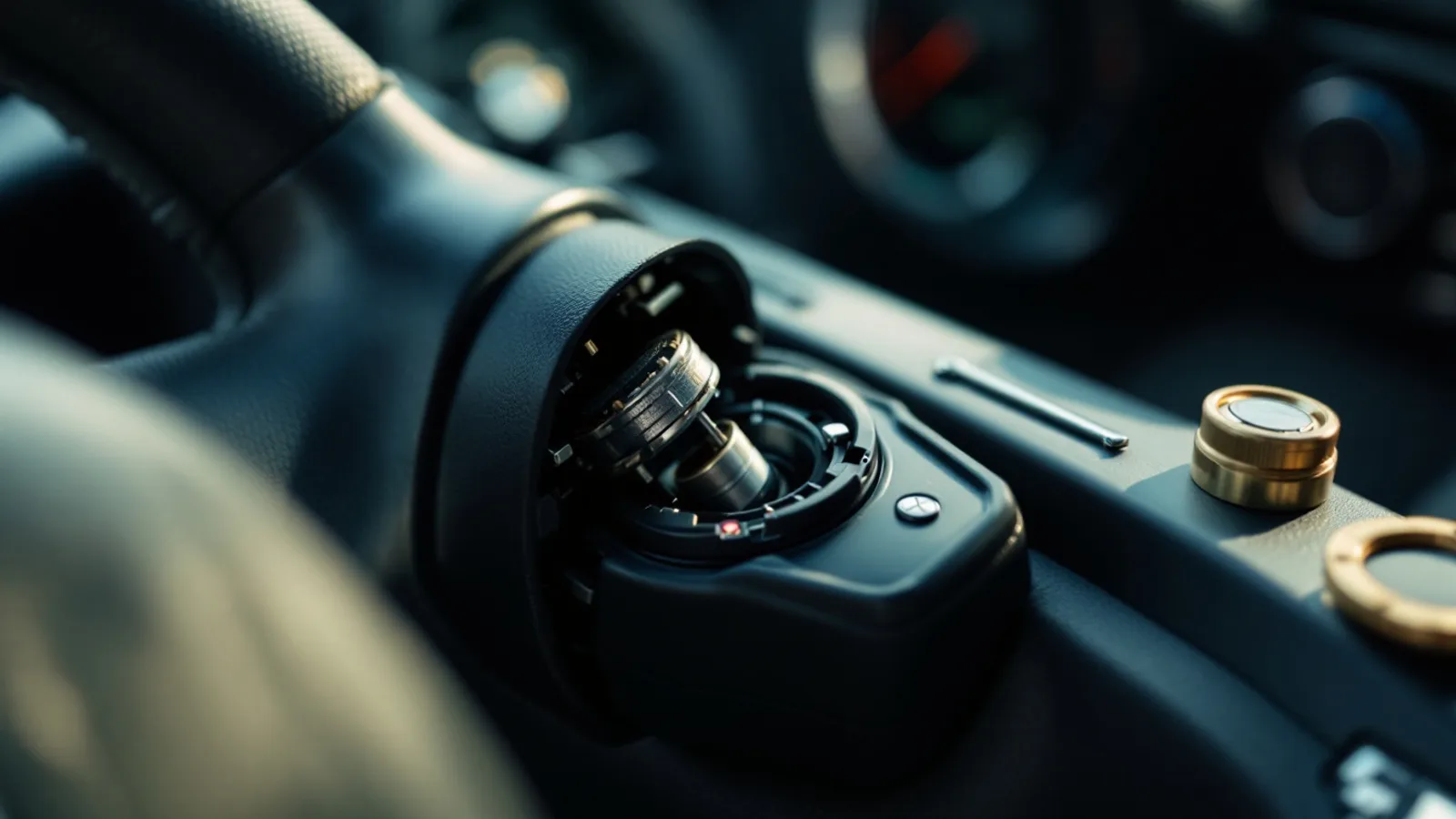
Honda Ignition Switch Repair in Dallas: Diagnosing Accord, Civic, CR-V and Pilot Faults
As of July 2026, Honda ignition system repair in Dallas typically runs $250-$480 by fault. How to tell a worn key from a cylinder, switch or interlock problem.
Four Different Faults Hide Behind One Sentence: "My Key Won't Turn"
As of July 2026, ignition system repair in Dallas typically runs from about $250 to $350 for servicing a cylinder that is still healthy, up to roughly $220 to $480 for replacing a failed electrical ignition switch, with a fresh transponder key at $120 to $200 if the key itself turns out to be the culprit. The reason that range is so wide is not pricing games — it is that "my key won't turn" describes at least four mechanically unrelated problems on a Honda, and only one of them is actually the ignition switch. Getting the diagnosis right before anyone orders a part is the entire job. This guide is written diagnosis-first: what each fault feels like in your hand, what it does to the dash, and how a technician separates them at the curb on an Accord, Civic, CR-V, or Pilot.
Hondas are everywhere in this metro — Accords commuting up 75, Civics parked across Richardson and Garland, CR-Vs and Pilots doing school runs through Mesquite. They are also honest cars to diagnose, because the architecture is simple: a mechanical lock cylinder, a separate electrical switch stacked behind it, an immobilizer antenna ring around the housing, and on automatics a shifter interlock that can freeze the whole assembly for reasons unrelated to wear. Our ignition repair service covers the first three on-site, and the Honda brand page lays out how the hardware differs across generations.
Fault One: The Key Blade Is Worn, Not the Ignition
The most common finding and the cheapest fix, which is why an honest technician checks it first. A Honda key blade is soft brass-alloy metal cut to a precise depth pattern, and a decade of daily insertion plus the side load of a heavy keyring rounds those cuts down measurably. The wafers inside the cylinder are fine — they just are not being lifted to the right heights anymore.
The signature is unmistakable once you know it. The key goes in fully but stops dead at the first detent, and lifting it slightly while turning suddenly makes it work. A drawer spare — barely used, barely worn — turns cleanly on the first try. If that describes your Accord, the ignition is innocent and a freshly cut, correctly programmed key is the entire repair. We cover those hand-feel differences in our guide to a key stuck in the ignition.
There is a trap here worth naming: copying a worn key copies the wear. A replacement has to be cut to the vehicle's original factory code, not traced off the tired original — that is what a proper car key replacement means, and why a hardware-store copy so often fails on the very car it was made for.
Fault Two: The Ignition Lock Cylinder Is Failing
If the spare key struggles too, attention moves to the cylinder. Inside a Honda ignition lock sits a stack of spring-loaded wafers riding in machined slots, plus a retainer and a cam that drives the electrical switch behind it. Wafers wear, springs weaken, and the graphite-and-grit paste that accumulates over a decade turns from lubricant into abrasive.
Cylinder failure has its own tells:
- Gritty, sandy resistance through the whole rotation rather than a hard stop at one point.
- The key will not come back out of the ACC position, because the cam is not returning cleanly.
- The cylinder turns with almost no resistance at all — a worn-out lock can eventually turn with a screwdriver-grade lack of security, which is a safety issue, not just an inconvenience.
Cylinder work splits two ways. Either the lock can be pulled, cleaned, re-shimmed, and re-wafered so it accepts your existing key again, or it is past that and a new cylinder goes in — re-keyed to your existing key so you are not carrying two keys for one car. That call is made with the cylinder out and on the bench, not from the driver's seat.
Fault Three: The Electrical Ignition Switch Has Failed
This is the fault people mean when they say "ignition switch," and it is a different part. Behind the mechanical lock sits a plastic-bodied block of contacts the cylinder's cam rotates through OFF, ACC, ON, and START. The lock decides whether you may turn it; the switch decides what gets power when you do.
When the electrical switch fails, the mechanical feel is perfectly normal. The key turns smoothly all the way to START and then:
- Nothing at all happens — no crank, no click, no dash change.
- Or the dash lights come on at ON, but START produces silence.
- Or the car starts and then dies when you release the key back to the ON position, because the run circuit contact is burned.
- Or accessories flicker, the radio cuts out over bumps, or the car stalls when you hit a pothole — the classic intermittent-contact signature.
That last group is the one people drive around with for months. An intermittent ignition switch that kills the engine at speed is a real safety problem, and it is the kind of defect NHTSA exists to track through its vehicle safety and recall programs. If your Honda has ever shut off while moving, treat it as urgent rather than annoying.
Fault Four: It Is the Shifter Interlock, and the Ignition Is Fine
Here is the diagnosis that saves the most money and gets missed most often. On an automatic Honda, an interlock ties the shifter and the ignition together: you cannot remove the key unless the shifter is fully in Park, and on many models you cannot turn it at all if the car does not believe it is parked.
Symptoms that point at the interlock rather than the ignition:
- The key will not turn, but nudging the shifter firmly further into Park frees it instantly.
- The key will not come out even though the car is off and the shifter looks like it is in Park.
- The brake lights are not working — the brake-light switch feeds the same interlock logic on many designs.
A cousin worth knowing: the steering lock. If the wheel spring-loaded itself against the lock pin when you parked, the key cannot rotate because the pin is under load. Rocking the wheel left and right with light key pressure releases it. That is a technique, not a repair, and it resolves a startling number of "my ignition is broken" calls for free.
How Honda's Immobilizer Changes the Picture
Every Honda built with an immobilizer carries a small antenna ring around the ignition cylinder housing. Inserting the key energizes the transponder chip in its head, and the encrypted answer goes to an immobilizer control unit that authorizes fuel and spark. Push-button Hondas swap the ring for cabin antennas and a smart key ECU, but the logic is identical: no valid credential, no combustion.
This matters for ignition work in two specific ways.
First, it changes what a "no start" means. If the key turns, the starter cranks, and the engine simply will not fire while a key symbol blinks on the cluster, that is an immobilizer failure, not a mechanical one. The cylinder did its job; the key, the antenna ring, or the immobilizer unit did not. Those cases are what our immobilizer and "no key detected" service is built for.
Second, it changes what happens after cylinder work. If a replacement cylinder cannot be re-keyed to your existing key, you are holding a different blade whose transponder has to be relearned before it will start anything. Ignition work and key programming are two halves of one visit on a modern Honda — a distinction we unpack in the ignition repair versus replacement cost guide.
Common Honda Problems We See
Accord: the high-mileage cylinder
Our most frequent Honda ignition call. Typically a car past 120,000 miles where the original key has been the only key for a decade, and the diagnosis splits cleanly between a worn blade and a gritty cylinder. The spare-key test settles it in thirty seconds.
Civic: keyring load and the ACC hang
Civics arrive with heavy keyrings and a key that hangs in ACC instead of returning to OFF. That is cam and retainer wear accelerated by side load, and lightening the keyring is genuinely part of the long-term fix.
CR-V: interlock and brake-switch confusion
The CR-V generates a disproportionate share of "key won't come out" calls that turn out to be interlock, not ignition. Checking whether the brake lights actually illuminate has saved CR-V owners from an unnecessary cylinder replacement more than once.
Pilot: intermittent electrical switch
Higher-mileage Pilots show the electrical-switch pattern — accessories cutting out, a stall on a rough road, a start that succeeds on the second try. The mechanical feel stays perfect throughout, which is why the diagnosis gets missed by feel alone.
The Honest Boundary: What Is Not a Locksmith Job
This is where a straight-dealing shop draws its line out loud.
A locksmith handles the lock cylinder, the key, the transponder and immobilizer relearn, the electrical ignition switch in most Honda designs, and the diagnosis that tells all of those apart.
A locksmith does not handle structural steering-column work — a collapsed column, a damaged column shroud casting, a failed clockspring, an airbag-adjacent repair, or a lock housing that has to come apart in ways that disturb the airbag system. Those belong at a shop equipped for column work.
Shifter-interlock and brake-light-switch faults sit in a gray zone. We identify the interlock as the cause and free the vehicle, but replacing a shift cable, an interlock solenoid, or a brake-light switch is repair work we refer out rather than selling you a cylinder you do not need.
We also will not guess on the newest platforms. For late-model Hondas with push-button start and encrypted smart-key architecture, a technician confirms your exact setup from the VIN before dispatch rather than promising a curbside outcome that may not exist.
Honda Ignition System Repair Costs in Dallas (2026)
Here is how the four faults price out in the Dallas market as of July 2026, on the published mobile scale. Note that the row you land on is decided by the diagnosis, not by the symptom you called about.
| Diagnosed fault | What the repair actually is | Dallas range (2026) |
|---|---|---|
| Worn key blade, cylinder healthy | Fresh key cut to factory code + transponder programmed | $120 – $200 (transponder) / $160 – $280 (remote head) |
| Cylinder serviceable | Pull, clean, re-wafer and re-shim to your existing key | $250 – $350 |
| Cylinder past service life | New lock cylinder, re-keyed so your existing key still works | $180 – $400 |
| Electrical ignition switch failed | New switch behind the cylinder; mechanical lock retained | $220 – $480 |
| Immobilizer relearn after cylinder swap | New key credential written to the immobilizer unit | $120 – $280 by key type |
| No working key exists alongside ignition work | All-keys-lost recovery added to any row above | Add $75 – $250 |
| Shifter interlock / brake-switch fault | Identified and vehicle freed; component repair referred out | Diagnostic only |
| Dealer path, same job | Parts at retail + labor + tow + service queue | Commonly $700 – $1,100+ |
Two clarifications. Every range above assumes a serviceable Honda diagnosed on-site — the diagnosis is what selects the row, and a technician will not quote a cylinder replacement over the phone on a car that may only need a key. And the dealer comparison row includes the tow, because a Honda that will not turn over cannot drive itself to a service department.
What a Dallas Visit Looks Like
- Phone triage. Model, year, mileage, and a precise symptom — does the key turn, does the engine crank, does the dash light up, does a spare behave differently. That alone narrows it to one or two faults.
- Ownership verification. Photo ID plus registration or title before any work that produces a new working key.
- The spare-key test and the interlock test. Free, fast, and they eliminate two of the four faults before a tool comes out.
- Cylinder extraction if warranted. The lock comes out for bench inspection, where "service it" versus "replace it" becomes an evidence-based call.
- Electrical switch check. Continuity through OFF, ACC, ON, and START tells us whether the switch behind the lock is doing its job.
- Relearn and verification. Any new credential is written, then crank, run, accessory, key removal, and a hot restart are all tested before we leave.
We run the identical Honda service across Dallas, Richardson, Garland, and Mesquite, with the broader automotive locksmith service covering everything adjacent. Locked out rather than fighting an ignition? Start at emergency locksmith. Remote functions dead too? Key fob programming. Key simply gone? Lost car keys, or reach us through contact.
Frequently Asked Questions
Q: How much does ignition system repair in Dallas cost for a Honda in 2026? A: It runs roughly $250 to $350 to service a healthy cylinder, $180 to $400 to replace a worn one re-keyed to your existing key, and $220 to $480 to replace a failed electrical ignition switch. If the key itself is the fault, a properly cut transponder key at $120 to $200 fixes it outright. The dealer path for the same work commonly lands at $700 to $1,100+ once a tow and service queue are added.
Q: How do I know if it is my Honda key or my ignition cylinder? A: Try your spare key. If a lightly used spare turns cleanly while the daily key hangs up, the daily key's cuts are worn and the cylinder is fine. If both keys fight the lock equally, the cylinder is the suspect. That single thirty-second test separates the cheapest repair from the more involved one before anyone spends money.
Q: My Accord cranks but will not start and a key light is blinking — is that the ignition switch? A: No, that is an immobilizer fault, not an ignition switch fault. If the starter is turning the engine over, the mechanical lock and the electrical switch both did their jobs. A blinking key symbol means the immobilizer did not recognize your key's transponder, which points at the key chip, the antenna ring around the cylinder, or the immobilizer control unit.
Q: Why will my Honda key not come out of the ignition? A: The most common cause on an automatic is the shifter interlock — the car does not believe the shifter is fully in Park, so it refuses to release the key. Push the shifter firmly into Park and try again, and check whether your brake lights work, since the brake-light switch feeds that same logic. If the interlock checks out, a worn cam inside the cylinder is the next suspect.
Q: Can a mobile locksmith replace a Honda ignition switch at my location? A: Yes, for most Honda models the lock cylinder, the electrical switch behind it, and any required key programming are all done on-site in your driveway or parking space, with the car drivable when the technician leaves. The exceptions are structural steering-column damage and airbag-adjacent column work, which get referred to a shop equipped for that repair.
Q: Will I need a new key after my ignition cylinder is replaced? A: Not necessarily. Whenever the new cylinder can be re-keyed to your existing key, you keep carrying the same key and no relearn is needed. If the cylinder must take a different key, then the new key's transponder has to be programmed to your Honda's immobilizer before it will start the engine, which adds $120 to $280 depending on whether it is a basic transponder or a remote head key.
The Bottom Line
On a Honda, "the key won't turn" has four suspects: a worn key blade, a tired lock cylinder, a failed electrical switch, and a shifter interlock that has nothing to do with the ignition at all. The spare-key test and the Park-and-brake-light test eliminate half that list for free, and everything downstream follows from an honest diagnosis rather than a guess. Have your Accord, Civic, CR-V, or Pilot's model year, mileage, and exact symptom ready and call (469) 896-4128. Dallas Locksmith Pros answers 24/7 and quotes flat-rate before anyone is dispatched.
Written by the mobile technicians at Dallas Locksmith Pros, who diagnose Honda ignition faults on-site across Dallas and the surrounding suburbs.
Related articles
Hyundai and Kia Ignition Repair in Dallas: Rebuild the Cylinder or Replace the Assembly?
As of July 2026, Hyundai and Kia ignition repair in Dallas runs $250-$480 depending on rebuild versus replace. Sonata, Elantra, Tucson, Sorento, Telluride.
Read moreVolkswagen Passat & Golf Ignition Repair in Dallas: Two Faults Owners Keep Confusing
As of August 2026, VW ignition repair in Dallas runs $250-$350 to re-pin a cylinder. A cluster-hosted immobilizer fault is a different job entirely.
Read moreSubaru Outback and Forester Ignition Repair in Dallas: Why the Key Stopped Turning
As of August 2026, most Subaru key-won't-turn calls in Dallas are a bound steering lock or a worn cylinder, not a failed ignition. What it really costs.
Read moreNeed a Dallas locksmith right now?
Licensed mobile automotive locksmith. Same-day response across DFW.
Call (469) 896-4128