
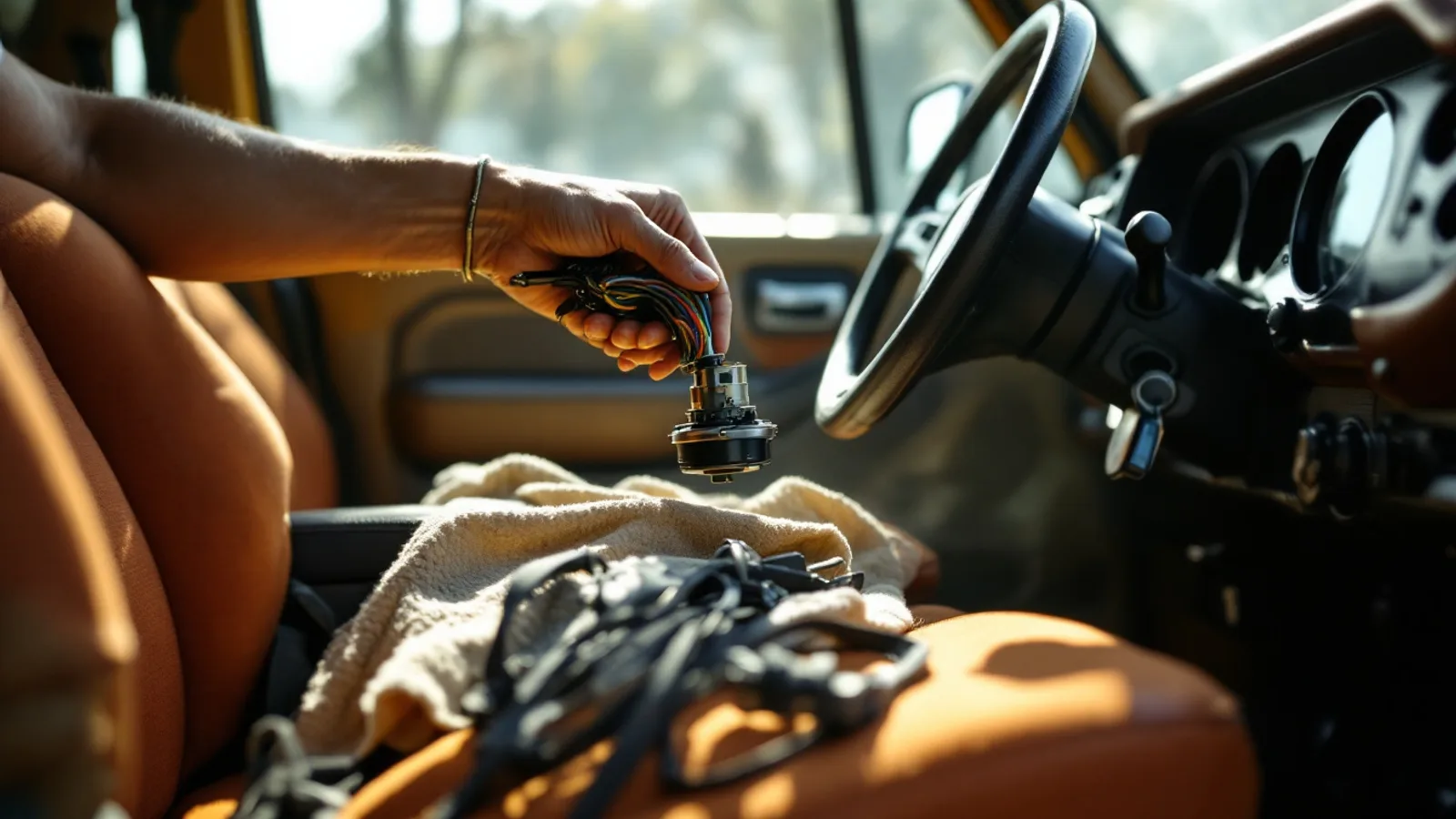
Subaru Outback and Forester Ignition Repair in Dallas: Why the Key Stopped Turning
As of August 2026, most Subaru key-won't-turn calls in Dallas are a bound steering lock or a worn cylinder, not a failed ignition. What it really costs.
The Cheapest Repair in This Article Costs Nothing
Before we talk about cylinders, switches, or modules, do this: put the key in, hold light pressure on it in the turn direction, and rock the steering wheel firmly left and right. If the key suddenly turns, your Subaru never had an ignition fault. It had a steering column lock loaded against its pin, which happens when the wheel gets nudged after the car is parked — a curb in a Carrollton lot, a hard tug on the wheel while getting out, a slope in a driveway.
That thirty-second test resolves a real fraction of the Subaru "my key won't turn" calls we take, and we tell people to run it on the phone before we dispatch. As of August 2026, when the problem is genuinely mechanical, Subaru ignition work in Dallas starts with an on-site diagnosis and key work runs $120 to $200 for a blade transponder key up to $250 to $500 for an Access Key proximity fob. What it should never be is a guess. Call (469) 896-4128 and we will run the free test with you first.
Quick Answer
A Subaru Outback or Forester with a key that will not turn is usually one of three things: a steering column lock bound against the ignition pin, a worn ignition lock cylinder, or a worn key that no longer matches the cylinder's wafers. Only the second and third cost money to fix, and the repair is mechanical rather than electronic. If the key turns fine but the engine cranks without firing, you have moved into immobilizer territory instead, where the BIU holds the key registry. Key pricing runs $120 to $200 for a blade transponder, $160 to $280 for a remote head key, and $250 to $500 for an Access Key fob, with all-keys-lost adding $75 to $250.
Subaru Ignition and Key Costs in Dallas (2026)
| Job | Applies to | Dallas price range (2026) |
|---|---|---|
| On-site ignition diagnosis | Turn-key Outback, Forester, Impreza, Legacy | Quoted before work begins |
| Ignition lock cylinder repair or replacement | Higher-mileage turn-key models | Quoted after diagnosis; rekeyed to your existing key where serviceable |
| Blade transponder key, cut and registered | Base-trim turn-key models | $120 – $200 |
| Remote head key | Turn-key models with remote buttons | $160 – $280 |
| Access Key proximity fob | Keyless Access push-button models | $250 – $500 |
| All keys lost (add-on) | Any Subaru | +$75 – $250 |
| Immobilizer relearn after module work | BIU or ECM replacement | $120 – $280 |
| Subaru lockout, non-destructive entry | Any | $85 – $200 day / $125 – $275 after-hours |
| Dealer path, all-in | Any | Commonly $700 – $1,100+ |
The cylinder row has no number in it on purpose. Cylinder condition ranges from "clean it, service it, and rekey it to the key already on your ring" to "the assembly is finished." Quoting that sight-unseen would be a number invented for a brochure.
Three Different Parts, One Complaint
Owners say "my ignition is broken." Three separate components can produce that sentence, and they fail differently.
The lock cylinder — the mechanical half
This is the barrel your key physically enters. Inside it, spring-loaded wafers read the cuts on your blade and either align to permit rotation or refuse. Wafers wear. Blades wear. Both wear faster when a heavy keyring hangs off the ignition for a decade, because every bump in a Dallas surface street becomes leverage on the cylinder.
The classic failure curve is gradual and ignorable, which is why so many people are surprised by it. First the key needs a little jiggle. Then it needs a specific angle. Then it needs the spare key, which everyone interprets as the first key having gone bad. Then one morning nothing works. A key that has to be wiggled is a key telling you the cylinder is on a clock.
The ignition switch — the electrical half
Behind the cylinder sits the electrical switch that the cylinder actually rotates. It routes power to accessories, run, and start. When this component fails, the symptom is different and diagnostic: the key turns normally and the car does nothing, or the dash lights up in accessory and dies at start, or things work intermittently when you jostle the column. If the key rotates freely and the electrics are the problem, replacing the cylinder would be pure waste.
The steering column lock
The pin that immobilizes the wheel is what makes the free test at the top of this article work. Under load, that pin binds the cylinder and no amount of key force will move it — and forcing it is precisely how blades snap off inside the barrel. That is the same failure mode we described in our write-up on the Honda Accord and Civic ignition switch repair pattern, because column-lock bind is not a Subaru quirk. It is universal to every turn-key car ever built.
Common Outback and Forester Patterns We See
Outback: the high-mileage wagon nobody babied
The Outback earns its miles in this market — long commutes, weekend loads, and owners who keep them well past the ten-year mark. That mileage profile is exactly what produces cylinder wear, and the fourth-generation and earlier turn-key cars are the ones we service most for it. The tell is almost always the same: the owner has been "doing the trick" with the key for months.
Forester: two keyrings, one worn cylinder
The Forester generations before the current one commonly ran a blade or remote head key on base trims, and Foresters live household lives — two drivers, two keyrings, one of which is enormous. When one key works and the other does not, people conclude the second key is defective. Frequently the truth is inverted: the cylinder has worn to match the shape of the more-used key, and the other key is simply the one telling the truth about the cylinder's condition.
Both: key turns, engine cranks, never fires
Now you have left the mechanical world entirely. A strong crank with no start, especially with a security or key-shaped indicator on the dash, is the immobilizer refusing to authorize. The blade turning proves the cylinder is fine; the engine not firing proves the transponder conversation failed.
Both: the blade that snapped off in the barrel
This is what happens after weeks of forcing a bound or worn ignition. Do not try to fish it out with pliers, superglue, or a screwdriver — every one of those attempts pushes fragments deeper and turns a straightforward extraction into a cylinder replacement. Broken key extraction is a five-minute job with the right tool and a hundred-dollar mistake without it. If your key is stuck rather than broken, our guide to a key stuck in the ignition covers the shift-interlock causes first.
Both: a used fob bought online that the car ignores
Subaru will not accept a fob that has not been registered, regardless of how genuine the part is. A marketplace fob is a shell and a circuit board until the car's registry says otherwise.
Where the BIU Fits Into All of This
Subaru routes its immobilizer through the BIU — the Body Integrated Unit — a body-electronics module behind the dash that doubles as the security gatekeeper. It stores the list of registered key identities, reads the transponder through an antenna ring at the ignition on turn-key cars or through the Keyless Access antennas on push-button cars, and tells the engine control module whether a crank is allowed to become a start.
Two consequences matter for anyone reading this with a dead Subaru.
Every key is a registration, not a copy. Cutting a blade does nothing on its own. The BIU has to be told the new key exists. That is why a hardware-store copy will open your doors and never start your engine.
A failed BIU is a module job, not a key job. When the module itself is the fault rather than the key list inside it, you are buying a Subaru BIU key replacement and module service with a registration attached, which is a different price and a different conversation. We separate those two before quoting, not after.
The trim split is the other thing to know. Base Impreza, Crosstrek, Forester, and Outback trims kept a turn-key blade transponder for years after Limited and Touring trims moved to the Access Key proximity fob. The same model year can take either key. That is not us hedging — it is why we ask for the VIN instead of the year.
Repair, Replace, or Rekey?
Three honest outcomes, in order of what we hope to find.
Service and rekey. If the cylinder is worn but serviceable, the repair path preserves it and rekeys it to the key already on your ring — meaning no new transponder, no registration, and no new key to carry. This is the best outcome and it is more common than people expect.
Replace the cylinder, rekey to your key. When the barrel is past saving, a replacement cylinder can usually be keyed to your existing blade so your current transponder key still starts the car. You keep your key; only the hardware changes.
Replace and re-register. If the assembly has to change and the key cannot be preserved, then a new blade is cut and registered to the BIU, and that lands on the key pricing in the table above. Our broader ignition repair page covers the decision framework across makes, and the cost comparison is laid out in our ignition repair versus replacement cost guide. The same three-way decision shows up on other makes with similar cylinder wear profiles — our Mazda6 and CX-9 ignition switch repair breakdown walks the identical logic on a different platform.
The Honest Boundary
The newest Subarus tighten security access around the BIU. Registration procedures that are routine on a 2014 Outback are not automatically routine on the latest model years, and we confirm feasibility from the VIN rather than assuming.
A genuinely failed BIU can be a dealer answer on the very latest VINs. A module replacement with registration is a bigger job than a key, and on some current cars it belongs in the factory channel. We would rather say that on the phone than in your driveway.
Push-button Subarus have no ignition cylinder at all. If your Outback or Forester has Keyless Access, there is nothing mechanical to wear out at the ignition — a no-start there is the fob, the antennas, the start switch, or the module. Anyone quoting you a "cylinder replacement" on a push-button car has not looked at the car.
A technician confirms your exact setup from the VIN before anyone is dispatched. Trim, key type, and module generation all change the work. Proof of ownership — photo ID plus registration or title — is required for key work and verified at the vehicle.
What a Dallas Subaru Visit Looks Like
- Phone triage, starting with the free steering-lock test and your exact symptom wording.
- Ownership verification at the vehicle.
- Mechanical separation — does the key turn? Does it turn and do nothing? Is the blade worn, or the cylinder?
- Cylinder service, rekey, or replacement, preserving your existing key wherever the hardware allows.
- BIU registration if a new key is genuinely required, including cutting to code from the VIN and pairing remote functions.
- Verification before departure — start, accessory positions, remote functions, and a clean turn through every detent.
We cover Carrollton, Richardson, Garland, and Rockwall for this work, which tracks where the older turn-key Subarus actually live in this metroplex. Model-by-model detail sits on the Subaru brand page, and standard chip-key work on transponder key programming.
Frequently Asked Questions
Q: My Subaru key will not turn in the ignition. What do I try first? A: Rock the steering wheel firmly left and right while holding light turning pressure on the key. A steering column lock that has bound against its pin is the single most common cause, and releasing that load frequently lets the key turn immediately at no cost. If the key still refuses after several attempts, stop forcing it — continued force is how blades snap off inside the cylinder.
Q: How do I know whether it is the lock cylinder or the ignition switch? A: Watch what the key does. If the key is hard to insert, needs wiggling, or will not rotate, the fault is mechanical and lives in the lock cylinder or the blade itself. If the key turns smoothly through its positions and the car simply does nothing — no dash lights, no crank, or intermittent behavior when you jostle the column — the electrical switch behind the cylinder is the suspect instead.
Q: How much does a Subaru key cost in Dallas in 2026? A: A blade transponder key runs $120 to $200 cut and registered, a remote head key $160 to $280, and an Access Key proximity fob $250 to $500 including the concealed emergency blade. All keys lost adds $75 to $250 because the BIU registry has to be rebuilt with nothing to copy from. Dallas dealers commonly land at $700 to $1,100+ once towing and shop time are included.
Q: Can I keep my current key if the ignition cylinder is replaced? A: Usually yes, and that is the outcome we aim for. A replacement cylinder can generally be keyed to your existing blade, which means your current transponder key still starts the car and no new key has to be cut or registered to the BIU. That saves you both the key price and the registration step, so ask for it specifically before authorizing any ignition work.
Q: Why does my Subaru have a turn-key ignition when my neighbor's same-year car is push-button? A: Because Subaru split key hardware by trim rather than strictly by model year. Base Impreza, Crosstrek, Forester and Outback trims kept the blade transponder key and a conventional ignition cylinder well after Limited and Touring trims moved to the Access Key with push-button start. The two take completely different keys and different service paths, which is why the VIN matters more than the year.
Q: My Subaru cranks strongly but never starts, and the security light is flashing. Is that the ignition? A: No, that is the immobilizer. The key turning proves the mechanical side is fine, and a flashing security or key-shaped indicator means the BIU did not accept the transponder and refused to authorize the engine control module. The likely causes are a damaged transponder, a key that was never properly registered, or a module fault, all of which are diagnosed electronically rather than by replacing a cylinder.
The Bottom Line
Subaru ignition complaints break cleanly into a free fix, a mechanical fix, and an electronic fix, and the order you check them in determines what you spend. Rock the wheel first. If the key still will not turn, you are looking at a cylinder that has been warning you for months and can often be serviced and rekeyed to the key already in your hand. If the key turns and the engine cranks without firing, put the cylinder aside — the BIU is refusing to authorize and that is a registration problem, not a hardware one. Tell us which of those three you have and call (469) 896-4128. Dallas Locksmith Pros is mobile 24/7 and quotes the repair, not the worst case.
Written by the Dallas Locksmith Pros mobile automotive team, serving Subaru owners across Dallas and the northeastern suburbs 24/7.
Related articles
Honda Ignition Switch Repair in Dallas: Diagnosing Accord, Civic, CR-V and Pilot Faults
As of July 2026, Honda ignition system repair in Dallas typically runs $250-$480 by fault. How to tell a worn key from a cylinder, switch or interlock problem.
Read moreHyundai and Kia Ignition Repair in Dallas: Rebuild the Cylinder or Replace the Assembly?
As of July 2026, Hyundai and Kia ignition repair in Dallas runs $250-$480 depending on rebuild versus replace. Sonata, Elantra, Tucson, Sorento, Telluride.
Read moreDallas Ignition Repair vs Replacement: 2026 Cost Guide and How to Tell Which You Need
Ignition repair in Dallas runs $250-$350; replacement $180-$550. A 2026 guide to telling them apart — and why a mobile locksmith beats the dealer and the tow.
Read moreNeed a Dallas locksmith right now?
Licensed mobile automotive locksmith. Same-day response across DFW.
Call (469) 896-4128