
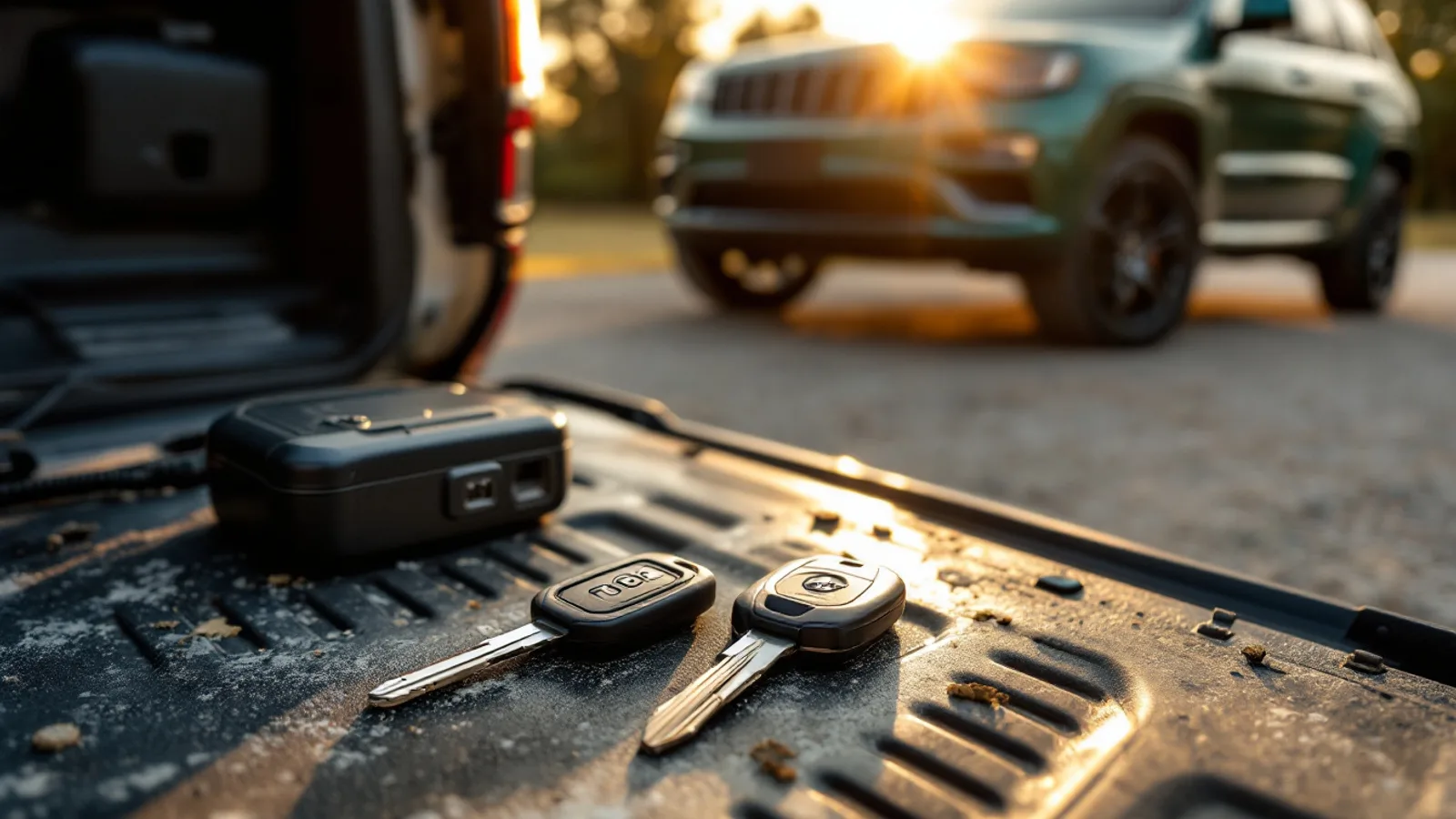
Jeep Grand Cherokee & Wrangler Key Replacement in Dallas: The WIN Module Is the Whole Job
As of August 2026, a Jeep key in Dallas is a WIN module conversation, not a cut blade. FOBIK $150-$300, smart prox $250-$400. Here is what that buys.
Your Jeep Does Not Have a Key Problem, It Has a Module Conversation
Cut a Jeep key on a machine and you have produced a piece of metal that opens a door. That is the entire extent of what the blade does. Everything that makes a Wrangler or a Grand Cherokee actually start lives inside a module most owners have never heard of: the WIN, or Wireless Ignition Node, on the older architecture, and the RF Hub on the newer one.
That distinction is not trivia. It is why a Jeep owner can hold a brand-new dealer-boxed FOBIK and still be stranded, why the hardware store down the road cannot help, and why the correct search is really for a car locksmith in Dallas with module tooling rather than for a key cutter. The WIN holds the list of key identities the vehicle will accept and gates the start permission. Until a technician opens a legitimate security dialogue with that module and writes your key into its table, the key is a paperweight with buttons.
As of August 2026, Jeep key work in Dallas prices by what the vehicle actually uses: $150 to $200 for an older blade transponder key, $150 to $300 for a FOBIK programmed to the WIN, and $250 to $400 for a smart proximity fob on RF-Hub models, with $75 to $250 added when every key is gone. Have your VIN ready and call (469) 896-4128.
Quick Answer
Yes, a properly equipped mobile locksmith programs Jeep keys on-site, including all-keys-lost, without a tow. Budget $150 to $300 for a FOBIK, $250 to $400 for a smart proximity fob, or $150 to $200 for an older blade transponder, plus $75 to $250 if no working key exists. The work happens in your driveway because the WIN and RF Hub are reachable through the vehicle's diagnostic port, not because someone cut a better blade.
Jeep Key Replacement Pricing in Dallas (2026)
| Jeep key scenario | Typical models | Dallas price range (2026) |
|---|---|---|
| Blade transponder key, working key present | Older Wrangler, Liberty, Patriot | $150 – $200 |
| FOBIK programmed to the WIN | Wrangler JK, Grand Cherokee WK2 2011-2013 | $150 – $300 |
| Smart proximity fob, RF-Hub models | Grand Cherokee 2014-2021, Wrangler JL, Gladiator | $250 – $400 |
| All keys lost, blade transponder | Older Jeeps | $225 – $450 |
| All keys lost, FOBIK | Wrangler JK, Cherokee KL | $225 – $550 |
| All keys lost, smart proximity | Grand Cherokee, Wrangler JL, Gladiator | $325 – $650 |
| Immobilizer or module relearn, no new key | Any Jeep | $120 – $280 |
| Lockout entry, keys visible inside | Any Jeep | $85 – $200 day / $125 – $275 after-hours |
| Dealer path, all-in | Any Jeep | Several hundred more once a tow and shop labor are stacked on |
Those ranges are for a mobile visit at your location. We will not invent a hard dealer figure, but a flatbed plus shop labor at $150 to $220 an hour reliably lands that route well above the mobile one.
How the Jeep Immobilizer Actually Works
The WIN: Wireless Ignition Node
On the FOBIK generation, Chrysler replaced the traditional lock cylinder and ignition switch assembly with an electronic node. Push the FOBIK into the slot, twist, and you are not turning a mechanical barrel. You are asking a computer for permission.
The WIN performs three separate jobs that owners tend to collapse into one. It is the ignition switch, deciding which electrical positions are live. It is the receiver for the fob's transmission. And it is the immobilizer host, holding the table of accepted key identities and telling the powertrain controller whether a start is authorized.
That triple role is exactly why WIN symptoms are so confusing. A single failing module can produce a dead dash, a fob that refuses to be recognized, and a no-start, all at once, in a vehicle whose battery and starter are perfectly healthy. We keep a dedicated page on that failure class at Dodge, Chrysler and Jeep WIN and RF Hub issues because it accounts for a large share of the "I bought three keys and none of them worked" calls we take.
The RF Hub: the newer architecture
From roughly the 2014 Grand Cherokee onward, and across the Wrangler JL, Gladiator, Cherokee KL and the Compass and Renegade, the radio-frequency side moved into an RF Hub. Push-button start replaced the FOBIK slot on most trims, and the vehicle now listens for a proximity fob rather than reading a key inserted into a node.
The security logic is the same in principle and different in practice. The RF Hub handles the fob's radio conversation; the immobilizer authority is distributed across the network with a gateway sitting in the middle. Programming a proximity fob means talking to more than one module and satisfying a handshake that did not exist on the FOBIK cars. That is where the price step from $150 to $300 up to $250 to $400 comes from.
The emergency blade nobody thinks about
Every proximity Jeep carries a concealed mechanical blade inside the fob body, and the driver's door retains a lock cylinder. It is a genuine escape hatch when the fob battery dies, and it is also a component that has to be cut correctly to the vehicle when a new fob is supplied. Owners are frequently surprised that a "keyless" Jeep still needs a physical key cut.
Generations, in plain terms
The Wrangler JK ran 2007 to 2018 and is FOBIK territory throughout. The Wrangler JL arrived in 2018 with an RF Hub and proximity fobs on most trims. The Grand Cherokee WK2 splits cleanly: 2011 to 2013 is FOBIK, and 2014 to 2021 moved to the newer hub architecture. The Cherokee KL from 2014 to 2023, the Compass and Renegade from 2015 on, and the Gladiator from 2020 sit on the newer side. Model year is the most useful thing you can tell us after the VIN.
Common Jeep Problems We See
Grand Cherokee: "No Key Detected" on a car that was fine yesterday
This is the most common Jeep call in the metroplex. The dash reports No Key Detected or Key Not Detected, the engine will not start, and the fob had been working normally. Roughly half of these are a fob battery or a fob that has drifted out of sync, which prices as fob diagnosis and battery service at $40 to $95. The rest are genuine module or antenna faults, and the honest answer is that the two look identical from the driver's seat. Diagnosis comes first, parts second.
Wrangler JK: the FOBIK the WIN stopped recognizing
JK owners live outdoors with their vehicles, which is hard on a fob. But the classic JK failure is not the fob at all. It is a WIN that has begun to fail intermittently, so the vehicle recognizes the key on Monday and refuses it on Thursday. Buying a second FOBIK does not fix this, and we say so before anyone spends money. When the node itself is the fault, it is genuine module work and covered on our Chrysler and Dodge WIN module replacement page.
Older Jeeps: the key stuck in the ignition
On the pre-FOBIK vehicles with a conventional barrel, keys get stuck, and the causes are few: a worn key, a worn cylinder, a shifter interlock that has not released, or debris. A key that must be jiggled is a warning shot. The next stage is a blade sheared off inside the barrel.
Wrangler JL and Gladiator: dead buttons, live vehicle
A proximity fob whose buttons have stopped working but which still starts the vehicle when held near the start button is telling you something specific: the passive side of the system is fine and the remote-control side is not. That is often a battery or a cracked board from a drop, not an immobilizer problem, and it does not require a full replacement fob in every case.
Any Jeep: bought used with exactly one key
This is not a symptom, it is a countdown. A used Grand Cherokee sold with a single fob puts the owner one lost jacket away from a $325 to $650 recovery instead of a $250 to $400 spare.
Spare Key Versus All Keys Lost
These are not the same job priced differently. They are different procedures.
Adding a spare works against a vehicle that already trusts a credential. The technician presents an accepted key, the module opens for authorized programming, and the new key is appended to the existing table. It is quick, and it is the cheapest version of every Jeep key you will ever buy.
All keys lost removes the trusted credential from the equation. Now the technician has to establish legitimate security access to a module engineered specifically to refuse that, rebuild or extend the stored key data with nothing to authenticate against, generate and pair new keys, and confirm the powertrain controller agrees afterward. The $75 to $250 add-on describes that work. It is not an urgency premium.
There is also a security outcome worth naming. When new keys are registered during a recovery, the missing credentials stop working. A fob that later turns up in a parking lot, or one that was taken rather than lost, no longer starts the vehicle. If you are only adding a spare, your existing key keeps working alongside the new one.
Proof of ownership is mandatory on every all-keys-lost job. Photo ID plus registration or title, no exceptions, on every call regardless of the vehicle or the hour. Creating a working key from nothing is exactly the capability an immobilizer exists to restrict, and the NHTSA vehicle theft-prevention guidance is the framework the entire system is built around.
The Honest Boundary on Jeep Key Work
A physically failed WIN is a part, not a programming step. If the node has failed rather than simply lost its pairing, no quantity of new keys resolves it. The module has to be replaced and re-bound to the vehicle, and that is module work with a different price and a different timeline.
The newest secure-gateway vehicles get VIN-verified first. Late-model Jeeps sit behind a security gateway, and access rules have tightened across the industry. We check feasibility from the VIN before dispatching a truck, because the alternative is a technician discovering a limitation in your driveway at your expense.
A worn ignition cylinder on an older Jeep is not solved by a new key. If the barrel is the problem, a fresh blade buys you a few weeks. Diagnosis has to separate a worn key from a worn cylinder before anyone quotes.
We will tell you when the fob battery is the answer. Fob diagnosis and battery service runs $40 to $95, and a meaningful share of "No Fob Detected" calls end there. Nobody should sell a $400 proximity fob to fix a $6 problem.
What a Dallas Jeep Key Call Looks Like
- Phone triage with the VIN and model year. FOBIK or RF Hub, working key or none, and a flat-rate quote before a truck moves.
- Ownership verification on arrival. Photo ID plus registration or title, every time, without exception.
- Non-destructive entry if the vehicle is also locked. No drilled cylinders, no broken glass, no damaged trim.
- Battery and voltage check. A weak 12V system produces a convincing imitation of an immobilizer fault, and nothing is diagnosed on bad voltage.
- Module diagnosis. WIN or RF Hub read first, so you find out whether this is a key job or a module job before parts are involved.
- Key generation and pairing, including cutting the mechanical blade or emergency blade to the vehicle.
- Full verification. Start and run, remote lock and unlock, panic, tailgate or swing gate, passive detection at each door on proximity vehicles, and the emergency blade physically tested in the driver's door.
We cover Dallas, Plano, Frisco, McKinney and Rockwall along with the rest of the metroplex, at any hour. The general capability sits on our car key replacement and lost car keys pages, the full model breakdown is on the Jeep brand page, and if you want the wider picture of what a mobile automotive locksmith in Dallas actually programs, our guide to what we program by make covers it make by make. If the phrase itself is what brought you here, we also wrote plainly about what car key programming near me actually means.
Frequently Asked Questions
Q: Can a locksmith program a Jeep key without going to the dealer? A: Yes, on the large majority of Wrangler, Grand Cherokee, Cherokee, Compass, Renegade and Gladiator model years, including all-keys-lost. The technician reaches the WIN or RF Hub through the diagnostic port and writes the new key identity into the module's accepted list on-site. Budget $150 to $300 for a FOBIK, $250 to $400 for a smart proximity fob, or $150 to $200 for an older blade transponder, plus $75 to $250 when no working key exists.
Q: What does a Jeep key replacement cost in Dallas? A: It depends on which key your Jeep actually uses, not on the model name. Older blade transponder keys run $150 to $200. A FOBIK programmed to the WIN is $150 to $300. A smart proximity fob on the RF-Hub vehicles is $250 to $400. Add $75 to $250 if every key is gone. All of those are mobile prices at your location, which avoids the tow and shop labor that push the dealer route several hundred dollars higher.
Q: My Jeep says "No Key Detected" but the fob is right here. What is wrong? A: Three things produce that message. A dead or dying fob battery is the most common and the cheapest, at $40 to $95 for diagnosis and battery service. A fob that has lost synchronization needs a relearn at $120 to $280 and no new hardware. The third is a genuine WIN or RF Hub fault, where the module itself is failing to recognize a perfectly good key. They look identical from the driver's seat, which is why diagnosis comes before parts.
Q: I bought a used FOBIK online. Why will it not start my Jeep? A: Because a FOBIK is inert until the WIN accepts it. Every Jeep key carries an identity that has to be written into the module's authorized table, and buying the physical part accomplishes none of that. A used fob also may be locked to its previous vehicle depending on type. We can often program owner-supplied hardware, but we check the part number and condition first rather than promising it will work sight unseen.
Q: Do I need my Jeep towed for an all-keys-lost? A: No, in the large majority of cases. All-keys-lost programming happens on-site through the diagnostic port, so the vehicle stays where it is. Budget $225 to $550 on a FOBIK Jeep and $325 to $650 on a proximity vehicle, and expect the visit to take longer than a simple spare because security access has to be established with nothing trusted present. Photo ID plus registration or title is required before any work begins.
Q: Is a Jeep spare key worth buying before I need it? A: Yes, and the gap is large enough to make it obvious. A spare programmed against a working key is $150 to $400 depending on type. The same vehicle with every key gone is $225 to $650 because the procedure changes entirely. If you bought your Wrangler or Grand Cherokee used with one fob, you are already carrying the more expensive version of this job as a standing risk.
The Bottom Line
A Jeep key is not a blade with a chip glued to it. It is an identity that has to be written into a WIN or an RF Hub by someone equipped to hold that conversation, which is why the parts counter cannot help. Most Wranglers, Grand Cherokees, Cherokees, Compasses, Renegades and Gladiators are programmed in your driveway for $150 to $400 depending on key type, plus $75 to $250 when every key is gone, and when the module itself has failed we will tell you that instead of selling you a third fob. Have your VIN and model year ready and call (469) 896-4128. Dallas Locksmith Pros answers 24/7, verifies ownership on every recovery, and quotes flat-rate before anyone is dispatched.
Written by the Dallas Locksmith Pros mobile automotive team, serving Jeep owners across Dallas and the surrounding metroplex 24/7.
Related articles
What It Costs to Program a Key You Already Bought in Dallas (2026)
As of September 2026, programming a fob you supplied costs $75-$250 in Dallas with a working key, $150-$400 without. Full labor table and what we can't program.
Read moreExotic & Ultra-Luxury Car Key Replacement Cost in Dallas (2026)
As of September 2026, an exotic car key in Dallas runs $350-$600+ before module work, and some marques are factory-order only. Here is the real breakdown.
Read moreJaguar I-PACE Spare Key in Dallas: The Electric Cat That Still Runs on 12 Volts
As of September 2026, a second Jaguar I-PACE key in Dallas runs $350-$600+. Why the spare matters more on an EV, and what the keyless module must agree to.
Read moreNeed a Dallas locksmith right now?
Licensed mobile automotive locksmith. Same-day response across DFW.
Call (469) 896-4128