
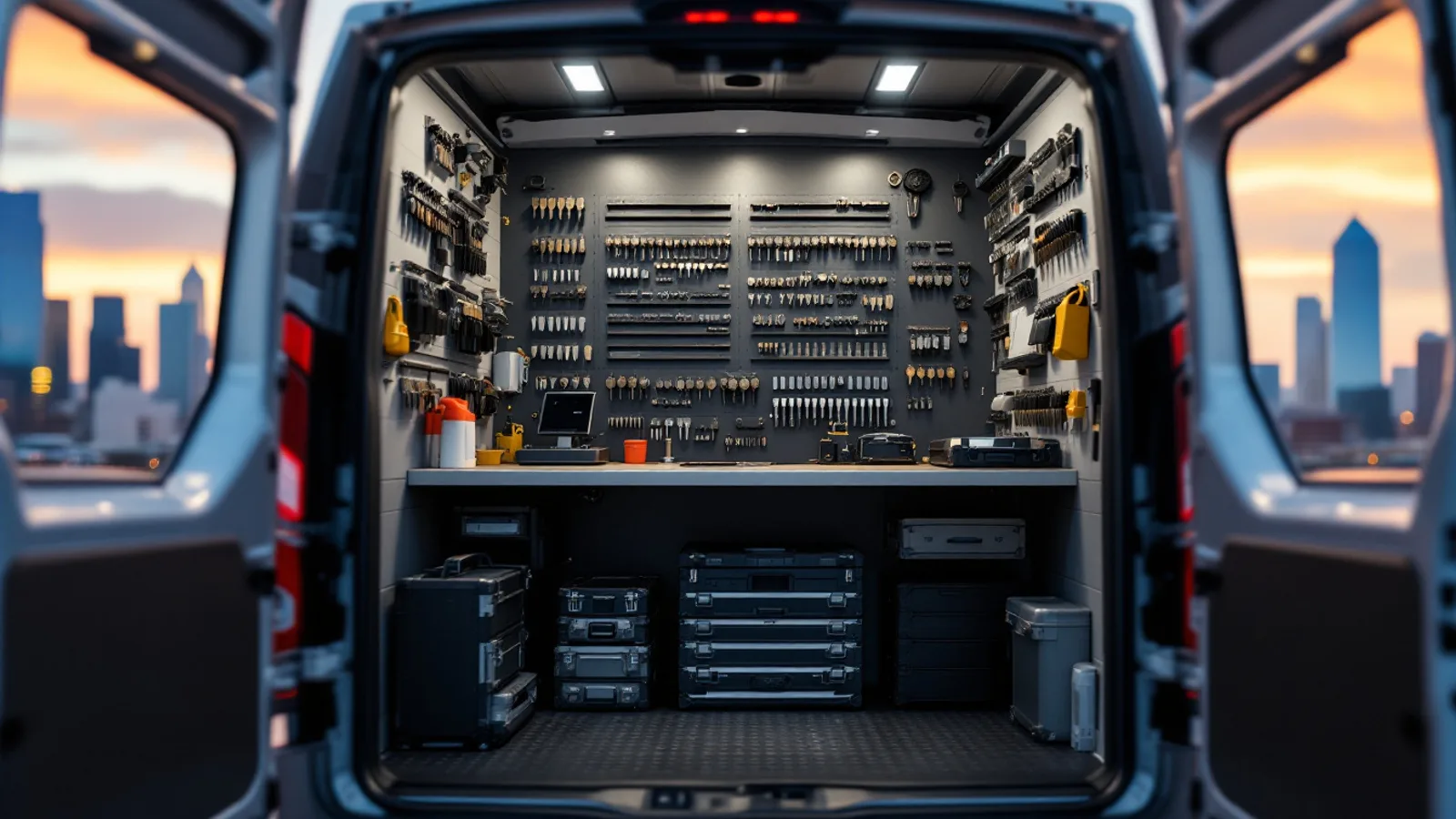
Automotive Locksmith in Dallas: What We Actually Program, Make by Make
As of August 2026, a Dallas automotive locksmith covers keys $120-$600+, ignitions, and module programming. Full make-by-make capability list.
Quick Answer
A mobile automotive locksmith in Dallas cuts and programs car keys, adds spares, repairs and replaces ignition assemblies, and programs vehicle control modules — at your car, without a tow. As of August 2026 the work runs $120 to $200 for a basic transponder key, $250 to $500 for a smart proximity fob, and $350 to $600+ for European smart fobs, with an all-keys-lost recovery adding roughly $75 to $250. Call (469) 896-4128 with your year, make, model, and VIN and you can have a real answer in about two minutes.
That is the short version. The rest of this page is the long version, because "automotive locksmith" is one of those job titles that hides an enormous amount of variation. Two vans can arrive at the same driveway carrying wildly different capability. This article is about where the line falls, service by service and make by make.
The Four Things This Trade Actually Does
Strip away the marketing and mobile automotive locksmithing is four distinct competencies. Most shops are good at one or two. The difference between them matters more than anything you will read on a website banner.
Key replacement means producing a working credential for a car that has none in your hand. That is mechanical cutting plus electronic pairing, and on a modern vehicle the electronics are the hard part. Our car key replacement page covers the general path.
Spare keys are the same work performed while a key still works, which changes the economics completely. The vehicle is cooperative because it already trusts a credential; the technician is adding to a list rather than rebuilding it. That is why a spare car key is the cheapest smart money in vehicle ownership.
Ignition work is mechanical and electrical at once — worn wafers, a cylinder that will not turn, a key that will not come out, a switch that no longer sends the run signal. See ignition repair for the repair-versus-replace decision.
Computer and module programming is the deep end: engine controllers, body control modules, transmission controllers, steering locks, instrument clusters, and the security modules that gate all of it. This is where most "locksmiths" stop and where a properly equipped shop starts. That capability lives on our module programming and repair page.
Everything below is a map of where each make sits inside those four buckets.
Automotive Locksmith Pricing in Dallas
| Service | Typical vehicles | Dallas range (2026) |
|---|---|---|
| Basic transponder / chip key | Older Toyota, Honda, Ford, GM sedans and trucks | $120 – $200 |
| Remote head key | 2000s–2010s domestics and Asian imports | $160 – $280 |
| Flip / switchblade key | VW, Audi, Chrysler group, many Hyundai and Kia | $180 – $320 |
| Smart / proximity fob | Push-to-start Toyota, Lexus, Nissan, Ford, GM, Genesis | $250 – $500 |
| European smart fob | BMW, Mercedes, Audi, Porsche, Jaguar, Land Rover | $350 – $600+ |
| All keys lost, any type | Any make, add to the band above | Add $75 – $250 |
| Ignition repair or replacement | Most makes | Quoted after inspection |
| Car lockout | Any vehicle | $85 – $200 day / $125 – $275 after-hours |
A dealership quote for the same job typically lands 40 to 60 percent higher once you count labor at $150 to $220 per hour, an OEM part at retail, and a flatbed to get the car there in the first place. Our breakdown of 24/7 response times and pricing walks through what a Dallas call actually costs after hours, and what Texas DPS Private Security Program licensing means for who is allowed to do this work at all.
Domestic Makes
Ford, Lincoln
Ford's security architecture has been called PATS for decades, and the practical consequence is that key work usually routes through the powertrain control module rather than a standalone immobilizer box. Older transponder and remote head keys are routine. Push-to-start F-150, Explorer, Expedition, Mustang, and the Lincoln lineup use proximity fobs in the smart-key band. Where Ford gets interesting is when the PCM itself is replaced or reflashed and the key relationship has to be rebuilt from scratch — that is Ford PATS key programming territory, not fob-cloning territory.
Chevrolet, GMC, Cadillac, Buick
General Motors moved from the resistor-pellet VATS system through Passlock and into full transponder and proximity systems, which means "a GM key" can mean five different things depending on the badge year. The most common Dallas call is a Silverado, Tahoe, Suburban, or Yukon owner who is down to one key — and adding the second one is straightforward while that key still works, which is the whole argument in our Tahoe and Suburban spare key guide. Escalades escalate faster than the rest of the family because of the trim electronics; the recovery process is laid out in Cadillac Escalade all keys lost. Security-light no-starts on older GM iron are their own diagnostic branch, covered under GM theft deterrent no-start.
Dodge, Chrysler, Jeep, Ram
The Chrysler group centralizes wireless security in a body-side hub — historically the WIN module, later the RF hub — and that single design decision explains most of the odd behavior owners report. Keys that intermittently fail, ignitions that will not release, remote functions that die while the car still starts: those symptoms often point at the module, not the key. Grand Cherokee, Wrangler, Charger, Challenger, Ram 1500, and Pacifica all sit inside this family.
Japanese and Korean Makes
Toyota and Lexus
Toyota is the most consistently serviceable major make in this trade, and it is also the one where the spare-versus-lost gap is widest. A Camry, Corolla, RAV4, Tacoma, Tundra, 4Runner, or Highlander with a working key is a short visit. The same vehicle with no keys at all can require significantly deeper access depending on generation. Truck owners in particular tend to run one key for years, which is why we wrote the Tacoma and Tundra spare key guide. Lexus proximity systems follow Toyota's architecture with additional layers on the newer platforms.
Honda and Acura
Honda's immobilizer talks to the engine control module, and the practical effect is that key programming and ECU work overlap more than owners expect. Accord, Civic, CR-V, Pilot, and Odyssey are routine on the key side. Ignition cylinder wear is a genuine Honda pattern — a key that has to be jiggled is a cylinder telling you it has a finite number of cycles left.
Nissan and Infiniti
Nissan and Infiniti route security through the body control module, and BCM behavior is the single most common source of "my car will not start and the security light is on" calls across the two brands. Altima, Rogue, Sentra, Maxima, Pathfinder, Titan, and the Infiniti Q and QX lines share the pattern. If the vehicle cranks but will not run and the immobilizer indicator is flashing, start at Nissan BCM immobilizer no-start before you buy a key you may not need.
Hyundai, Kia, Genesis
The Hyundai group runs one of the more serviceable smart-key architectures on the road, which is good news for Elantra, Sonata, Tucson, Santa Fe, Telluride, Sorento, and Genesis owners alike. Older models use flip keys in the $180 to $320 band; push-to-start models sit in the smart-fob band. Ignition switch failures on certain mid-2000s to mid-2010s models are common enough to be a recognizable Dallas service pattern.
Subaru, Mazda, Mitsubishi
Subaru's body integrated unit governs key acceptance on Outback, Forester, Ascent, and Crosstrek. Mazda's transponder and proximity systems are conventional and generally cooperative; Mazda6 and CX-9 ignition cylinders wear in a predictable way. Mitsubishi is low-volume in North Texas but serviceable on most model years.
Tesla
Tesla is a different animal and deserves saying plainly: key cards and phone keys are paired through the vehicle's own interface and the owner's Tesla account, which means the owner has to be present and authenticated. No locksmith legitimately bypasses that. What a mobile tech genuinely adds is fob pairing, card replacement, and lockout access — the practical scope is described in Tesla key fob programming.
European Makes
BMW and Mini
BMW's security has moved through CAS and FEM/BDC generations, and the model year determines almost everything about how a key job runs. Comfort Access adds a passive-entry layer on top. All-keys-lost recoveries on older CAS cars are routine for a properly equipped shop; newer FEM and BDC vehicles narrow considerably. See BMW key programming for the generational breakdown. Mini shares the underlying architecture with its own body variations.
Mercedes-Benz
Mercedes concentrates ignition, steering lock, and key authorization into the EIS/EZS assembly, and that concentration is why Mercedes symptoms are so specific: a key that will not turn, a steering lock that will not release, a dash that reads "no key detected" on a car with a perfectly good fob in hand. The last of those is common enough across C-Class, E-Class, and GLE owners that it has its own walkthrough in Mercedes no key detected, and it is very often a $6 coin cell rather than a $600 fob.
Audi and Volkswagen
The MQB platform changed VW group key work meaningfully — component protection means new modules and credentials have to be adopted by the vehicle rather than simply installed. Golf, Jetta, Tiguan, Atlas, A4, Q5, and Q7 all sit inside this world. Pre-MQB cars are generally more open; MQB cars require the right tooling and honest expectations.
Porsche, Jaguar, Land Rover, Volvo
These four sit at the top of the European band both in price and in variability. Cayenne, Macan, F-Pace, XF, Range Rover, Discovery, XC90, and XC60 are all serviceable on many model years by a shop with dealer-level equipment, and genuinely gated on some others. That distinction is the single most important thing to establish before anyone drives to you.
The Honest Boundary
Every capability list on the internet is written to sound unlimited. This one is not.
The newest model years narrow fastest. Manufacturers add authentication layers with each generation, and the vehicles built in the last two or three model years are consistently the hardest to service independently. Mercedes FBS4-era systems, the newest BMW body controllers, and several current European platforms fall here.
Some authentication is dealer-gated by design. Certain key-generation operations require manufacturer-side authorization through secured channels. There is no legitimate independent workaround, and any shop that claims one on a current-year luxury vehicle is either confused or lying. The industry framework governing this class of secure vehicle access exists precisely because the boundary is real.
Module work has its own limits. An airbag or SRS module reset clears stored crash data in the module — it does not replace deployed airbags, and no reputable shop will pretend otherwise.
Proof of ownership is required. Photo ID plus registration or title, every time, especially for all-keys-lost. The whole point of an immobilizer is to make key creation hard for people who are not the owner.
A technician confirms your exact setup from the VIN before anyone is dispatched. That is the policy that makes all of the above workable. Two minutes on the phone beats a wasted trip and a stranded car.
How a Dallas Call Runs
- VIN triage. Year, make, model, VIN, and whether any working key exists. This determines serviceability, part availability, and price band before a van moves.
- Ownership verification on arrival.
- Cheap causes first. Coin cell, vehicle battery, corroded contacts, and interference get eliminated before anyone authorizes module work.
- Cut and pair. Mechanical blade where applicable, then electronic pairing against the vehicle's security module.
- Full function test. Passive entry at each door, start, remote functions, trunk, and panic — verified before the technician leaves.
We run this across Dallas, Irving, Garland, Mesquite, and Grand Prairie, and the general capability picture lives on our automotive locksmith page.
Frequently Asked Questions
Q: What can an automotive locksmith in Dallas do that a dealer cannot? A: Come to the vehicle. That is the practical difference — a mobile automotive locksmith cuts, programs, and tests at your driveway, office lot, or roadside, which removes a flatbed tow from the equation entirely. Cost follows from that: with no dealership labor rate and no OEM retail markup on the key, mobile service typically lands 40 to 60 percent below the all-in dealer path for the same result.
Q: How much does a car key cost in Dallas in 2026? A: Between $120 and $600+ depending entirely on key type. Basic transponder keys run $120 to $200, remote head keys $160 to $280, flip keys $180 to $320, smart proximity fobs $250 to $500, and European smart fobs $350 to $600+. If every key is gone, add roughly $75 to $250 for the all-keys-lost recovery, because the vehicle has to be persuaded to accept a credential it has no reason to trust.
Q: Can you program a key for any make and model? A: No, and that is the honest answer. Most vehicles on Dallas roads are serviceable, but the newest model years and certain dealer-gated luxury platforms require manufacturer-side authentication that no independent shop legitimately bypasses. A technician confirms your exact setup from the VIN before anyone is dispatched, so you find out in a phone call rather than after a van has already parked behind your car.
Q: My car cranks but will not start and the security light is flashing. Is that a key problem? A: Usually it is an immobilizer communication problem rather than a dead key, and the two are not the same repair. The vehicle is refusing to authorize fuel or spark because it cannot verify the credential, which can come from a weak transponder, a failed antenna ring, or a body control module fault. Diagnosis comes first — buying a new key before that is confirmed is a common and expensive mistake.
Q: Is it cheaper to add a spare key now or replace everything later? A: Dramatically cheaper now. Adding a spare while a working key exists puts you at the low end of your key's price band with no all-keys-lost surcharge, because the vehicle already trusts an existing credential and the technician is simply adding to the authorized list. Losing your only key adds $75 to $250 on top of the key itself and turns a short visit into a recovery job.
Q: Do you need proof of ownership to make a car key? A: Yes, every time, without exception. Photo identification plus vehicle registration or title is the standard, and it is checked on site before any key work begins. This is not paperwork theater — the entire purpose of a vehicle immobilizer is to make key creation difficult for anyone who is not the owner, and a shop that skips the check is one you should not be calling.
The Bottom Line
"Automotive locksmith" covers four different jobs and roughly forty different security architectures, and the only useful answer to "can you do my car" starts with your VIN. Most vehicles on the road in Dallas County are serviceable at the curb for far less than a dealer visit — keys from $120 to $600+, ignitions repaired rather than replaced where the cylinder allows, and module-level work that most shops in this trade do not attempt. The exceptions are real, and we will name them out loud rather than discover them at your bumper. Have your year, make, model, and VIN ready and call (469) 896-4128. Dallas Locksmith Pros runs 24/7 mobile service across the metroplex and quotes a flat rate before dispatch.
Written by the Dallas Locksmith Pros mobile automotive team, serving drivers across Dallas and the surrounding metroplex 24/7.
Related articles
Automotive Locksmith in Dallas TX: Service Area Coverage and What Travels in the Van
As of August 2026, here is exactly which Dallas corridors we cover, realistic drive times, and the module capability that comes with the truck.
Read moreAnti-Theft Light Flashing and the Car Won't Start in Dallas: A Diagnosis Guide
As of August 2026, a flashing security light with a no-start in Dallas is an immobilizer authentication failure. Diagnosis $40-$95, relearn $120-$280.
Read moreKey Fob Programming Near Me in Dallas: Who Does It, What It Costs, What It Actually Is
As of September 2026, key fob programming in Dallas runs $120-$500 depending on fob type, done at your car by a mobile automotive locksmith.
Read moreNeed a Dallas locksmith right now?
Licensed mobile automotive locksmith. Same-day response across DFW.
Call (469) 896-4128