
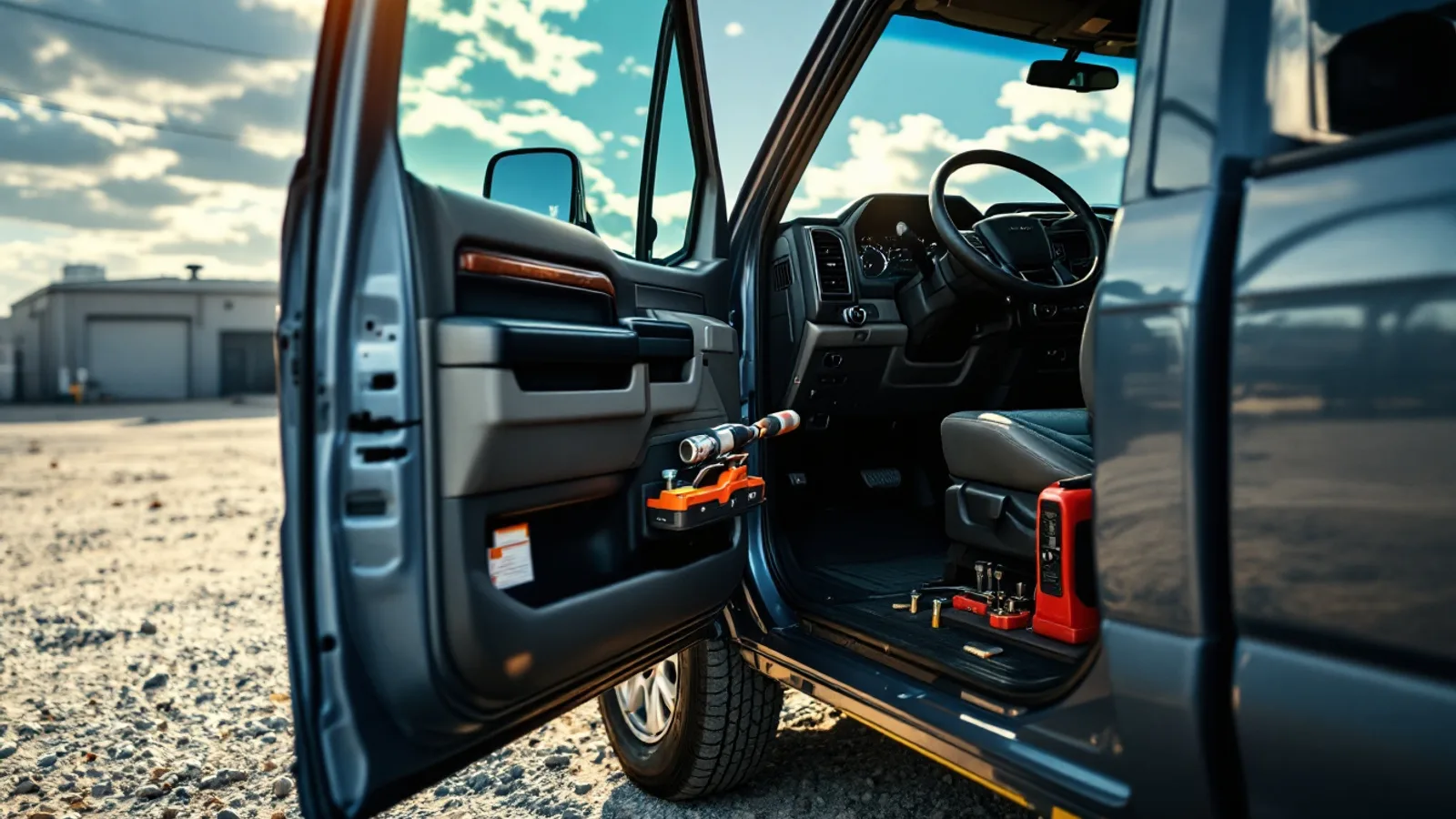
Ford F-150 and Expedition Ignition Repair in Dallas: Worn Cylinder or PATS No-Start?
As of August 2026, a Ford F-150 that will not start is either a worn ignition cylinder or a PATS fault. They look identical and cost very different money.
A Truck That Does Not Start Is a Day That Does Not Happen
Nobody calls about an F-150 casually. These trucks carry tools, tow trailers, and start at hours when nothing else in the neighborhood is awake, and when one refuses to turn over in a Mesquite driveway at 5:40 in the morning, the cost of a wrong diagnosis is not just parts — it is a job site sitting idle.
Here is the fork in the road that decides everything: a Ford that will not start is either a mechanical fault at the ignition lock cylinder or an electronic fault in the PATS anti-theft system. From the driver's seat those two look close to identical. In the shop they are unrelated repairs on different price scales, and the wrong guess buys parts that fix nothing. As of August 2026, Ford key work in Dallas runs $120 to $200 for a PATS transponder key and $250 to $500 for a smart fob, while a cylinder repair is a mechanical quote made after somebody actually looks at the truck. Call (469) 896-4128 and we will separate the two before anything is ordered.
Quick Answer
If the key is hard to insert, needs jiggling, or will not rotate, the ignition lock cylinder is worn and the repair is mechanical — often serviceable and rekeyed to the key already on your ring rather than replaced outright. If the key turns normally and the engine cranks without firing while the anti-theft light flashes, the fault is PATS and the truck is refusing to authorize fuel, which is an electronic repair. Ford transponder keys run $120 to $200, flip and remote head keys $160 to $280, smart fobs $250 to $500, with all keys lost adding $75 to $250. A dealer path lands at $700 to $1,100+ once towing and shop labor are counted.
The Symptom Decoder
Read your truck's behavior against these three descriptions before you call anyone — including us.
The key will not go in cleanly, or goes in and will not turn. Mechanical. The cylinder's wafers or the blade's cuts have worn past the point of agreement. Sometimes there is a third factor: the steering column lock is loaded against its pin, which happens easily on a heavy truck parked on a slope. Hold light turning pressure and work the wheel side to side before assuming the worst.
The key turns through its positions and the truck does absolutely nothing. Electrical, but not necessarily anti-theft. The switch assembly behind the cylinder routes power to accessory, run, and start. When it fails, the cylinder rotates perfectly and nothing downstream wakes up.
The key turns, the starter spins, the engine never catches, and the theft light is flashing. PATS. The truck can crank and has decided not to run because it did not recognize the key credential. Replacing a cylinder here would be a several-hundred-dollar way to change nothing.
Ford Ignition and Key Costs in Dallas (2026)
| Job | Applies to | Dallas price range (2026) |
|---|---|---|
| On-site diagnosis: cylinder, switch, or PATS | F-150, Expedition, Explorer, Escape | Quoted before work begins |
| Ignition lock cylinder repair or replacement | Turn-key trucks and SUVs | Quoted after diagnosis; rekeyed to your existing key where serviceable |
| Broken key extraction from the cylinder | Any turn-key Ford | Quoted on site; usually the fastest job on this list |
| PATS transponder key, cut and programmed | Turn-key F-150, Expedition, Escape | $120 – $200 |
| Flip or remote head key | Trucks with remote buttons in the head | $160 – $280 |
| Smart fob, push-button start | Intelligent Access trims and later trucks | $250 – $500 |
| All keys lost (add-on) | Any Ford | +$75 – $250 |
| PATS relearn after PCM or BCM work | Post-module-replacement | $120 – $280 |
| Ford lockout, non-destructive entry | Any | $85 – $200 day / $125 – $275 after-hours |
| Dealer path, all-in | Any | Commonly $700 – $1,100+ |
Why F-150 and Expedition Cylinders Wear Faster Than Cars Do
Cylinder wear is not random. Three forces drive it, and full-size Fords catch all three.
Duty cycle. A commuter car gets started twice a day. A working F-150 gets started at the yard, at the supply house, at two job sites, at lunch, and again on the way home. Cycle count, not calendar age, is what grinds wafers, which is why a seven-year-old truck with a working life can be further along than a twelve-year-old sedan.
The keyring. Trucks attract keys. Gate keys, trailer locks, padlocks, a fob, a bottle opener somebody thought was funny. That mass hangs off the cylinder and gets multiplied by every expansion joint on the road. A heavy ring is a slow lever, and it is the single most preventable cause of ignition wear we encounter.
Grit and heat. North Texas gives lock hardware a hard year — fine dust, summer cabin temperatures that thin lubricant, and the general reality of a vehicle that lives outdoors. Cylinders in this climate age faster than the same part would in a garage-kept car up north.
The warning sequence is consistent and almost universally ignored. First the key needs a nudge. Then it works from one specific angle. Then only the spare works, which owners misread as the original key having failed. Then nothing. Any truck at stage two is a truck we can usually still service instead of replace — the same escalating pattern we documented across a completely different platform in our Hyundai and Kia ignition switch repair breakdown, because worn wafers behave the same way regardless of the badge on the grille.
PATS: The No-Start That Wears a Mechanical Disguise
Ford's Passive Anti-Theft System is the reason a truck with a perfectly good ignition cylinder can still refuse to run.
What the theft light is actually saying
The anti-theft indicator on the cluster is a status report, and its behavior is diagnostic. A light that flashes rapidly during a start attempt means the system read something and rejected it — a damaged transponder, an unprogrammed key, or a key the module no longer has on file. A theft indicator that stays solid, or a truck that cranks and dies within a second or two, points at the authorization handshake failing rather than at anything mechanical.
None of that is fixed by a cylinder. All of it is fixed electronically.
Where PATS actually lives
On most Fords the key data sits in the PCM, the powertrain control module, which reads the transponder through a ring antenna around the ignition and verifies it against the stored key list before permitting the engine to run. Newer push-button trucks route detection through the body control module instead.
That architecture has a consequence owners run into after engine work: replace or reflash a PCM and the keys have to be re-paired to it. A truck that started fine last week and now flashes theft after a module swap does not have a key problem — it has a relearn that never happened. Our write-up on Ford PATS module programming and PCM relearn covers that scenario end to end, and the deeper module side of the work sits on our Ford PCM and ECU programming page.
Common F-150 and Expedition Patterns We See
The 2009–2014 F-150: the classic cylinder job
This generation is our most frequent Ford ignition call in Dallas, and it is squarely mechanical most of the time. Blade transponder and remote head keys, a conventional cylinder, and enough accumulated cycles to have worn it. When a truck from these years cranks strongly and fires normally once you get the key to turn, you have already proven PATS is fine and the cylinder is the whole story.
The 2015–2020 F-150: two trucks wearing one badge
The aluminum-body generation split by trim. XL and XLT trucks generally kept the blade PATS key and a conventional ignition; upper trims moved to an Intelligent Access proximity fob with push-button start. Same model year, same nameplate, completely different failure modes — and a push-button truck has no ignition cylinder to wear out at all. If a shop quotes you a cylinder replacement without asking which trim you own, that is a meaningful tell.
Expedition: the family hauler with truck-grade duty
The Expedition shares the F-150's underlying architecture and much of its key story, with later models moving to push-button start across most of the range. What sets Expedition calls apart is usage: third-row family SUVs get short-trip, high-cycle use, and they collect keyrings the way trucks do. The wear profile ends up looking more like a work truck's than a sedan's.
Any Ford: the blade that snapped off inside the barrel
This is the predictable ending to weeks of forcing a stiff ignition, and it is the moment a cheap repair becomes an expensive one — but only if it is handled badly. Do not attempt to retrieve fragments with pliers, adhesive, or a thin screwdriver. Each of those pushes the broken piece deeper and can damage the wafers, turning a quick broken key extraction into a full cylinder replacement. Extraction with proper tooling is usually the fastest job on our entire price list. If the key is intact but trapped, our key stuck in the ignition guide covers the shift-interlock causes first.
Repair, Replace, or Rekey
Service and rekey. A worn but serviceable cylinder gets cleaned, serviced, and rekeyed to the key already on your ring. No new transponder, no programming, no second key to carry. This is the outcome we look for first and it succeeds more often than owners expect.
Replace and key to your existing blade. When the cylinder is finished, a replacement can usually be cut to match your current key, so your existing transponder key still starts the truck. You keep your key; only the hardware changes.
Replace and program a new key. If the key cannot be preserved, a new blade is cut to code from the VIN and programmed through PATS, landing on the key pricing above. The cross-make decision framework lives on our ignition repair page, and straightforward key work on car key replacement.
The Honest Boundary
The newest gateway-era Fords route programming access through authorized channels. Most Ford key work is squarely on-site — PATS transponders, Intelligent Access fobs, all-keys-lost, post-PCM-swap relearns — but the latest VINs add secured steps, and occasionally the honest answer is the dealer. We check before dispatching.
Phone-as-key is not a locksmith operation. Ford's phone-based credential pairs through the owner's own account on the owner's handset. Nobody's van does that, and anyone claiming otherwise is selling something else.
A push-button truck cannot have a worn ignition cylinder, because it does not have one. A no-start on an Intelligent Access F-150 or Expedition is the fob, the antennas, the start switch, or a module — never a mechanical barrel.
A technician confirms your exact setup from the VIN before anyone is dispatched. Model year, trim, key type, and whether a working key exists all change the procedure and the price.
Proof of ownership is required for key work and verified at the truck — photo ID plus registration or title. If a child or a pet is shut inside a vehicle, call 911 first; that is not a situation to wait out for a locksmith.
What a Dallas Ford Visit Looks Like
- Phone triage, starting with which of the three symptom descriptions above matches your truck, plus year, trim, and VIN.
- Ownership verification at the vehicle.
- Mechanical versus electronic separation before any part is sold — does the key turn, does the starter spin, what is the theft light doing?
- Cylinder service, rekey, extraction, or replacement where the fault is mechanical, preserving your existing key when the hardware allows.
- PATS work where the fault is electronic — key programming, all-keys-lost key data rebuild, or a relearn after module replacement, through Ford PATS key programming.
- Verification before departure — a clean turn through every detent, a start, remote functions, and lost credentials invalidated on an all-keys-lost job.
We run this across Mesquite, Garland, Grand Prairie, Irving, and Rockwall, which is where the working trucks in this metroplex actually park overnight. Full model coverage sits on the Ford brand page.
Frequently Asked Questions
Q: How do I tell a worn ignition cylinder from a PATS problem on my F-150? A: Watch whether the key turns. If the key is hard to insert or will not rotate, the fault is mechanical and lives in the cylinder or the blade. If the key turns normally and the starter spins while the engine refuses to catch — especially with the anti-theft light flashing — the fault is PATS refusing to authorize the engine, and no amount of cylinder work will change that outcome.
Q: How much does Ford key replacement cost in Dallas in 2026? A: A PATS transponder key runs $120 to $200 cut and programmed, a flip or remote head key $160 to $280, and a smart fob for push-button trucks $250 to $500 including the concealed emergency blade. All keys lost adds $75 to $250 because the key data in the PCM has to be rebuilt with nothing to copy from. A dealer typically lands at $700 to $1,100+ once towing and labor are included.
Q: What does a flashing anti-theft light on a Ford actually mean? A: It means PATS evaluated a key credential and rejected it, which is why the engine cranks but will not run. The usual causes are a damaged or worn transponder in the key, a key that was never properly programmed to this truck, or key data lost during a PCM replacement or reflash. It is an electronic fault every time, so start with diagnosis rather than buying ignition hardware.
Q: My key broke off in the ignition. Can it be removed without replacing the cylinder? A: Yes, in the large majority of cases, and it is usually the quickest job we do. Extraction tools grip the broken blade and withdraw it without disturbing the wafers, and the cylinder is then evaluated for the wear that caused the break in the first place. What ruins this outcome is a do-it-yourself attempt with pliers or glue, which pushes fragments deeper and frequently forces a full cylinder replacement.
Q: Do I need a new key if my ignition cylinder is replaced? A: Usually not. A replacement cylinder can generally be cut to match the key already on your ring, so your existing transponder key continues to start the truck with no programming required. Ask for that specifically before authorizing the work, because it saves you both the key price and the PATS programming step on the same visit.
Q: My truck started fine until the PCM was replaced, and now the theft light is on. What happened? A: The new module has no record of your keys, so PATS is doing exactly what it should and refusing to authorize the engine. What the truck needs is a key relearn that pairs your existing keys to the replacement module, priced at $120 to $280, not a new set of keys. This is one of the most common post-repair calls we take on high-mileage Fords.
The Bottom Line
Every Ford no-start splits along one line: does the key turn? If it does not, you have a worn cylinder that has been warning you for months and can frequently be serviced and rekeyed to the key in your hand rather than replaced. If it turns and the engine cranks without firing while the theft light flashes, put the cylinder away — PATS is refusing to authorize and that is a programming job, not a hardware one. Getting that fork right is the difference between a morning delay and a lost workday. Tell us which side you are on and call (469) 896-4128. Dallas Locksmith Pros is mobile 24/7 across the metroplex, diagnoses before it sells, and quotes before it dispatches.
Written by the Dallas Locksmith Pros mobile automotive team, serving Ford truck and SUV owners across Dallas and the eastern suburbs 24/7.
Related articles
Honda Ignition Switch Repair in Dallas: Diagnosing Accord, Civic, CR-V and Pilot Faults
As of July 2026, Honda ignition system repair in Dallas typically runs $250-$480 by fault. How to tell a worn key from a cylinder, switch or interlock problem.
Read moreNissan Titan & Frontier Ignition Repair in Dallas: Cylinder Wear vs the Steering Lock
As of August 2026, Nissan Titan and Frontier ignition repair in Dallas is $250-$350 — after separating a worn cylinder from an electronic steering lock fault.
Read moreRam 1500 & 2500 Ignition Repair in Dallas: Worn Wafers, Dead Switch, or a WIN Fault
As of August 2026, Ram 1500 and 2500 ignition repair in Dallas runs $250-$350 — but only after you know whether it is the cylinder, the switch, or the WIN.
Read moreNeed a Dallas locksmith right now?
Licensed mobile automotive locksmith. Same-day response across DFW.
Call (469) 896-4128