
Key Turns but the Car Won't Crank: No Click, Dash Lights On (Dallas Guide)
Key turns but car won't crank or click? Battery, terminals, interlocks, worn key, ignition switch, immobilizer. 2026 Dallas costs $90-$480.
Quick Answer
As of November 2026, a key that turns in the ignition while the car does nothing, with no crank and no click, is usually one of five things, in this order of likelihood: a weak or dead 12-volt battery, a failed electrical ignition switch, a dirty or loose battery terminal, a worn key or cylinder that is not turning the switch fully, or an immobilizer or module fault. The first three cost little or nothing to check. A switch replacement is $220 to $480, cylinder service $90 to $200, and an immobilizer relearn $120 to $280. Call (469) 896-4128 if the car is stranded.
Which Version of "Nothing" Do You Have?
"The key turns and nothing happens" describes at least four different failures, and they point to different parts. Before you do anything, work out which of these you have, because the answer cuts the search in half.
Dead silent, no dash lights at all. Turning the key does not wake the dash, the radio or the interior lights. That is almost always a battery or power-supply problem, not a key problem: a dead battery, a loose or corroded terminal, or a failed main connection. It can also be a failed ignition switch that is not passing power at all, but the battery is the first suspect.
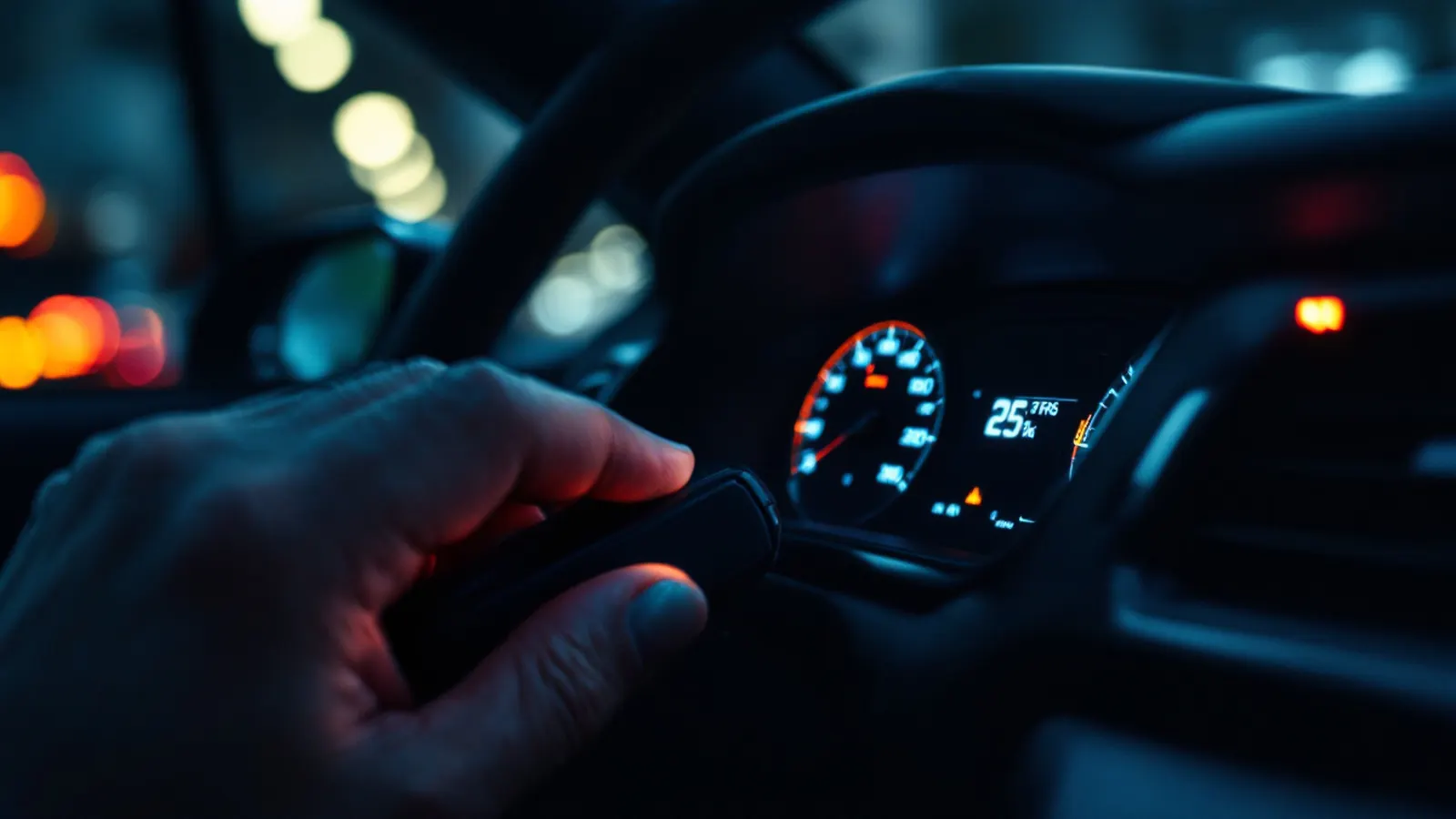
Dash lights come on, but no crank and no click. The key wakes the dash, so power is reaching the car. The starter is not being asked to turn, or it is being asked and not answering. That points toward the start circuit: the switch's start position, a neutral-safety or clutch switch, the starter relay, or an immobilizer that has decided not to allow starting.
Dash lights come on, and you hear a single click or rapid clicking. That is a different symptom, a starter-circuit or low-battery sign, not a "no click" case. A single loud click often means the starter solenoid is being asked to work and the battery or starter cannot deliver. Rapid clicking usually means a battery too weak to turn the engine.
Dash lights come on, the engine cranks but will not start. That is not an ignition fault at all. A car that cranks and does not run is a fuel, spark or immobilizer problem. The anti-theft light often flashes in that case; our anti-theft light flashing guide covers it.
This guide is about the second and first versions: the key turns, the car does not respond. If your car has a start button and no key slot, the right page is our push-button start not working guide, because a button car has no cylinder to fail.
The Diagnostic Order
Work through these in order. They go from the cheapest and most common to the most expensive and least likely. Do not skip ahead to the ignition switch because it sounds like the answer; most of the time it is not.
1. The 12-volt battery
This is the first suspect in a car that will not respond to the key. A weak battery can have enough charge to light a few dash bulbs and run a radio, and not enough to run the starter. A battery that is a few years old, a car that has been sitting for a couple of weeks, or one that made a slow crank the day before are all warning signs. Dallas summers are hard on batteries; heat shortens their life, and the failure often shows up on the first cool morning of fall. If the headlights dim sharply when you turn the key, or the dash flickers or resets, suspect the battery before anything else. A proper load test is quick, and a fresh battery clears more "mystery" no-starts than any other single repair.
If your car is also locked and the battery is dead, the locked out with a dead car battery guide covers that combination and the trunk-battery trap on some models.
2. Battery terminals and the main grounds
A battery can test fine and still deliver no power because a terminal is corroded or loose. Look for white or green crust on the posts, and check that the clamps do not move when you try to twist them by hand. A loose terminal can give you a dash that lights up, goes dim when the starter is asked to work, and a car that does nothing. Cleaning and tightening the terminals is free if you have a wrench and costs little if you do not. Ground straps between the battery, the body and the engine matter just as much. A corroded ground can mimic a dead battery and a dead starter at once.
3. The shifter and clutch interlocks
Automatics will not crank unless the transmission reports Park or Neutral, and manuals will not crank unless the clutch pedal is fully depressed. A misadjusted or failed park/neutral switch, or a clutch switch that has stopped registering, leaves the starter circuit open even though the key turns. Try shifting to Neutral and starting from there. Wiggle the shifter in Park. Press the clutch firmly to the floor. If the car starts in Neutral and not in Park, the switch is the culprit, not the ignition.
4. Is the key turning the switch all the way?
This is where the ignition cylinder and key come in, and it is a common source of "nothing happens." The cylinder is only the mechanical front end. When it turns, it rotates the electrical switch behind it. If the key is worn, or the wafers inside the cylinder are worn, the key can turn the cylinder only partway, or it can turn but not carry the switch all the way into the start position. The dash may light in the "on" position and then nothing happens when you reach "start."
Try the spare key if you have one. A spare that works smoothly means the main key is worn. A spare that behaves the same way means the cylinder or switch is the suspect. Look at the key in good light: if the cuts are rounded off, or the blade is bent or shiny with wear, a fresh key is a cheaper first step than any repair. Our ignition key wiggles loose page explains how to read the wear. Never force a key that will not turn.
5. The electrical ignition switch
The contact block behind the cylinder routes power to accessories, the ignition circuit and the starter as the key moves through its detents. The contacts burn over many thousands of cycles, and the plastic block can crack. When the switch fails you see the kind of symptoms that confuse people: the key turns freely, the dash lights up in "on" and then goes dark when you turn to "start," accessories cut out when you try to crank, or the car starts only if you hold the key at an odd angle. A switch that is failing often works intermittently first. If the dash lights flicker when you tap the key or move the steering column, the switch moves to the top of the suspect list.
Replacing the switch is $220 to $480 in our published service pricing, and changing the cylinder alone does not fix it. That is the most common misdiagnosis in the trade, and the reason we test the circuits before replacing any part. The full price context is in our ignition repair cost guide.
6. The immobilizer and security module
A car with an immobilizer will refuse to crank if it does not recognise the key. In many cars the symptom is a no-start with a flashing security light, and the engine cranks but does not run. In some cars, and on some module faults, the starter is blocked entirely, so you get a key that turns and a car that does nothing, with a security light that stays on or flashes. Causes include a weak key battery on a transponder fob, a failed antenna ring around the cylinder, a car battery that has lost synchronisation after being disconnected, or a faulting module.
A relearn is $120 to $280 when the key and the car need to be re-introduced. Module programming runs $250 to $600 when the module itself is the problem. This is the least likely cause and the most expensive, which is why we leave it for last. If the car is a Lexus, the Lexus RX and ES immobilizer no-start page covers the same fork. If the fob got wet, see the car does not detect the key when wet guide. If the car is a Mercedes with a locked wheel, see the Mercedes steering lock fault guide. If the car is a Nissan, our BCM immobilizer no-start guide explains how to tell it apart from an ignition fault, and the Ford PATS module page does the same for Ford.
7. The starter, relay and fuse
If the dash lights, the key turns smoothly, the battery is strong and the interlocks are fine, the fault may be in the starter itself, its relay or its fuse. Those are mechanical and electrical repairs, not locksmith repairs, and we say so honestly. A mobile technician can narrow the cause by testing whether power reaches the starter. If the fault is the starter or the relay, we tell you, and you take the car to a mechanic instead of paying us for work we did not need to do.
Symptoms and Likely Causes
| What you see | Most likely cause | Realistic Dallas cost |
|---|---|---|
| No dash lights, no sound at all | Dead battery or loose terminal | Battery or a few dollars of cleaning |
| Dash lights dim hard when the key turns | Weak battery or a bad ground | Battery test, replacement if failed |
| Dash lights on, nothing at "start," works in Neutral | Park/neutral or clutch switch | Mechanic repair; not a key job |
| Key turns loosely, dash goes dark at "start" | Worn electrical ignition switch | $220 – $480 |
| Key feels gritty, only sometimes turns the switch | Worn key or cylinder wafers | New key or $90 – $200 service |
| Key turns, security light flashing, no crank | Immobilizer or key communication fault | $120 – $280 relearn; module $250 – $600 |
| Key turns, engine cranks but will not start | Not an ignition fault; fuel, spark or immobilizer | Diagnosed on site |
Costs as of November 2026, Dallas metro, drawn from our published service pricing. A replacement key, if the key itself is the fault, follows the key replacement cost guide: $120 to $200 for a transponder key and up to $500 for a smart fob.
What You Can Safely Try Before You Call
A few checks are safe for anyone and cost nothing. Try the spare key. Try Neutral on an automatic. Press the brake firmly. Turn the steering wheel gently left and right while turning the key, because a wheel that has been shut off against the lock can bind the cylinder. Check that the dash lights come on at all and note how bright they are. Look at the battery terminals if you can safely open the hood. If the car has a transponder key, replace the fob battery if the key has one, a step our dead key fob battery guide describes.
A few things are not worth trying. Do not hammer the column or pull the key hard. Do not spray lubricant into the keyhole, because wet products attract dirt and make a worn cylinder worse. Do not keep cranking a car that is clicking, because a weak battery drains further and can make a simple problem harder. And do not jump-start a car that has no lights at all until you have checked the terminals, because a loose terminal will defeat the jump and waste your time.
What You Should Not Assume
Three assumptions cause expensive mistakes.
"It must be the key." A worn key is a real cause, but a new key does not fix a dead battery, a failed switch or an immobilizer fault. Try the spare first. If the spare behaves the same way, spending money on a new key is a waste.
"It must be the starter." A starter that does not turn is a real failure, but a starter that is never asked to turn looks identical from the driver's seat. If the key turns and the dash goes dark, the starter may be perfectly healthy.
"It must be the immobilizer." Immobilizer faults are real and are the most expensive on the list, but they are also the least common cause. They tend to come with a flashing light and a history, such as a recent battery change or a jump start. Rule out the cheap causes first.
When to Call a Professional
Call when the battery tests good and the car still will not respond, when the key turns loosely or only works at an odd angle, when the dash cuts out as you reach "start," or when a security light flashes. A mobile technician can test the battery, check the circuits, try the key and the spare, and tell you which part is at fault at your location, without a tow. If the fault turns out to be a starter, a relay or a transmission switch, we say so and point you to a mechanic. If it is the ignition, a key or an immobilizer fault, we fix it on the spot in most cases.
A tow to a shop should not be your first move. A tow costs money, it does not diagnose anything on the way, and a car that will not respond to the key may be a quick fix at the curb. Our ignition repair service and no-key-detected and immobilizer service pages describe how we handle each case.
What the Visit Looks Like
You call (469) 896-4128 and describe what the car does: the dash, any sounds, whether a security light flashes, whether a battery was recently changed. We tell you which cause is most likely and the realistic range. At the car we test the battery and terminals, the key and the spare, the switch circuits and the immobilizer response. If a part is at fault, we replace it, test every ignition position, and confirm that the key still works the doors and trunk. If the immobilizer needs a relearn, we run it. If the problem is outside our scope, we tell you plainly and you pay only for the diagnosis.
Where We Work
This symptom shows up wherever cars sit for a week and then need to start on a cold morning. We respond to calls in Dallas, Plano, Richardson, Irving and Garland, and across the rest of the metro. The service is mobile and runs around the clock, so the diagnosis happens where the car is parked.
Frequently Asked Questions
Q: Why does my key turn but the car does nothing? A: Most often a weak 12-volt battery or a loose terminal, then a failed electrical ignition switch, then a worn key or cylinder, and rarely an immobilizer fault. Check the battery and try the spare key first. A switch replacement is $220 to $480 and cylinder service is $90 to $200, so a cheap check beats an expensive guess.
Q: How do I tell a dead battery from a bad ignition switch? A: A dead battery gives you dim or no dash lights, and the lights fade hard when you try to start. A bad switch usually leaves the battery strong, so the dash is bright in the "on" position and goes dark or does nothing at "start." A quick load test settles the question in minutes, and costs far less than a part.
Q: Can a worn key cause a no-crank? A: Yes. A worn key or worn cylinder wafers can turn the cylinder only part of the way, so the electrical switch behind it never reaches the start position. Try the spare key. If it works, the main key is the fault and a fresh key at $120 to $200 for a transponder is the cheapest fix.
Q: Will replacing the ignition switch fix a car that will not start? A: Only if the switch is the fault. A failing switch cuts power at the start position, so the dash goes dark when you turn the key, and replacement is $220 to $480. If the battery is weak, an interlock is stuck or the immobilizer has blocked starting, a new switch will not help and the money is wasted.
Q: Could the immobilizer be stopping the car? A: Yes, though it is the least common cause. Typical signs are a flashing security light, a recent battery change or jump start, or a key that works on the spare but not the main fob. A relearn is $120 to $280 and module programming is $250 to $600, so we rule out the cheaper causes first.
Q: Should I tow the car to a shop? A: Not as the first move. A tow does not diagnose anything, and a no-response key is often a battery, terminal or switch problem a mobile technician can test at the curb. If the cause turns out to be a starter or a transmission switch, we tell you honestly, so you only tow when it is needed.
The Bottom Line
A key that turns and a car that does nothing is, most of the time, a battery, a terminal or a switch problem, not a dramatic failure. The cheap checks come first, the $220 to $480 switch comes next, and the immobilizer, at $120 to $600, comes last. Work in that order and you spend money only on the part that is actually broken.
Call (469) 896-4128 with the year, make and model, and tell us what the dash does when you turn the key. We will tell you the likely cause and the price range before anyone is dispatched.
Related articles
Honda Ignition Switch Repair in Dallas: Diagnosing Accord, Civic, CR-V and Pilot Faults
As of July 2026, Honda ignition system repair in Dallas typically runs $250-$480 by fault. How to tell a worn key from a cylinder, switch or interlock problem.
Read moreDallas Ignition Repair vs Replacement: 2026 Cost Guide and How to Tell Which You Need
Ignition repair in Dallas runs $250-$350; replacement $180-$550. A 2026 guide to telling them apart — and why a mobile locksmith beats the dealer and the tow.
Read moreEuropean Car Ignition Repair Cost in Dallas (2026): Priced by Ignition Type
2026 Dallas ignition repair prices for VW, MINI, Volvo, Jaguar, Alfa Romeo and Fiat: $180 to $550+, sorted by cylinder, key dock or start button.
Read moreNeed a Dallas locksmith right now?
Licensed mobile automotive locksmith. Same-day response across DFW.
Call (469) 896-4128