
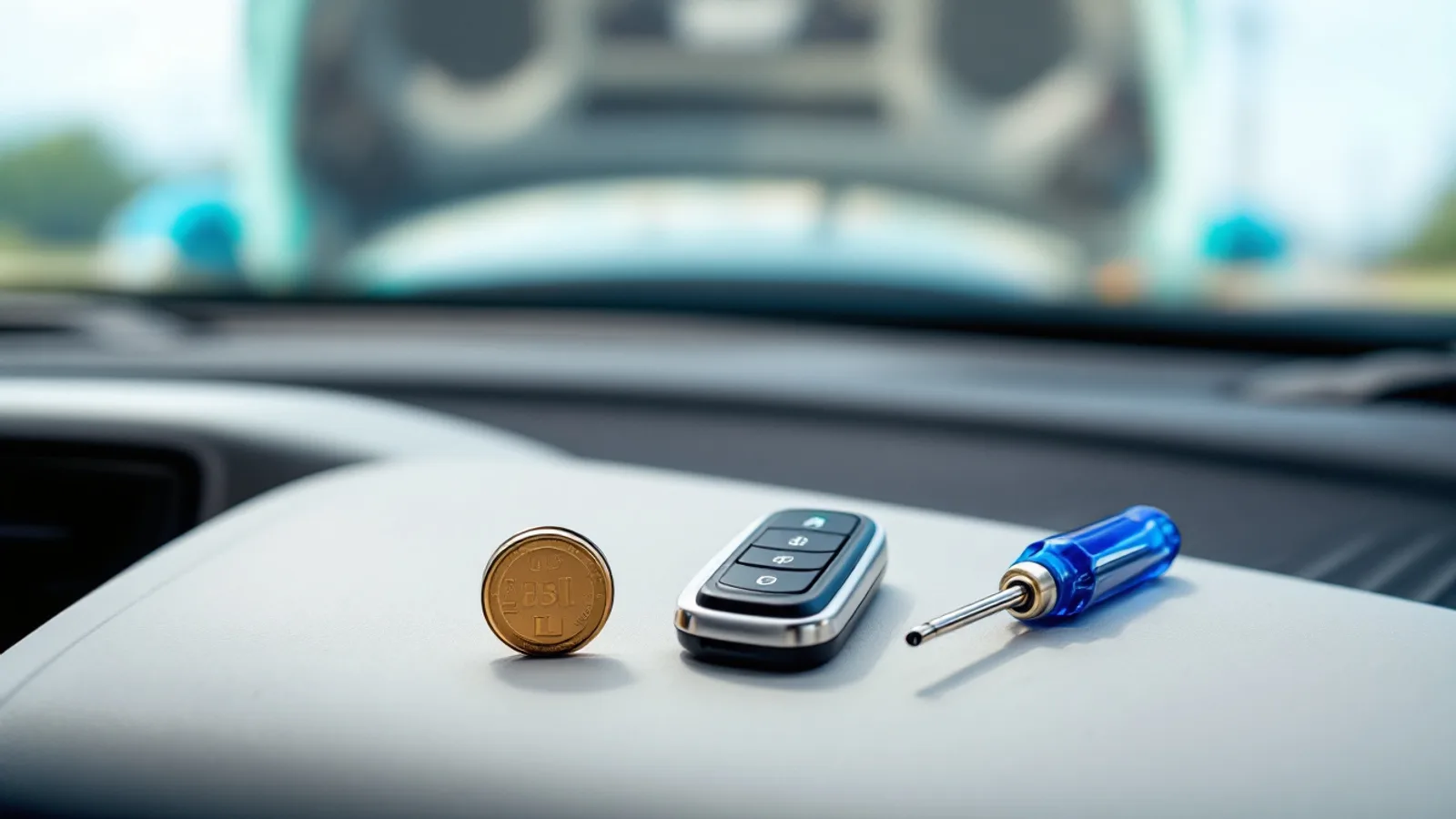
Toyota Prius & Camry Hybrid Smart Key Replacement in Dallas: The 12V Trap
As of August 2026, a Prius or Camry Hybrid smart key in Dallas is $250-$500 — but check the 12V battery first; it fakes a dead key better than anything.
The Most Common Wrong Diagnosis on a Hybrid
More Prius and Camry Hybrid owners call us about a "dead key" than about any other Toyota problem, and a large share of them do not have a key problem at all.
Here is the trap, stated as plainly as it can be: a perfectly healthy hybrid traction battery does not prevent a dead 12-volt auxiliary battery from shutting down your keyless entry and refusing to enter READY. Those are two completely separate batteries doing two completely separate jobs. The big one moves the car. The small one runs the computers, the door locks, the smart key receiver, and the entire authorization conversation that has to happen before the car will do anything at all.
When the small one goes flat, the car stops unlocking with the fob, the start button does nothing, and the owner reasonably concludes the key died. Then they buy a key. As of August 2026 a Toyota smart proximity fob in Dallas is $250 to $500, and fob diagnosis and battery service is $40 to $95 — so guessing wrong in that direction is an expensive way to not fix your car. Call (469) 896-4128 before you buy anything.
Quick Answer
A Toyota Prius or Camry Hybrid smart key replacement is $250 to $500 in Dallas, programmed on site, and fob diagnosis or battery service is $40 to $95 when the fob is simply not being detected. Before assuming the key is the problem, check the 12-volt auxiliary battery — a flat 12V on a hybrid kills keyless entry and READY mode while the traction battery sits fully charged, and it is the single most common false "my key died" call we take on these cars. Both models are serviceable at your location on the large majority of model years.
Toyota Hybrid Key Pricing in Dallas (2026)
| Job | What it covers | Dallas price range (2026) |
|---|---|---|
| Smart proximity fob | Prius or Camry Hybrid, paired on site, emergency blade cut | $250 – $500 |
| Fob diagnosis and battery service | Not detected, short range, intermittent READY | $40 – $95 |
| All keys lost | Recovery add-on when no working fob exists | add $75 – $250 |
| Immobilizer relearn, no new key | Existing fobs re-paired after module or 12V work | $120 – $280 |
| Transponder key | Older non-proximity Toyota hybrids with a bladed key | $120 – $200 |
| Fob shell swap, electronics transferred | Cracked case, snapped emergency blade | $40 – $95 plus the shell |
| Hybrid lockout entry | Non-destructive only — no drilling, no broken glass | $85 – $200 day / $125 – $275 after-hours |
| Dealer path, all-in | Either model | Several hundred more once a tow and shop labor at $150–$220/hr stack up |
Why the 12V Fools Everyone
On a conventional car, a dying battery announces itself. You get a slow, labored crank for a week before it finally quits. That sound is a warning, and everybody recognizes it.
A hybrid never makes that sound. There is no cranking starter motor in the normal start sequence — you press the button, the dash says READY, and the car is on, silently. So the usual early-warning signal simply does not exist. The 12V degrades quietly for months and then one morning there is not enough left to wake the body electronics, and the car goes from perfect to completely unresponsive with no audible warning stage in between.
That is why the failure looks so much like a key problem:
- The fob no longer unlocks the doors. (The receiver has no power.)
- The start button does nothing. (The authorization conversation cannot happen.)
- The dash may flash and die, or show a scatter of unrelated warnings. (Brownout, not a fault.)
- Nothing sounds wrong, because nothing has ever sounded like anything.
Two additional details make it worse. First, on many Prius generations the 12V battery does not live under the hood — it sits in the rear cargo area, so owners who pop the hood and see no battery assume something exotic is wrong. Second, these batteries are small. They are not designed to crank an engine, only to run electronics, which means they have far less reserve capacity to hide their decline behind.
Before anything else, check 12V state of health. We do it on every hybrid call before a single word about programming, because low voltage produces a flawless imitation of a security fault and no programming should ever be attempted on marginal power. The broader failure pattern, on hybrids and conventional cars alike, is laid out in our dead key fob battery and no-start guide.
How a Toyota Smart Key Actually Authenticates
When the key genuinely is the problem, this is the path it travels.
The certification ECU validates the credential
Toyota's smart key system runs through a certification ECU — the module that receives the fob's rolling challenge and decides whether the credential is genuine. It is gate one, and it is the module an owner is unknowingly describing when they say the car does not see the key.
The immobilizer and engine controller countersign
Validation is not permission to run. The engine control side has to independently agree before the hybrid system will go READY. This is why a Prius can unlock, light every screen, run the climate and still refuse to move: two separate permissions were required and only one was granted.
Antennas decide where the fob is
Low-frequency antennas in the door handles and cabin determine whether the fob is outside the driver's door or in the center console. This is why passive entry can work at one door and do nothing at another — an antenna circuit, not a dead key.
The near-field backup
Every Toyota proximity system carries a close-range fallback so a flat coin cell never strands you: hold the fob against a designated point and the car reads it at almost no power. A hybrid that only goes READY when the fob touches the start button has a working backup coil and a failed passive path — which is a dead coin cell far more often than it is anything else, and a $40 to $95 conversation rather than a $250 to $500 one.
The same architecture, on the luxury side of the same corporate house, is covered in our Lexus GX and LX spare key guide. Conventional Toyota sedans follow the same authentication logic without the hybrid's battery complication — see our Toyota Camry and Corolla all-keys-lost guide for that version.
Texas Heat and the Coin Cell
A fob that lives in a cupholder or a center console through a Dallas August is a lithium coin cell living at temperatures it was never specified for. Heat accelerates its self-discharge, and a cell that would comfortably run three years in a mild climate can fall short here.
The failure is progressive, not sudden, and it announces itself long before it strands you:
- You have to stand closer to the door for it to unlock.
- It works from your pocket in the morning and needs to be waved at the handle by evening.
- One particular door stops responding first.
- The car occasionally asks you to touch the fob to the start button.
Every one of those is a warning shot. A coin cell replacement costs almost nothing compared to the alternative. We wrote the seasonal version of this in our summer heat car key fob failures guide, and it is the cheapest preventive maintenance on any car in your driveway.
The same heat is hard on 12V batteries. In this climate, both problems peak in the same weeks — which is exactly why August produces the highest volume of hybrid "dead key" calls we get from Plano, Richardson and across Dallas.
Spare Fob vs All Keys Lost
A spare is an append operation. The car already trusts a credential. The technician authenticates with what the system accepts, writes an additional identity into the authorization, cuts the concealed emergency blade to code, and verifies passive entry at each door, the remote functions, the trunk or hatch, and the blade physically tested in the door cylinder. $250 to $500, a short scheduled visit at a time you chose.
A recovery is a rebuild. With nothing trusted present, security access has to be established legitimately against a system built specifically to refuse that, the authorization rebuilt rather than extended, new fobs generated and paired, and the engine side re-confirmed before READY is permitted. That is the $75 to $250 add-on, and it takes meaningfully longer on every make.
Prius owners are unusually exposed here for a mundane reason: these cars are durable, they get resold repeatedly, and a fifteen-year-old Prius on its third owner very often arrives with exactly one fob and a coin cell nobody has thought about since the last owner. If that describes your car, the spare is the cheapest insurance you can buy this month. Households in Lewisville and Carrollton tend to discover this the hard way.
There is also a security dividend on a recovery: rebuilding authorization invalidates the missing credential. If the fob vanished in a parking garage rather than behind a couch cushion, that invalidation is the actual product.
What Else Goes Wrong on These Two
Intermittent keyless after a 12V replacement
Replacing or disconnecting the auxiliary battery can leave the keyless system out of step with itself — warnings appear, detection range collapses, the start button becomes unreliable. That is a synchronization fault, not new hardware, and it prices as a $120 to $280 relearn. We rule it out before quoting a fob.
The marketplace fob
A used fob bought online is not a Toyota key until the certification ECU accepts it. Some are locked to a previous vehicle and cannot be re-registered, some are the wrong market variant or frequency, and some are counterfeit shells whose electronics fail the challenge outright. We will attempt a customer-supplied fob and say immediately if it is rejected — but a real share of those purchases simply cannot be used, and that is worth knowing before you spend money on one.
Cracked shells and snapped blades
The emergency blade concealed inside the fob is thin by design and snaps when used as a pry tool. Transferring working electronics into a fresh shell and cutting a new blade is one of the cheapest jobs on this page.
Water
Hybrids get driven, and fobs go through washing machines and into pools like any other fob. A soaked fob sometimes recovers and often does not. Do not put it on a heat source. Pull the cell, let it dry, and expect a replacement.
The full Toyota model breakdown is on the Toyota brand page, and the general capability sits behind key fob programming and car key replacement.
The Honest Boundary
Newer model years are VIN-verified before dispatch. Later Toyota platforms restrict what may communicate on the diagnostic network, and some model years require a manufacturer credential no aftermarket tool legitimately provides. That line is knowable from the VIN, which is why we ask for it on the phone rather than discovering it in your driveway at your expense.
A failed certification ECU is a different job. Sourcing, installing and binding a replacement module is not key work. We diagnose it and say so rather than selling you fobs that cannot fix it.
We do not service the high-voltage system. Traction battery work is a qualified hybrid technician's job, full stop. What we do is the 12V, the credential and the module conversation — and we will tell you clearly when your problem is on the other side of that line.
A customer-supplied fob is attempted, never guaranteed. The modules are the final authority and no tooling overrides them.
Proof of ownership is mandatory on every all-keys-lost call. Photo ID plus registration or title, no exceptions. Creating a working credential from nothing is exactly what an immobilizer exists to prevent, which is the premise behind NHTSA's vehicle theft-prevention guidance. Dallas Locksmith Pros operates under the Texas DPS Private Security Program.
Frequently Asked Questions
Q: How much is a Prius or Camry Hybrid smart key in Dallas? A: A smart proximity fob is $250 to $500, programmed at your location, which covers pairing it to the car and cutting the concealed emergency blade. If every key is already gone, add $75 to $250 for the all-keys-lost recovery. Before buying anything, fob diagnosis and battery service at $40 to $95 is worth doing, because a flat coin cell or a flat 12V explains a large share of these calls.
Q: My Prius has a healthy hybrid battery but nothing works. Is my key dead? A: Probably not — check the 12-volt auxiliary battery first. The traction battery moves the car, but the small 12V runs the computers, the door locks and the smart key receiver, and when it goes flat the fob stops unlocking and the car will not enter READY even with a fully charged traction pack. Hybrids give no slow-crank warning, so the 12V fails silently and looks exactly like a dead key.
Q: Where is the 12V battery on a Prius? A: On many Prius generations it lives in the rear cargo area rather than under the hood, which is why owners who open the hood and find no battery assume something exotic has failed. It is a small battery sized to run electronics rather than crank an engine, so it has limited reserve capacity and tends to decline quietly. Location varies by generation, so confirm against your specific model year.
Q: My fob only works when I hold it against the start button. What does that mean? A: That is the near-field backup coil doing its job while the passive detection path has failed. The fallback exists precisely so a dead coin cell never strands you. Start with fob diagnosis and battery service at $40 to $95, because a flat cell explains most of these, especially after a Texas summer. If the cell is healthy, the next candidates are a door or cabin antenna fault or a certification ECU problem.
Q: How long does a Toyota smart key take to program? A: A spare is a short visit, usually well under an hour on site, because the work appends a credential to a system that already trusts one. An all-keys-lost recovery takes meaningfully longer on every make, since security access must be established and the authorization rebuilt from nothing before any new fob can be written. Making the spare while a working key exists is what keeps it a short visit.
Q: Why do these fobs fail more often in Dallas summers? A: Heat accelerates the self-discharge of the lithium coin cell inside the fob, and a fob that sits in a cupholder or console through a Texas August lives well outside the temperature range it was specified for. The failure is progressive — you notice you have to stand closer to the door, or one particular handle stops responding first. Those are warning shots, and a cell replacement is inexpensive compared with ignoring them.
The Bottom Line
On a Prius or a Camry Hybrid, the most expensive mistake is buying a key you did not need. Check the small battery first: a flat 12V shuts down keyless entry and READY mode while the traction pack sits fully charged, and it does it silently because a hybrid never gives you the slow-crank warning a normal car would. When the key genuinely is the problem, it is $250 to $500 programmed in your driveway, and diagnosis is $40 to $95. If your car is on one fob, make the spare before August finishes the coin cell for you. Have the VIN ready and call (469) 896-4128. Dallas Locksmith Pros answers 24/7, verifies ownership on every recovery, and quotes flat-rate before dispatch.
Written by the Dallas Locksmith Pros mobile automotive team, serving Toyota owners across Dallas and the surrounding metroplex 24/7.
Related articles
Chevrolet Corvette C7 & C8 Key Replacement in Dallas: The Body Module Decides
As of August 2026, a Corvette C7 or C8 smart proximity fob in Dallas runs $250-$500, plus $75-$250 when every key is gone.
Read morePush-Button Start Not Working in Dallas? 2026 Fix Guide
2026 Dallas guide: why push-button start won't work. Most fixes are cheap (dead fob battery); a new smart fob runs $250-$500. Backup-start trick inside.
Read moreMy Key Fob Buttons Stopped Working But the Car Still Starts — Dallas Diagnosis Guide
Dead fob buttons with a car that still starts means the immobilizer half is fine. As of September 2026 most Dallas fixes are $40-$95, not a new $250-$500 fob.
Read moreNeed a Dallas locksmith right now?
Licensed mobile automotive locksmith. Same-day response across DFW.
Call (469) 896-4128